
The internet was first sold to the public as a tool of access. It would connect people to information, markets, institutions, and one another. That promise remains one of the defining economic achievements of the digital age. In 2025, roughly 6 billion people were online, equal to nearly three quarters of the world’s population. Yet the mid-2026 reality is no longer simply that more people are connected; it is that connected life has morphed into a working system for direct and indirect influence.
Behavioral economics explains why this matters. Online environments alter the cost, visibility, timing, and emotional weight of a choice. A ranked feed can make one issue feel urgent. A recommendation system can make one product feel inevitable. A notification can turn absence into anxiety. A checkout flow can make hesitation disappear. Political persuasion, activist mobilization, marketing, misinformation, online news, and social commerce use the same machinery of visibility, repetition, trust, emotion, and friction.
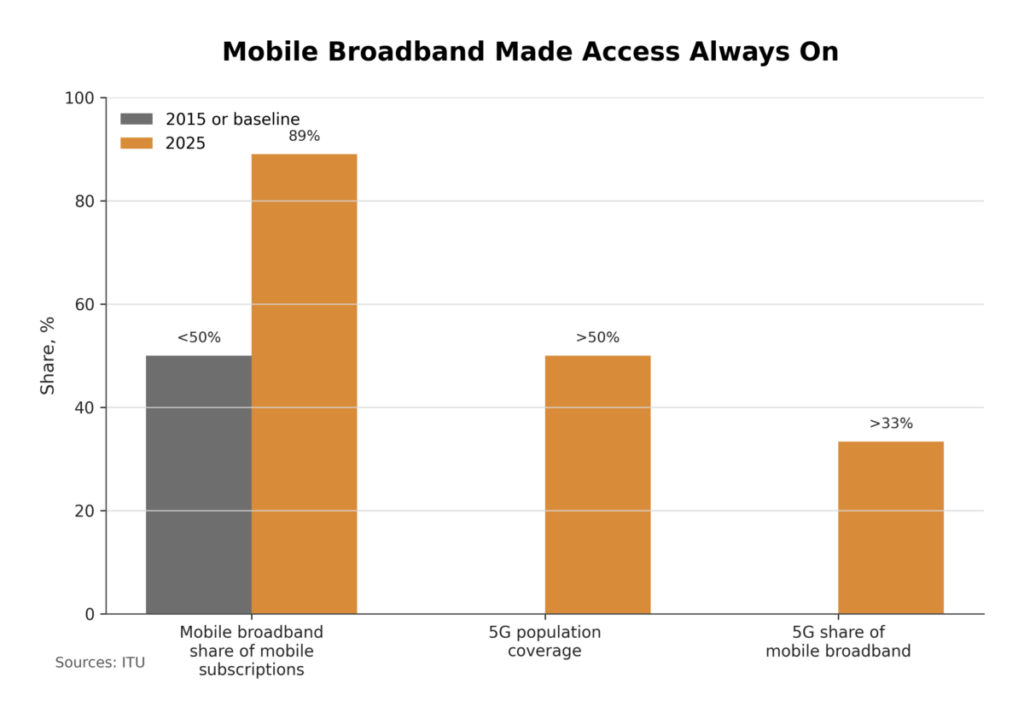
By mid-2026, the influence question had become more concrete and more contested. The category now reaches across algorithmic feeds, targeted advertising, influencer marketing, online news behavior, youth self regulation, dark patterns, and platform regulation. It is not about offline psychology in general. It is about how internet and social media systems are used, optimized, and sometimes abused to influence individuals and shape outcomes.
| From Internet Proliferation to Behavioral Change | |||
|---|---|---|---|
| Stage | Enabling Layer | Behavioral Shift | Visible Outcome |
| Internet proliferation | Connectivity infrastructure | Access expands from scarce to routine | Nearly 6 billion people online |
| Mobile access | Smartphones and mobile broadband | Connection becomes continuous | Online life moves into daily routines |
| Platform engagement | Social platforms and apps | Attention becomes measurable | Feeds, likes, shares, follows, pauses |
| Algorithmic ranking | Recommendation systems | Visibility becomes selective | Some signals travel farther than others |
| Monetization | Ad tech and social commerce | Behavior becomes economic input | Attention, intent, and return behavior are priced |
| Sources: ITU; DataReportal; IAB; PwC | |||
From Access to Influence
Behavioral economics gives internet adoption a practical frame because people respond to the design of the environment around them. Friction changes behavior. Defaults change behavior. Social proof changes behavior. Digital platforms turn those old principles into live machinery. What once appeared as individual online activity now often moves through systems designed to test attention, measure intent, and steer action at scale.
Social media made this transformation visible by turning ordinary engagement into a feedback economy. A post is not only a message. It is a signal about attention, affinity, emotion, and likely response. Small acts of viewing, sharing, and ignoring become part of a larger prediction system. Platforms do not need to understand a person completely to predict and influence the next choice. They need only observe enough patterns to make one option feel more immediate than another.
Algorithmic feeds are the clearest mechanism because they convert engagement into distribution. The feed decides which content appears first, which signals matter most, and which behavior earns more reach. For users, the feed feels like a stream of available information. For platforms, it is a ranking system that continuously learns what holds attention. That difference is where much of the behavioral economics sits.
The same machinery now works across public life and consumer life. Campaigns test language against audience response before messages harden into public narratives. Activist movements spread through visual repetition and social identity before institutions can respond. Rumors travel through private messaging before public moderators can see them. Products become desirable when the recommendation arrives through social proof rather than through a traditional advertisement.
The scale of the behavioral economy is already visible in advertising. U.S. internet advertising revenue reached nearly $300 billion in 2025. Social media advertising alone reached $117.7 billion, while programmatic advertising reached $162.4 billion. Digital persuasion is no longer a side market attached to media. It is one of the central business models of the internet.
| How Digital Tools Shape Online Behavior | |||
|---|---|---|---|
| Tool | How It Works | Behavioral Effect | Common Use |
| Algorithmic feeds | Rank content by predicted engagement | Makes some issues feel more urgent | News, politics, entertainment |
| Recommendation engines | Serve the next likely item | Turns attention into continuation | Video, shopping, search |
| Push notifications | Interrupt absence with prompts | Creates return behavior | Apps, messaging, commerce |
| Search ranking | Orders information by relevance signals | Shapes perceived authority | Health, products, politics |
| Dark patterns | Use friction, urgency, or defaults | Reduces resistance at decision points | Subscriptions, consent, checkout |
| Sources: OECD; ICPEN; European Commission | |||
Choice Architecture at Scale
The incentive structure of the internet economy reshaped platform design. The most successful digital environments reduce the effort required to continue. Their power often sits in the quiet removal of friction, where the next action feels less like a decision than a natural continuation of the last one.
Behavioral economics has a name for much of this: choice architecture. The design of an environment changes the likelihood of a decision without formally removing freedom.
The enabling technologies are practical and already widespread. Recommendation engines decide what appears next in a feed. Search ranking shapes what looks authoritative. Ad tech systems sort users into audiences before auctioning attention in real time. Dark pattern interfaces use friction, urgency, defaults, and confusion to steer decisions at the final step.
Most users encounter these tools as convenience. The phone remembers the password, the app remembers the card, the platform remembers the last video, and the feed remembers the last reaction. That memory reduces effort, but it also builds momentum. The easier it becomes to continue, the harder it becomes to notice where the choice was shaped.
Personalization is not inherently manipulative. It can reduce search costs, improve discovery, and help people navigate an overwhelmingly crowded internet. The risk begins when the platform understands a person’s likely behavior more clearly than the person can understand the platform’s design. At that point, convenience can become asymmetry.
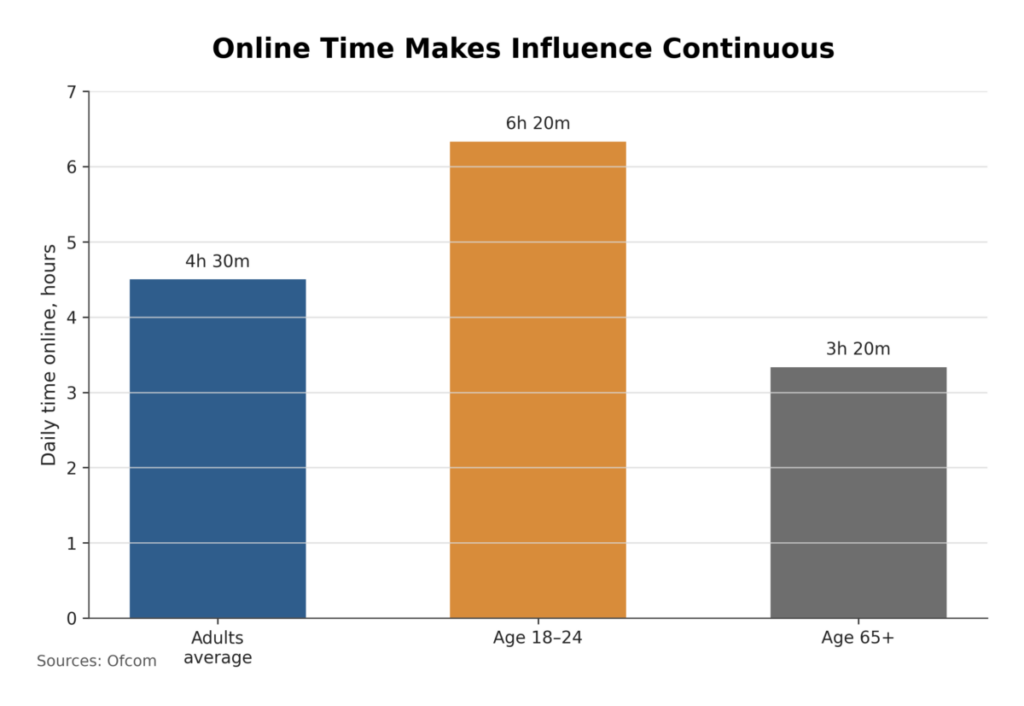
Platform engagement shows how deeply these environments have entered daily life. In the United Kingdom, adults spent 4 hours and 30 minutes per day online on personal smartphones, tablets, and computers in May 2025. Adults aged 18 to 24 spent 6 hours and 20 minutes per day. These are not marginal behaviors. They represent a substantial share of waking life spent inside spaces where ranking, recommendation, and measurement are routine.
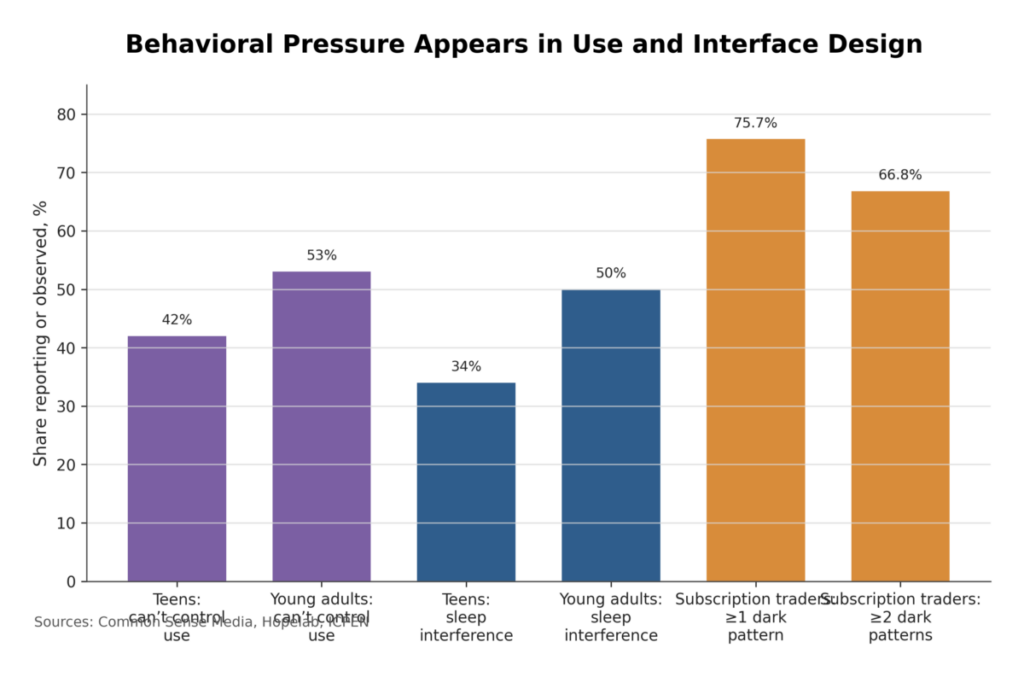
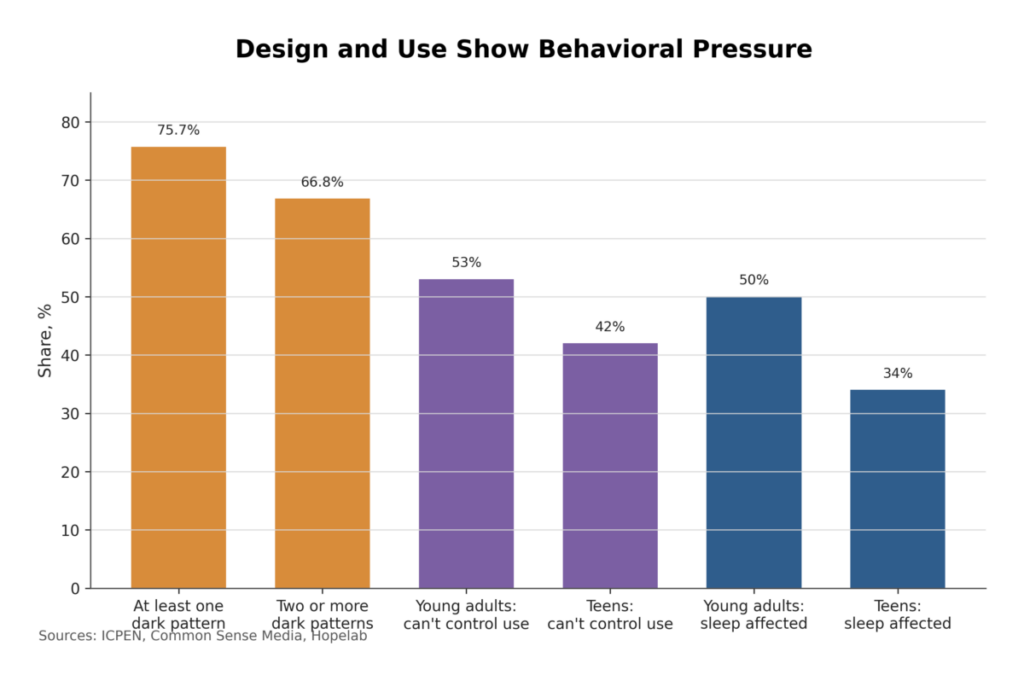
Behavioral pressure is clearest when use becomes difficult to regulate from the user side. Among young people, the issue is often described as screen time, but that phrase understates the mechanism. The pressure comes from social expectation, variable reward, emotional feedback, and the sense that something important may be happening elsewhere. Common Sense Media and Hopelab found that 53% of young adults and 42% of teens said they could not control their social media use or used it longer than intended. Sleep was affected as well, with 50% of young adults and 34% of teens saying social media interfered with rest.
The strongest claim is not that all digital use is harmful. Young people use online spaces for support, identity, learning, humor, and connection. A platform designed around return behavior may be experienced by an adult as convenience and by a teenager as social compulsion.
| Where Internet Influence Is Used and Abused | |||
|---|---|---|---|
| Domain | Influence Mechanism | Legitimate Use | Abuse Risk |
| Politics | Targeting, testing, mobilization | Reach likely supporters | Manipulate identity or trust |
| Activism | Hashtags, creators, visual repetition | Coordinate public attention | Oversimplify or inflame conflict |
| Marketing | Retargeting and social proof | Reduce search and discovery costs | Exploit impulse or vulnerability |
| Online news | Ranking, sharing, emotional activation | Distribute urgent information | Reward novelty over truth |
| Social commerce | Creators, recommendations, checkout flow | Connect discovery to purchase | Turn attention into pressure |
| Sources: Science; MIT Sloan; IAB; PwC; European Commission | |||
Emotion, Trust, and Misinformation
Online attention is not neutral. Social platforms reward content that generates reaction, and reaction often follows emotional intensity. Academic research on Facebook showed that altered emotional exposure in feeds affected later emotional expression among users. Other research found that moral emotional language increased retweet rates in political conversation. The exact magnitude varies by platform and context, but the pattern is consequential: algorithmic environments can make emotion more measurable, more transmissible, and more economically useful.
Influence spreads when technology and social behavior reinforce each other. Recommendation systems convert one reaction into the next exposure. The technology supplies ranking, reach, targeting, and speed. The social layer supplies trust, belonging, imitation, and status.
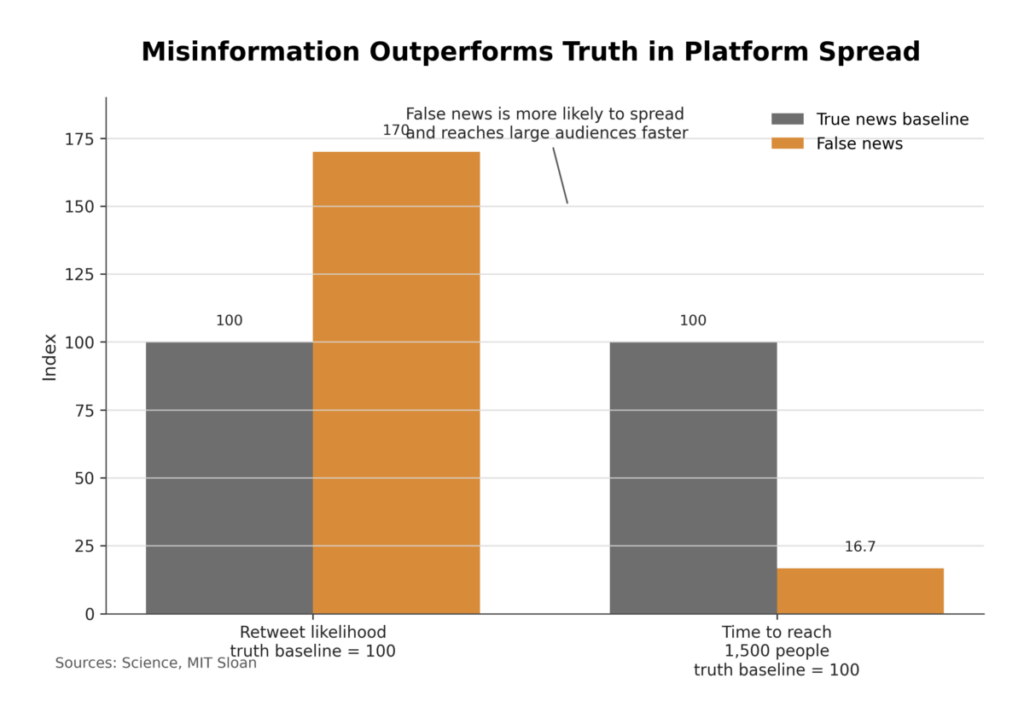
Online news behavior sits directly inside that incentive structure. False or misleading information often benefits from novelty, outrage, and identity confirmation. A major Science study of Twitter rumor cascades found that false news spread farther and faster than true news. MIT’s summary of the research noted that falsehoods were 70% more likely to be retweeted and reached 1,500 people about six times faster than truth. Misinformation is therefore not only a failure of fact checking. It is a behavioral market failure in which distribution value can separate from truth value.
Political and activist uses of the same system are now part of ordinary public life. Digital campaigns can test language, mobilize supporters, pressure institutions, and convert emotional attention into action. The tools that help communities organize can also help bad actors manipulate identity, suppress trust, or flood a channel with synthetic persuasion. The technology is not limited to one moral direction. It amplifies what can travel through attention.
Trust is being reorganized through platform signals. In earlier media systems, trust often attached to institutions with visible editorial identity. Online, trust frequently attaches to familiarity, repetition, peer endorsement, and placement inside a feed. Digital trust is powerful because it often feels social before it feels institutional.
Social commerce has absorbed the same mechanics. It is not only shopping inside a social app. It is a behavioral pathway in which entertainment, identity, recommendation, and purchase begin to collapse into one another. Demand is captured before a consumer has fully entered a buying mindset. The commercial environment becomes more effective because it meets the user inside attention rather than waiting for intent to arrive through search.
The platform does not need to create desire from nothing. It can observe weak signals and place them near stronger cues. Each step may feel ordinary to the user. Together, those steps form a behavioral funnel in which social proof and convenience carry more force than formal persuasion.
| Market Structure of the Behavioral Internet | |||
|---|---|---|---|
| Market Layer | Economic Logic | Behavioral Signal | Article Relevance |
| Programmatic advertising | Auction attention in real time | Probable action | Monetizes prediction |
| Social advertising | Price access to engaged audiences | Affinity and interaction | Turns engagement into revenue |
| Creator economy | Commercialize trusted personalities | Familiarity and imitation | Makes influence feel social |
| Retail media | Advertise near purchase intent | Search and cart behavior | Shortens discovery to purchase |
| Social commerce | Merge content and transaction | Attention before intent | Captures demand inside the feed |
| Sources: IAB; PwC; DataReportal | |||
Regulation of Digital Behavior
Dark patterns are the more explicit edge of online choice architecture. They use interface design to make some outcomes harder to avoid and others easier to accept. In a global sweep of subscription traders, consumer protection authorities found that 75.7% used at least one possible dark pattern and 66.8% used two or more. The significance is not only that some websites are annoying or confusing. It is that behavioral bias can be built into market conduct.
Abuse becomes clearer when the same influence chain works against the user’s interest. Targeting turns into manipulation, personalization becomes narrowing, and recommendations become compulsion when incentives reward pressure over value.
Messaging can become rumor infrastructure. Dark patterns can turn confusion into conversion. The issue is not one technology in isolation. It is the way internet proliferation connects these tools into a system that can scale behavioral pressure quickly.
The same tools can support legitimate persuasion or abuse. Political organizers use targeting to find likely supporters. Public health campaigns use creator networks to reach communities that distrust institutions. Retailers use recommendation systems to reduce search time. Fraud networks use the same channels to impersonate trust, accelerate scams, and overwhelm attention. The distinction is not always in the tool itself. It is in the incentive behind its use and the safeguards around the user.
Public accountability is now catching up to the design of digital choice. The older internet policy debate centered heavily on privacy, speech, liability, and competition. Those issues remain central, but a new layer has emerged around platform design. The European Union’s Digital Services Act treats platform scale as a governance issue, with very large platform obligations beginning at more than 45 million monthly active recipients in the EU. Australia’s under 16 social media restriction, scheduled to take effect in December 2025, moves youth safety into the realm of platform responsibility rather than leaving it entirely to households.
By mid 2026, the pressure had moved from theory into enforcement and national policy. Australia had become the first country to restrict social media access for children under 16. European governments were weighing similar age based limits. U.S. litigation over alleged child harm had grown into thousands of pending cases. The regulatory question was no longer whether digital systems influence behavior, but how much responsibility platforms carry when influence is built into the product itself.
Behavioral economics is no longer only a lens for understanding online life. It is becoming a framework for consumer protection. The same design choices that improve engagement can also become evidence in debates over harm and market conduct. The internet made behavioral influence continuous and adaptive.
It also made behavior more economically legible.
| Regulatory Pressure Points in Platform Design | |||
|---|---|---|---|
| Pressure Point | Observed Signal | Policy Concern | Governance Direction |
| Dark patterns | 75.7% used at least one possible pattern | Consent and market fairness | Consumer protection scrutiny |
| Youth self regulation | Teens and young adults report control problems | Sleep, attention, and compulsion | Age and safety rules |
| Recommender systems | Ranking shapes exposure | Opacity and risk amplification | Transparency obligations |
| Large platforms | EU threshold exceeds 45 million recipients | Scale as public risk | Very large platform duties |
| Child harm litigation | Thousands of U.S. cases pending | Product design responsibility | Courts testing platform accountability |
| Sources: ICPEN; Common Sense Media; Hopelab; European Commission; Australian eSafety Commissioner; Reuters | |||
The Behavioral Economy
The mid-year picture is not that platforms simply manipulate users or that personalization should be treated as harm. The sharper point is that online behavior has become an economic and political input. Attention, emotional response, trust signals, and social spread are measured and fed back into systems that shape what people see next.
The cascading impact of internet proliferation is that influence no longer waits for a formal institution to deliver it. This makes the internet especially powerful in countries where connectivity is still expanding, because the arrival of access can also bring the arrival of behavioral targeting before social norms are in place to understand it.
This loop creates the central tension of internet economics. Personalization can make life easier by reducing search costs, improving discovery, and matching people with useful services. It can also narrow exposure, deepen compulsive use, exploit vulnerability, and turn emotional instability into engagement.
The same system can be useful in one context and extractive in another.
The next debate will be less about whether people are online and more about how online environments are designed. Its most important force may not be the visible network, but the invisible arrangement of cues that shapes what people do next.
Key Takeaways
• The internet has shifted from a tool of access into an environment that shapes measurable online behavior.
• Internet proliferation creates a cascade from access to mobile use, platform engagement, algorithmic ranking, monetization, and behavioral change.
• Behavioral economics explains how digital platforms influence choices without formally removing freedom.
• Nearly 6 billion people were online in 2025, making digital influence a mass scale condition.
• U.S. internet advertising revenue neared $300 billion in 2025.
• Social media advertising reached $117.7 billion as platform behavior became more monetizable.
• Programmatic advertising shows how behavioral prediction is built into internet economics.
• Algorithmic feeds turn attention, reaction, and return behavior into platform signals.
• Youth behavior is a central pressure point because self regulation and social belonging remain highly sensitive.
• Misinformation spreads through behavioral incentives as much as through information failures.
• Dark patterns show how design can turn cognitive bias into market conduct.
• Mid 2026 marks a shift from platform influence as theory to platform influence as regulation and litigation.
Sources
• International Telecommunication Union; Facts and Figures 2025; – Link
• DataReportal; Digital 2026 Global Overview Report; – Link
• Interactive Advertising Bureau; Internet Advertising Revenue Report Full Year 2025; – Link
• Ofcom; Online Nation Report 2025; – Link
• Common Sense Media and Hopelab; A Double Edged Sword; – Link
• OECD; Students, Digital Devices and Success; – Link
• Cornell Chronicle; News Feed: Emotional Contagion Sweeps Facebook; – Link
• NYU Center for Social Media, AI, and Politics; Emotion Shapes the Diffusion of Moralized Content in Social Networks; – Link
• MIT Sloan School of Management; Study: False News Spreads Faster Than the Truth; – Link
• International Consumer Protection and Enforcement Network; ICPEN Sweep Finds Majority of Websites and Mobile Apps Use Dark Patterns in Subscription Services; – Link
• European Commission; The Digital Services Act; – Link
• Australian eSafety Commissioner; Social Media Age Restrictions FAQ; – Link
Keywords: Social Impact, Behavioral Economics, Social Media, Digital Advertising, Choice Architecture, Platform Regulation