
Internet Influence – Part 1 of 2 Part Series – See Part 2 (Here)
The internet produces social phenomena faster than societies have traditionally learned to explain them. A joke becomes a meme and then a shared cultural reference. A clothing silhouette moves from a handful of creators into recommendation feeds until it looks ordinary within a season. A hashtag can become a movement whose scale is visible to everyone watching, while a decades-old song can return to mass attention because one person gives millions of others a format they can recognize and imitate.
These outcomes look spontaneous because the people participating in them are acting voluntarily. Yet the patterns underneath are remarkably familiar. Human beings take cues from other people and become more receptive to things they recognize. Identity and emotion can make participation personally meaningful, while friction often determines whether that response becomes action. Behavioral economics and psychology have spent decades showing that decisions do not arise from preference alone. They emerge from the interaction between preference and environment.
| Measure | Scale | Context |
|---|---|---|
| Active social-media identities | 5.24 billion | More than 60% of global population equivalent |
| Annual social-media growth | 4.1% | Global active identities |
| Internet users in India | 1.02 billion | September 2025 |
| Unique social-media users in India | 500 million | Large-scale behavioral environment |
| Average social-media time in India | 3.2 hours daily | High-frequency digital exposure |
Sources: DataReportal, Reuters
The internet changes the scale at which those tendencies become visible. By early 2025, there were an estimated 5.24 billion active social-media user identities worldwide, 4.1 percent more than a year earlier. These figures do not represent 5.24 billion unique people, but they demonstrate the scale of environments in which attention, participation, and withdrawal leave measurable traces. What once happened primarily inside neighborhoods, markets, workplaces, political groups, or cultural communities can now unfold across networks in which millions of people observe one another reacting at almost the same time.
Human behavior is not perfectly predictable. It does not need to be. Once recurring tendencies are understood, the conditions under which people become more likely to notice, imitate, identify, participate, or withdraw become more understandable as well.
| Behavioral Pattern | Human Cue | Typical Online Signal | Behavioral Effect |
|---|---|---|---|
| Social Proof | What others do | Ratings or visible adoption | Reduces uncertainty |
| Familiarity | Prior exposure | Repeated formats | Lowers novelty |
| Identity | Group belonging | Community signals | Adds social meaning |
| Emotion | Salience or urgency | Emotionally charged content | Raises attention |
| Friction | Effort required | Steps to share or join | Changes action threshold |
Sources: Kahneman and Tversky, Muchnik Aral and Taylor, Montoya et al., Kramer Guillory and Hancock
━━━━━━━━━━━━━━━━━━━━━━━━━━━━━━━━━━━━━━━━
Predictably Irrational
Behavioral economics becomes most useful when it is treated not as a catalogue of mental mistakes but as an explanation of recurring human responses. People make choices with limited attention and incomplete information while social context, emotional response, and practical constraints shape the environment around them. A decision that appears inconsistent when isolated can become more intelligible once those surrounding conditions are included.
Five patterns are especially useful for understanding social activity online. People use visible behavior as evidence about what is normal or important, while familiarity makes the unfamiliar easier to process. Identity and emotion can turn recognition into personal relevance. Friction then helps determine whether that relevance remains private or becomes visible action. These mechanisms overlap in real life, but each changes behavior through a distinct route.
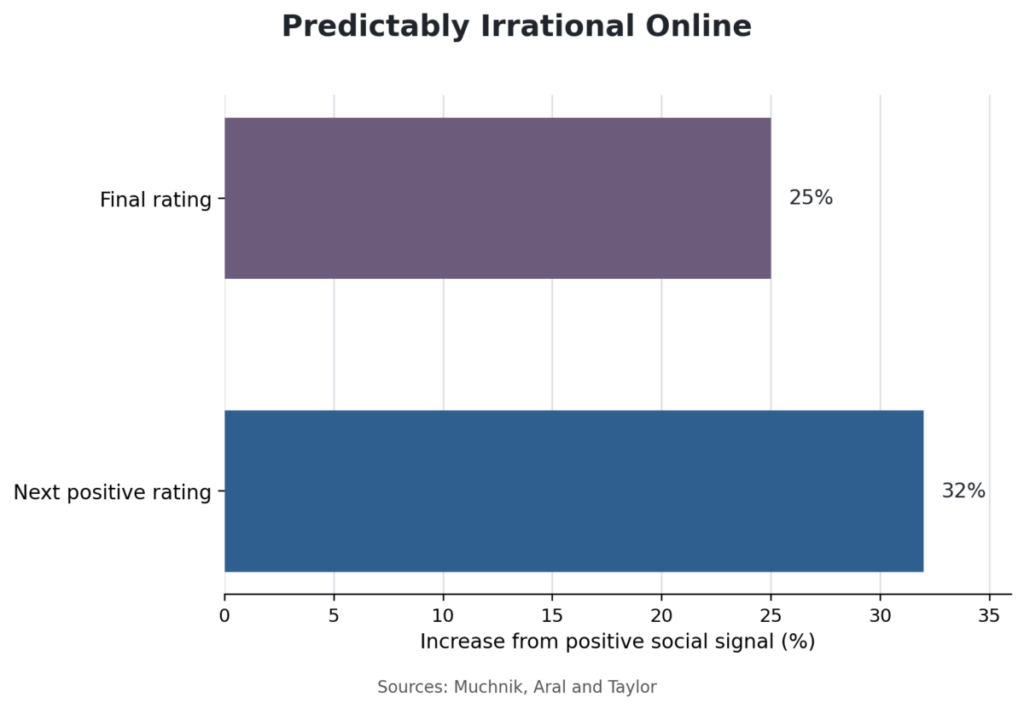
Social proof is particularly visible online because the internet turns other people’s behavior into numbers. In physical life, a crowded restaurant can signal that previous customers know something useful. Online, ratings and view counts serve a similar function by making prior behavior visible. In a randomized experiment on an online community, Muchnik, Aral, and Taylor found that giving a comment one artificial positive rating increased the probability that the next person would rate it positively by 32 percent. Positively manipulated comments ultimately finished with ratings 25 percent higher on average. Negative manipulation behaved differently because later users often corrected it, underscoring an important limit: visible behavior influences subsequent behavior without producing automatic conformity.
Familiarity operates differently because recognition itself changes the threshold for participation. A large meta-analysis of the mere-exposure literature examined 268 effect curves across 81 studies and found a broad relationship between repeated exposure and more favorable responses, although the effect weakened and could reverse after excessive repetition. The useful conclusion is not that repetition makes people believe or like anything placed in front of them. Familiarity reduces novelty. It makes an object easier to recognize and process, which can make subsequent encounters feel less uncertain.
That mechanism helps explain why internet culture so often spreads through templates. The first time someone encounters the Distracted Boyfriend image, the joke requires interpretation. After years of variations, the photograph carries a ready-made structure before the labels are even read. The cultural object has accumulated shared meaning. New participants no longer have to invent the joke or teach the audience how it works; they only have to place a new situation inside an established grammar.
Identity can move people beyond recognition toward participation. Clothing makes the process visible without requiring an ideological example. A silhouette or visual aesthetic can begin as personal taste and become a social marker once enough people associate it with a group or way of life. Internet communities accelerate these associations because users see both the object and the people adopting it. A choice begins answering more than “Do I like this?” It can also answer “Is this something people like me do?”
Emotion changes the threshold again. Humor can make a meme worth sharing, while anger or grief can concentrate attention around an event and transform private reaction into public expression. A large Facebook experiment involving 689,003 users found that reducing positive emotional content in feeds led people to produce slightly fewer positive and more negative posts, while reducing negative content produced the opposite effect. The individual effects were small, but the scale of the experiment established that emotional conditions in an online environment can measurably influence subsequent expression.
Friction finally determines whether these psychological states become action. A person may sympathize with a movement without donating or attending an event, just as someone may recognize a trend without adopting it. Digital environments can compress the distance between low-cost expression and higher-cost participation by making the next step nearly immediate. Sharing may take one tap, while joining a group or reproducing a meme can require little more effort. The same environment can also introduce friction. A difficult registration process or burdensome opt-out can alter what people ultimately do without necessarily changing the preference underneath.
The common thread is probability rather than destiny. Under recurring conditions, recognizable human tendencies make some actions more likely than others. Once those tendencies are understood, they become a practical framework for understanding how social behavior moves.
| Threshold | Key Condition | Design Principle | Observable Shift |
|---|---|---|---|
| Exposure | Attention reached | Audience selection | Notice |
| Recognition | Meaning understood | Positioning and repetition | Recall |
| Relevance | Personal or social fit | Identity and framing | Interest |
| Participation | Motivation exceeds effort | Reduced friction | Action |
Sources: Copenhagen Business School, NBER, Kahneman and Tversky
━━━━━━━━━━━━━━━━━━━━━━━━━━━━━━━━━━━━━━━━
Psychology Becomes Strategy
Marketing provides a useful bridge between psychological understanding and observable action because marketers have spent decades studying the distance between exposure and behavior. Commerce supplies the vocabulary, but the logic is much broader than purchasing. Segmentation asks which audience is receptive; positioning asks what meaning the audience attaches to an object or message. Funnels then describe the movement through stages of awareness and interest until an internal state becomes observable behavior, which marketing calls conversion.
That framework makes cultural adoption easier to understand. A new fashion trend does not ordinarily move from obscurity to mass adoption in one step. Early audiences may already be receptive to the aesthetic, but repetition makes the style recognizable and creators give it social context. As more people adopt the look and wider availability lowers the cost of imitation, what once seemed unusual can begin to feel like part of the current visual environment.
The behavioral importance of environment can be measured directly. In one randomized field experiment involving 1,493 users, differences in cookie-banner choice architecture shifted consent by 17 percentage points. The underlying privacy decision remained the same; what changed was how the choices were presented and how much effort different paths required. Another large experiment on the perceived value of Facebook data found that an opt-out default reduced stated privacy valuations by 14 to 22 percent, while changes in price anchoring shifted valuations by 37 to 53 percent. These findings are useful beyond privacy because they show how framing, defaults, and friction can alter both action and perceived value without changing the underlying object of the decision.
Memes follow a compressed version of the same progression. Once a format becomes legible, familiarity reduces the work required to understand later versions. Emotional relevance creates motivation to transmit it, while low reproduction costs make participation easy enough that each imitation becomes additional social proof.
Collective action develops through similar thresholds but carries greater consequences. A person may move from observing an event to expressing public alignment, then from low-cost signaling into more demanding forms of participation such as donating, organizing, or showing up in person. The internet can reduce the distance between these states by making the reaction of other people visible while lowering the effort required to take the next step.
The most useful concept is therefore not a commercial funnel but a behavioral threshold. People first have to notice something, then find it socially or personally relevant, and finally reach a point at which acting feels worthwhile. Different mechanisms matter at each transition. Social proof can make an unfamiliar action look normal, identity can make it meaningful, and emotion or reduced friction can help move intention toward participation.
Marketing principles help explain these transitions because commercial systems have long treated behavior as a sequence rather than a single decision. The internet extends the same logic to social and cultural life, where people continually encounter one another’s reactions.
The critical difference is that the response no longer disappears after it occurs. It becomes visible to the system and, often, to everyone else.
| Information Type | Source | Can Indicate | Cannot Establish Alone |
|---|---|---|---|
| Declared | User statement | Expressed preference | Future behavior |
| Observed | Recorded action | Behavioral response | Underlying motive |
| Inferred | Pattern analysis | Likely future response | Complete preference |
Sources: Netflix, Federal Trade Commission, DataReportal
━━━━━━━━━━━━━━━━━━━━━━━━━━━━━━━━━━━━━━━━
Behavior Becomes Data
Offline social behavior has always produced signals, but many were local and temporary. A teenager might notice several classmates wearing the same shoes, or a protest might grow from dozens of participants to hundreds. People inside those environments could perceive momentum, but measuring the behavior beyond the immediate community was difficult.
Digital environments transform much of that social response into recorded activity while it is unfolding. Attention leaves traces through viewing and replaying; participation leaves different traces through sharing, following, or joining. Even disengagement can become measurable when someone abandons a video or does not return. None of those actions reveals an entire psychological state, but together they create a record of how people respond.
The global scale of that observability is historically unusual. The estimated 5.24 billion active social-media identities counted in early 2025 were equivalent to more than 60 percent of the world’s population, with the total growing 4.1 percent over twelve months. DataReportal also estimates that 94.2 percent of internet users use social media, illustrating how deeply these observable environments overlap with the connected population.
Understanding what those records mean requires separating declared, observed, and inferred information. People can tell a service what they like, creating declared data. Their subsequent behavior produces observed evidence, from which systems may infer what is likely to interest them later. The categories overlap, but they are not interchangeable.
A user’s declared interest can begin the process while observed behavior gradually becomes more informative. Netflix provides a relatable example: users can initially indicate titles they enjoy, but ongoing viewing behavior increasingly shapes recommendations as the service accumulates evidence about completion and abandonment. What people say remains information. What they repeatedly do becomes another kind of information.
The distinction is essential because online behavior is not identical to belief or motive. Someone can watch political content because they oppose it, or repeat a meme because the format is funny rather than because they accept its underlying message. Data records the action more reliably than the reason.
Yet incomplete signals can still reveal cultural patterns. A system does not need to know every private motive to recognize that millions of people are using the same sound or that participation around a hashtag is accelerating. It can identify momentum without fully understanding why each person joined it.
Behavior that once disappeared into culture therefore becomes data about culture. The economic value lies partly in making social change observable while it is still developing rather than only after the outcome becomes obvious.
| Observed Pattern | More Predictable | Less Predictable |
|---|---|---|
| Repeated viewing | Future attention | Approval |
| Prior engagement | Likely exposure response | Belief change |
| Visible adoption | Further participation | Long-term commitment |
| Low action cost | Immediate action | Durable behavior |
Sources: Nature, Netflix, Muchnik Aral and Taylor
━━━━━━━━━━━━━━━━━━━━━━━━━━━━━━━━━━━━━━━━
Patterns Become Predictable
Prediction enters only after understanding. Human behavior becomes more predictable when recurring mechanisms are observed under comparable conditions, not because a platform has uncovered a complete account of someone’s personality or beliefs.
A meme that spreads rapidly illustrates the difference. Its success can look random if only the final outcome is visible. Examined behaviorally, the format may already be recognizable, easy to reproduce, and surrounded by visible imitation that encourages further participation. None of those conditions guarantees virality, but together they make additional spread more plausible.
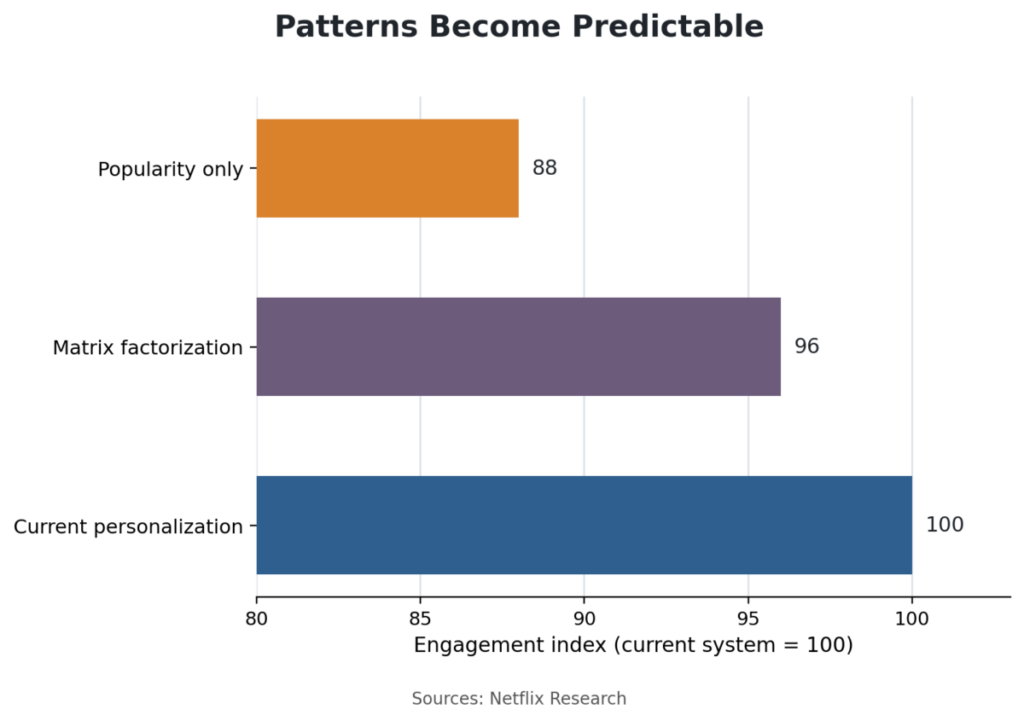
Recommendation systems operate on a related principle. A 2025 analysis of Netflix viewing behavior estimated that replacing its recommendation system with a simpler matrix-factorization system would reduce engagement by about 4 percent, while replacing personalization with popularity-based recommendations would reduce engagement by roughly 12 percent. Most of the estimated gain came from better targeting rather than mechanical exposure alone. The result is useful not because Netflix can perfectly predict what someone will watch, but because recognizing recurring differences in user behavior allows the service to construct environments in which some choices become more likely.
Controlled research on TikTok provides a social example. A 2026 Nature study ran 323 audits over 27 weeks and collected more than 280,000 recommendations. Accounts initially seeded with Republican content received about 11.5 percent more co-partisan recommendations, while Democratic-seeded accounts received roughly 7.5 percent more cross-partisan content. The research measured exposure rather than political conversion, but it demonstrates how differences in prior behavioral context can lead to measurably different subsequent information environments.
Fashion trends develop through similar thresholds. Novelty can attract early adopters, but wider adoption generally requires enough repetition and visibility for the look to feel socially legible. Once the style is also easy to reproduce, the distance between experimentation and ordinary adoption becomes smaller. Recommendation systems and creator networks compress the time between those stages by showing related visual signals repeatedly across different contexts.
Collective movements reveal another version of the pattern. A grievance may remain private until people discover that others share it. Once a visible identity forms around that recognition, low-cost expressions of alignment can widen participation, while a smaller group may move toward higher-cost action.
The important limit is that predictable exposure does not equal predictable belief. In a large Facebook field experiment, researchers reduced exposure to politically like-minded sources by about one-third among 23,377 users during the 2020 U.S. presidential election. The intervention changed what participants saw but produced no measurable effect across eight preregistered political-attitude outcomes, including ideological extremity and affective polarization. Digital systems can predict and alter parts of the environment more reliably than they can dictate what a person ultimately thinks.
What becomes predictable, then, is often the condition surrounding behavior. Familiarity, social validation, identity, emotion, and friction can jointly alter the probability that a person moves from exposure toward participation without determining the outcome for any individual.
The ability to anticipate those conditions becomes far more consequential when individual reactions begin reinforcing one another.
| Participation Level | Typical Action | Relative Cost | Social Signal |
|---|---|---|---|
| Attention | View | Very low | Audience size |
| Expression | Like or share | Low | Visible support |
| Identification | Adopt or publicly align | Moderate | Group membership |
| Commitment | Donate or organize | Higher | Sustained involvement |
| Collective Action | Attend or mobilize | High | Offline consequence |
Sources: Pew Research Center, Meta, Institute of Internet Economics
━━━━━━━━━━━━━━━━━━━━━━━━━━━━━━━━━━━━━━━━
Influence Becomes Amplification
At social scale, the five principles can begin operating as a system. A creator introduces a style and recommendation feeds increase its exposure until repetition produces familiarity. As followers adopt the look, their participation becomes evidence for later audiences, while wider availability makes imitation easier. What begins as a choice by a relatively small group can gradually become a recognizable cultural norm.
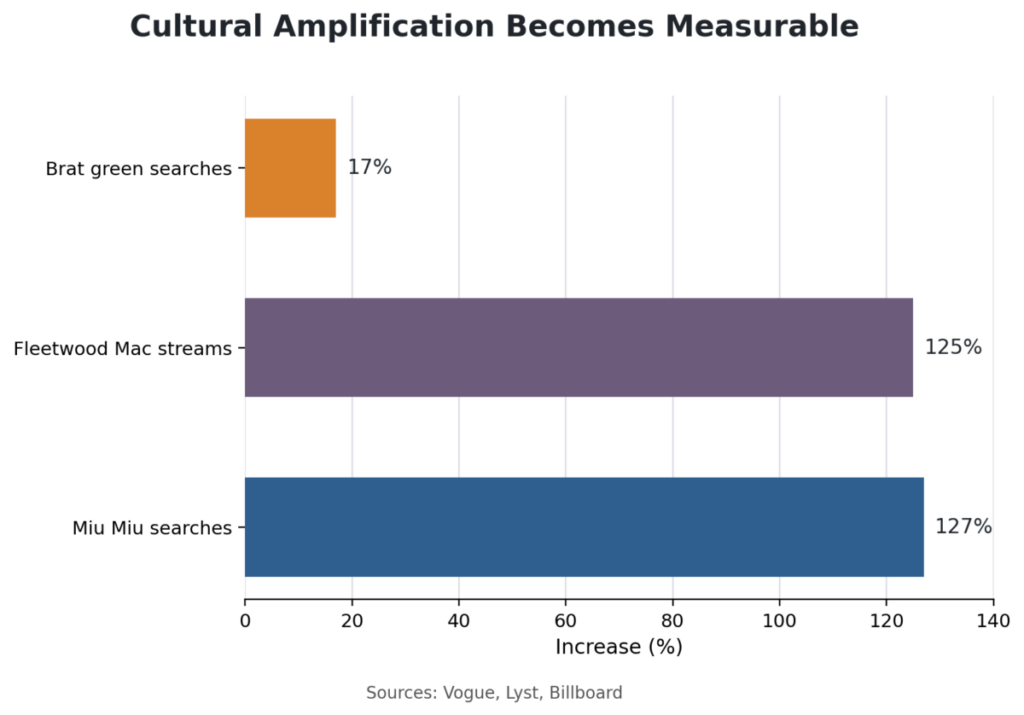
The Miu Miu micro-mini illustrates that progression. During its 2022 viral cycle, Lyst recorded roughly 900 searches per day for the skirt, and one high-profile magazine cover featuring the look coincided with a 127 percent increase in searches for Miu Miu on the platform. The design moved rapidly through creators and fashion media before appearing in cheaper imitations and other forms of downstream copying. Yet visibility did not automatically prove equivalent sales, a useful reminder that cultural relevance and economic conversion are related but distinct outcomes.
Charli XCX’s Brat aesthetic produced a newer version of the same mechanism. The distinctive green visual identity generated an estimated $22.5 million in media impact value as brands and audiences adopted the cultural language around it. Fashion searches for slime-green products rose 17 percent. Neither figure means that millions of people independently decided green had become objectively better. Recognition, identity, repetition, and visible adoption changed what the color meant in that particular cultural moment.
Memes can complete the same cycle much faster because replication costs approach zero. Nathan Apodaca’s 2020 TikTok of himself skateboarding while drinking Ocean Spray and listening to Fleetwood Mac’s “Dreams” created a format that other users, including Mick Fleetwood, could reproduce. The cultural effect became measurable in consumption: “Dreams” reached 8.47 million U.S. on-demand streams in the week ending October 1, up 125 percent from 3.76 million the previous week. The underlying song had not changed. Its social context had.
Collective action provides a higher-cost form of amplification. During the 2014 Ice Bucket Challenge, Facebook users shared more than 17 million challenge videos between June 1 and September 1. Those videos generated more than 10 billion views from more than 440 million people. Earlier in the campaign, more than 28 million users had already posted, commented on, or liked challenge-related content. The challenge paired a recognizable public nomination with an emotional purpose, then made reproduction easy enough that participation itself became the mechanism of distribution.
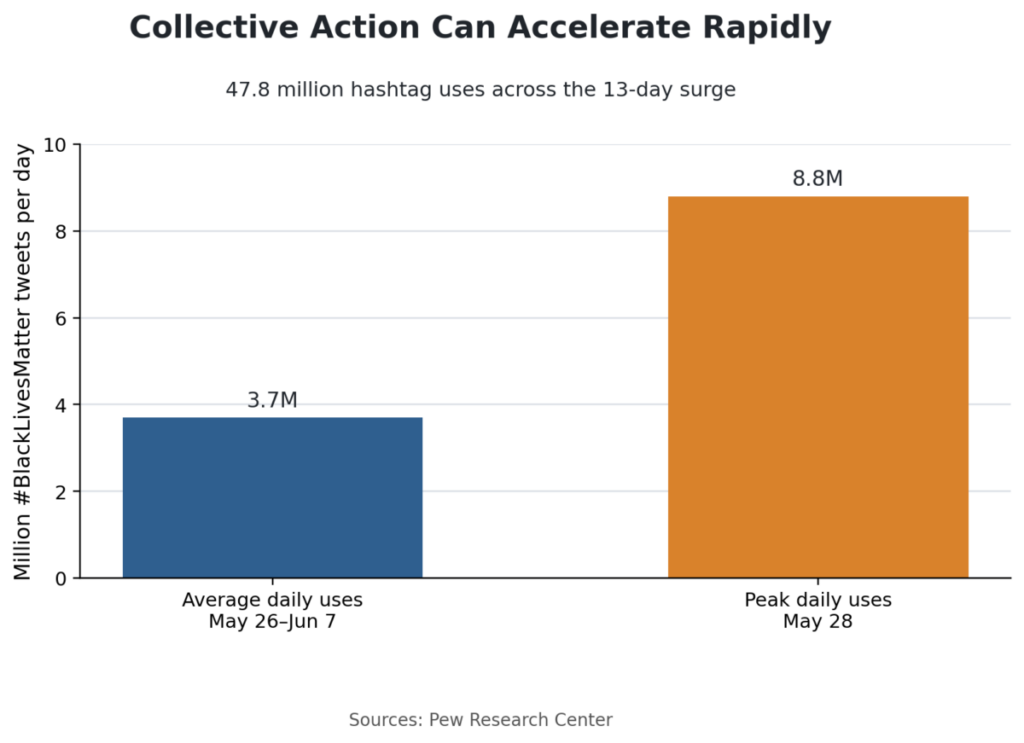
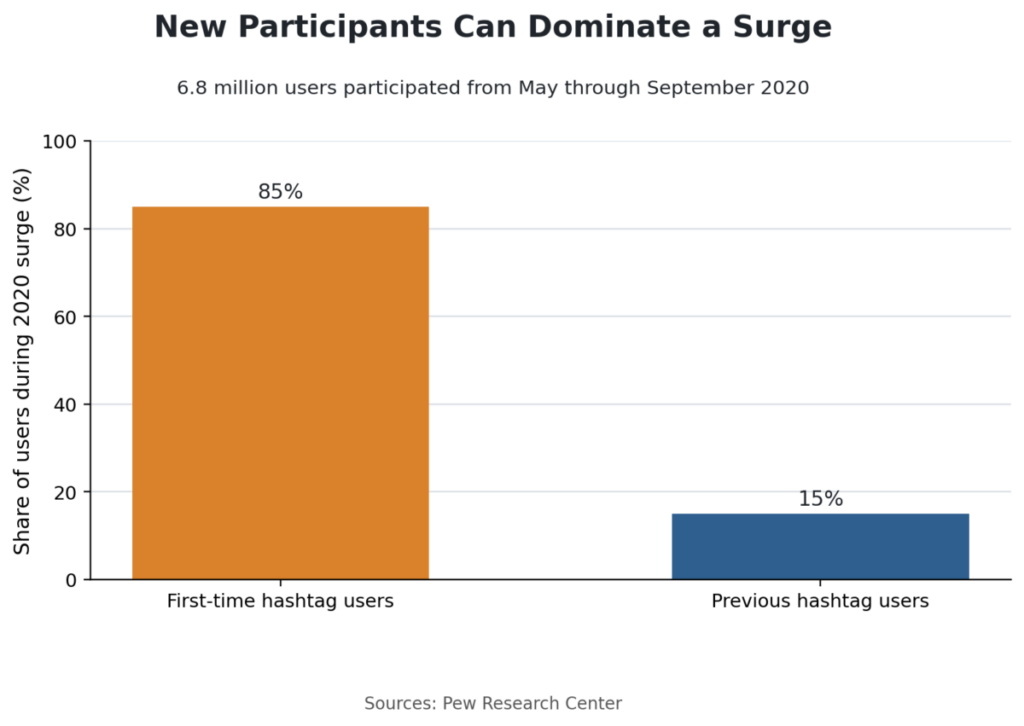
Black Lives Matter shows how similar dynamics can operate around political and social identity. From May 26 through June 7, 2020, the #BlackLivesMatter hashtag appeared approximately 47.8 million times on Twitter, averaging almost 3.7 million uses per day. On May 28 alone, nearly 8.8 million tweets contained the hashtag. Across the movement’s first decade, millions of distinct users participated, but participation intensity varied greatly. During the surge surrounding George Floyd’s death, large numbers of people used the hashtag for the first time. An emotionally salient event encountered a movement whose identity was already legible, and visible participation made expression easier for people who had not previously joined it.
These examples differ in consequence, motivation, and durability, yet their behavioral structures overlap. Exposure and repetition make an object familiar; visible adoption then gives that familiarity social weight. Once participation also carries identity or emotional meaning and the cost of acting falls low enough, more people can cross from recognition into participation.
Amplification therefore does more than enlarge an audience. It changes the decision environment. A person encountering a cultural phenomenon also encounters evidence of its adoption and momentum, which becomes part of the context in which the next decision is made.
At sufficient scale, individual reactions begin changing the context in which the next individual reacts.
| Stage | What Is Observed | Usable Signal | Next Adjustment |
|---|---|---|---|
| Exposure | What was shown | Reach | Audience or placement |
| Attention | What held interest | Viewing response | Presentation |
| Participation | What prompted action | Engagement | Format or friction |
| Persistence | What repeated | Return behavior | Future exposure |
| Feedback | Which variation performed differently | Comparative response | Next test |
Sources: Netflix
━━━━━━━━━━━━━━━━━━━━━━━━━━━━━━━━━━━━━━━━
The Machine Learns
Digital influence becomes distinctive when those reactions feed back into the environment. Behavioral principles that once had to be inferred from surveys, controlled experiments, market outcomes, or small-group observation can now be tested continuously against large streams of human behavior.
A platform can compare which presentation holds attention and which recommendation causes users to leave. Human participants learn too: creators see what spreads, while movements and communities see which symbols or messages travel beyond their original audience. Both forms of observation turn response into information about what may work next.
Netflix has long provided a useful illustration of the scale at which such experimentation can occur. The company has historically been reported to conduct around 250 A/B tests in a year, often using large control and experimental groups. Its experimentation work has shown that changing only the artwork presented for a title can increase viewing by 20 to 30 percent for some titles. The movie has not changed, and the audience has not necessarily changed. The frame surrounding the choice has.
That result brings the argument back to behavioral economics. Experimentation can reveal which presentation attracts attention, when repeated exposure becomes useful familiarity, and whether social signals or reduced friction move more people toward participation. Digital systems can test those conditions against actual behavior rather than assuming the first explanation is correct.
The feedback loop runs from environment to behavior, from behavior to observation, and from observation into a revised environment. Recommendation systems learn from viewing response and use that information to alter what appears next. Cultural systems adapt more informally as creators, communities, and movements repeat what appears to travel beyond its original context.
Artificial intelligence lowers the cost and time required for this experimentation. It can generate more variations, classify behavioral patterns, and adapt content across contexts more quickly. AI does not replace the behavioral mechanisms already described. It accelerates the process of testing environments and observing response.
Optimization also exposes the limits of behavioral measurement. A system that maximizes sharing may discover controversy rather than consensus, while one that maximizes viewing can identify what holds attention without learning whether the experience improves understanding. Visibility can also overstate social or economic consequence: a movement may dominate discussion without producing durable institutional change, just as a fashion trend may dominate feeds without equivalent purchasing behavior.
The metric records a threshold crossed. It does not fully explain what the action means.
The influence machine begins and ends with human behavior. Psychology and behavioral economics explain why recurring conditions can alter the probability of action, while marketing provides a practical language for the movement from exposure toward participation. The internet makes those responses visible at scale, allowing patterns to spread socially and feed back into the environments that produced them.
The internet did not make human nature predictable. It made patterned human behavior easier to observe, reproduce, test, and amplify, with greater consequences once millions of people could see one another acting at the same time.
What happens when that understanding is deliberately aimed at a particular social, commercial, ideological, or political outcome begins a different problem.
| Behavioral Effect | Evidence Base | Measured Result |
|---|---|---|
| Social influence | Randomized online experiment | Positive signal raised next positive rating probability 32%; final ratings rose 25% |
| Repeated exposure | 81 studies; 268 effect curves | Broad familiarity effect, with diminishing or reversing effects at high repetition |
| Emotional environment | 689,003 Facebook users | Feed emotion produced small but measurable changes in users’ subsequent expression |
Sources: Muchnik Aral and Taylor, Montoya et al., Kramer Guillory and Hancock
TL;DR Summary
- Human behavior online follows recurring patterns rather than emerging randomly from algorithms or platforms.
- Five mechanisms provide the core framework: visible behavior, familiarity, identity, emotion, and friction.
- Positive social signals increased subsequent positive ratings by 32 percent in a randomized experiment, demonstrating measurable social influence.
- Mere-exposure research across 81 studies supports familiarity as a recurring mechanism while also showing that repetition has limits.
- A 689,003-user Facebook experiment found that changes in emotional content produced small but measurable changes in subsequent expression.
- Choice architecture can materially affect action: cookie-banner design shifted consent by 17 percentage points, while defaults changed perceived privacy value by 14 to 22 percent.
- More than 5.24 billion active social-media identities make social response observable at unprecedented scale.
- Online behavioral data measures action more reliably than motive; sharing, watching, or following should not automatically be equated with agreement.
- Recommendation systems exploit recurring behavioral patterns, but changing exposure does not guarantee corresponding changes in belief.
- Internet amplification combines familiarity, visible participation, identity, emotion, and low-cost imitation across culture, fashion, activism, and memes.
- The Ice Bucket Challenge, Black Lives Matter, Brat, Miu Miu, and Fleetwood Mac’s “Dreams” illustrate different thresholds through which visibility becomes collective activity.
- Feedback makes influence adaptive by allowing digital systems and participants to observe what repeatedly moves people from exposure toward action.
Sources
Predictably Irrational
- Econometrica; Prospect Theory: An Analysis of Decision under Risk; – Link
- Science; Social Influence Bias: A Randomized Experiment; – Link
- Psychological Bulletin; A Re-examination of the Mere Exposure Effect: The Influence of Repeated Exposure on Recognition, Familiarity, and Liking; – Link
- Proceedings of the National Academy of Sciences; Experimental Evidence of Massive-Scale Emotional Contagion Through Social Networks; – Link
- Institute of Internet Economics; Digital Herding and Collective Behavior in Online Communities; – Link
Psychology Becomes Strategy
- Copenhagen Business School; Are You Sure, You Want a Cookie? The Effects of Choice Architecture on Users’ Decisions about Sharing Private Online Data; – Link
- National Bureau of Economic Research; Designing Consent: Choice Architecture and Consumer Welfare in Data Sharing; – Link
- USENIX Security Symposium; Uninformed Consent: Studying GDPR Consent Notices in the Field; – Link
Behavior Becomes Data
- DataReportal; Digital 2025: Global Overview Report; – Link
- DataReportal; Digital 2025: The State of Social Media in 2025; – Link
- Reuters; India’s Vast Internet and Social Media Apps Market; – Link
- Netflix; How Netflix Recommendations Work; – Link
- Federal Trade Commission; Cross-Device Tracking: An FTC Staff Report; – Link
Patterns Become Predictable
- International Journal of Industrial Organization; The Value of Personalized Recommendations: Evidence from Netflix; – Link
- Nature; Systematic Partisan Content Skews in TikTok During the 2024 US Elections; – Link
- Nature; Like-Minded Sources on Facebook Are Prevalent but Not Polarizing; – Link
Influence Becomes Amplification
- Pew Research Center; Ten Years of #BlackLivesMatter on Twitter; – Link
- Pew Research Center; #BlackLivesMatter Surges on Twitter After George Floyd’s Death; – Link
- Meta; The Ice Bucket Challenge on Facebook; – Link
- Vogue; The Miu Miu Spring 2022 Micro Mini Frenzy and the Business of Viral Fashion; – Link
- Vogue Business; The Business of Brat; – Link
- Institute of Internet Economics; The Internet Turns Feeling Into Impact; – Link
The Machine Learns
- Netflix Technology Blog; It’s All A/Bout Testing: The Netflix Experimentation Platform; – Link
- Netflix Research; Engineering for a Science-Centric Experimentation Platform; – Link
- WIRED; How Netflix Uses Data and Personalization to Shape What People Watch; – Link
Keywords: Behavioral Economics, Social Influence, Internet Culture, Collective Behavior, Behavioral Thresholds, Digital Choice Architecture, Cultural Amplification, Digital Activism