
[Primary SDGs: Digital Health; 3 – Good Health and Well-Being; 9 – Industry, Innovation and Infrastructure; 17 – Partnerships for the Goals]
Digital Health Changes What Happens Before Care Fails
Healthcare often fails before medicine does. A patient misses an appointment because the clinic is too far away. A chronic condition worsens between visits because the change is not seen soon enough. A rural facility cannot reach a specialist when the decision must be made. The economic loss begins where healthcare capacity exists but cannot reach the person efficiently enough to produce its full value.
Digital health changes that equation by allowing parts of healthcare to move across networks rather than depend entirely on physical proximity. Telemedicine extends clinical expertise, while connected records and monitoring preserve information between encounters. The economic function is not digitization itself, but the reduction of time, distance, duplication, and information loss within care delivery.
By 2024, 99.4 percent of U.S. non-federal acute-care hospitals had adopted certified electronic health records. Across OECD countries, average availability of online digital-health services reached 82 percent that year. Digital health has moved beyond an experimental market at the edge of medicine and into the infrastructure through which healthcare is increasingly organized.
That shift connects directly to the Sustainable Development Goals. SDG 3 is the clearest human outcome because better continuity and earlier intervention can improve health. SDG 9 provides enabling capacity because connectivity and interoperable information increasingly determine how far healthcare can operate beyond a physical facility. SDG 17 becomes essential when those systems cross institutional boundaries and require coordinated action among public institutions, healthcare providers, and digital infrastructure operators.
The internet does not add another technology layer to medicine. It changes the economics of how medical capacity reaches people.
Digital Health Changes What Happens Before Care Fails
| Health Access Measure | Value | Period |
|---|---|---|
| UHC service coverage index | 68 → 71 | 2015–2023 |
| People lacking essential health services | 4.6 billion | 2023 |
| People facing health-related financial difficulty | 2.1 billion | 2022 |
Sources: United Nations Statistics Division
The Value of Connectivity Depends on the Constraint It Removes
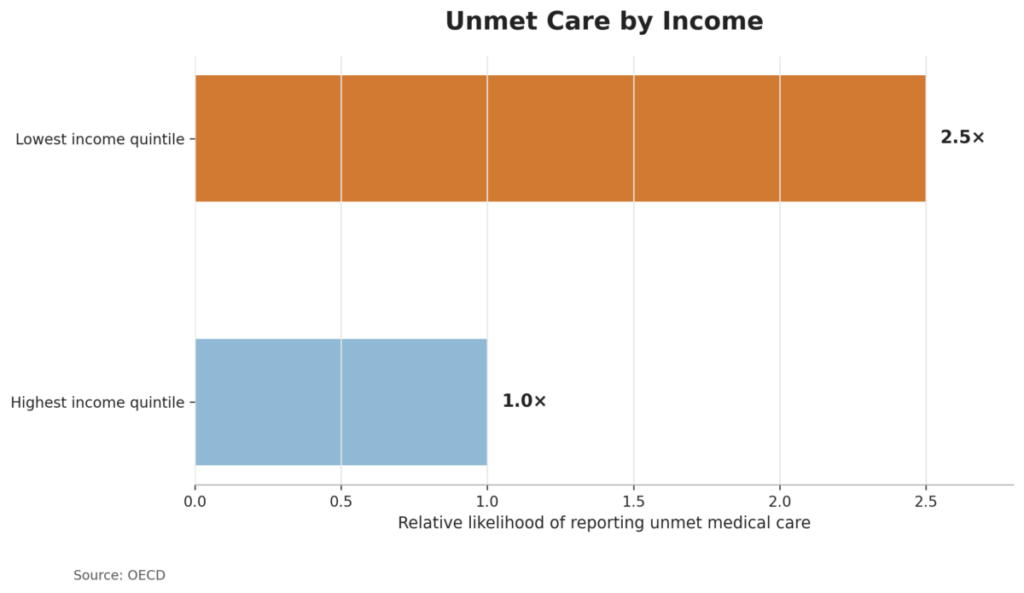
Digital health does not produce the same return everywhere because health systems do not begin from the same position. Across 28 OECD countries with comparable data, 3.4 percent of people reported unmet medical-care needs caused by cost, distance, or waiting times in 2024. People in the lowest income quintile were 2.5 times as likely to report unmet needs as those in the highest. Widespread infrastructure does not guarantee timely access.
In mature economies, basic connectivity is usually not the binding constraint. Hospitals already operate extensive digital systems, but the harder problem is absorption: whether organizations can redesign work around those investments strongly enough to reduce duplication, improve decisions, and make scarce professional labor more productive.
Technology expenditure alone does not create that return. A hospital can purchase another platform without changing care delivery. Productivity emerges when information reaches clinicians faster, repeated work disappears, deterioration is detected sooner, or institutional handoffs become simpler. Capital produces value only when organizational behavior changes around it.
Across many middle-income systems, digital infrastructure can improve coordination while extending specialized care beyond the places where specialists are concentrated. The same teleconsultation that creates scheduling efficiency in one market may substantially change geographic access in another.
Lower-income systems can experience a different first-order effect. Connectivity may become the practical bridge between households and institutions where physical healthcare remains thin. A remote interaction matters more when the alternative is no timely encounter at all. Distance becomes economically expensive when care requires travel, lost working time, or delayed treatment.
The technology can be similar while the constraint removed is different. Mature systems gain primarily through productivity and coordination, while developing systems may gain first through reach, visibility, and basic institutional connection.
The Value of Connectivity Depends on the Constraint It Removes
| Remote Care Measure | Value |
|---|---|
| Teleconsultations per person in 2019 | 0.5 |
| Teleconsultations per person in 2021 | 1.3 |
| Teleconsultations per person in 2023 | 1.0 |
| Share of doctor consultations delivered remotely | 13% |
Sources: OECD
Better Reach Creates a Development Multiplier
The first visible effect of digital health can appear deceptively small. A reminder keeps a patient connected to care. A remote consultation eliminates a journey. Monitoring identifies deterioration before the next scheduled visit.
The larger economic effect begins after that interaction.
Earlier intervention can prevent an illness from becoming an emergency, reducing hospitalization and releasing clinical capacity. Households can avoid transport costs or lost wages, while employers lose fewer working days and payers avoid part of the higher expenditure associated with severe treatment. A relatively inexpensive improvement in coordination can affect several balance sheets at once.
A 2025 systematic review and meta-analysis covering 40 randomized trials of remote patient monitoring for noncommunicable diseases found fewer hospitalizations than under usual care, with a risk ratio of 0.86. Hospital stays were also modestly shorter, although much of the evidence was low certainty. Well-integrated monitoring can shift some care away from resource-intensive episodes, but the return depends on clinical design and the capacity to act on incoming information.
Health creates wider multiplier effects because it is an input into economic and social participation. Serious illness can remove one household member from work while pulling another into caregiving. Savings may be redirected toward treatment, and education can be disrupted as family routines change. Improving the continuity or timing of care can therefore preserve part of a household’s productive capacity.
A telehealth service does not solve poverty, and an electronic record does not create educational attainment. Digital health influences these outcomes indirectly by changing the probability, cost, and duration of illness. That keeps SDG 3 at the center while explaining why gains can extend into labor participation, household resilience, public expenditure, and human development.
Better Reach Creates a Development Multiplier
| Evidence | Measured Effect |
|---|---|
| Cancer telehealth visits | 148.6 travel miles saved per visit |
| Cancer telehealth visits | 2.9 driving hours saved per visit |
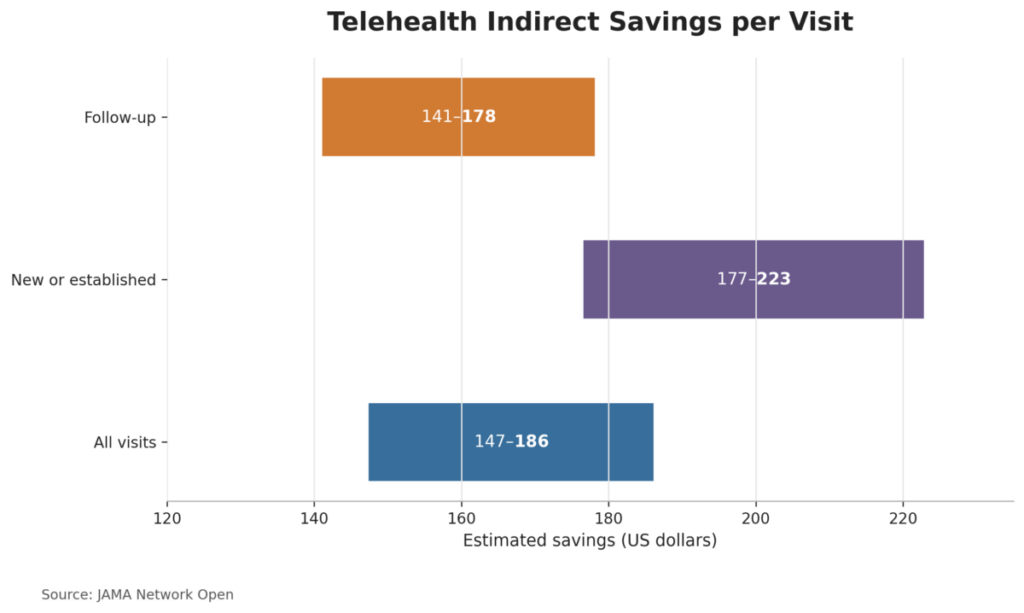
| Cancer telehealth visits | US$147–186 average indirect savings |
| Rural virtual wound care over 201 km | Up to 444 minutes and AU$507 saved per trip |
Sources: JAMA Network Open, PubMed Central
Integration Turns Digital Tools Into Health System Capacity
A digital tool can be useful without changing the health system. Development value grows when separate functions reinforce one another. A reminder becomes more effective when it connects to scheduling, while monitoring becomes clinically useful when incoming information enters the workflow where decisions are already made.
Electronic records can be widespread while information remains fragmented. Predictive systems can advance faster than the structured information required to support them, and new platforms can create more work instead of reducing it. Digitization can reproduce an older institutional problem when data still has to be copied or reconstructed across organizational boundaries.
OECD analysis published in 2026 estimates that realizing the full value of healthcare interoperability could be worth between 2.7 and 6.6 percent of health expenditure annually across OECD-country estimates. The potential value comes from allowing information to follow patients, reducing duplication, and organizing care around continuity rather than individual facilities.
The economics become clearest at the level of labor. Clinicians spend time reconstructing information that already exists. Tests may be repeated because another institution cannot see the result, while administrative staff maintain overlapping processes. Each failure consumes labor, capital, or time that could have been used elsewhere.
Integration changes the operating model. Information can follow the patient rather than remain attached to an institution, while clinical attention can move according to changing risk. SDG 9 therefore includes more than broadband. It includes the capacity to move reliable and usable information through healthcare organizations.
Once digital systems become part of ordinary clinical and administrative operations, they begin to raise the productive capability of healthcare itself.
Integration Turns Digital Tools Into Health System Capacity
| Hospital Comparison | Routine Interoperability | Counterpart |
|---|---|---|
| Large vs small | 53% | 38% |
| Urban vs rural | 47% | 36% |
| System-affiliated vs independent | 53% | 22% |
Sources: ONC Health IT
The Multiplier Reaches Beyond Healthcare
A health system that depends more heavily on digital coordination also becomes economically connected to industries outside traditional medical delivery. Telecommunications capacity affects whether remote care remains available, while shared digital infrastructure increasingly influences continuity across clinical systems. Healthcare reliability starts to depend on the wider internet economy.
That interdependence can improve productive capacity. Better connectivity increases the usefulness of remote care, while better information strengthens supply planning and resource allocation. Digital payment and identity systems can also reduce administrative friction where healthcare financing crosses institutional boundaries.
The same interdependence introduces vulnerability. Integration improves efficiency partly by increasing dependency. If a critical medical process relies on a network or shared digital service, failure can propagate into healthcare, especially where digital access substitutes for weak physical alternatives.
Efficiency and resilience therefore belong to the same economic calculation. Infrastructure that lowers coordination costs must also be dependable enough that efficiency does not create unacceptable fragility. Patient safety, cybersecurity, governance, and interoperability matter economically because disruption can reverse the gains from digital coordination.
WHO’s Global Strategy on Digital Health has been extended through 2027 and treats effective digital transformation as requiring financial, organizational, human, and technological capacity. Deployment alone is insufficient when institutions cannot convert technology into better care.
The Multiplier Reaches Beyond Healthcare
| Digital Dependency Measure | Scale |
|---|---|
| Large U.S. healthcare breaches | 725 in 2024 |
| Records exposed in hacking or IT incidents | At least 259 million |
| Change Healthcare breach impact | 192.7 million people |
| Hospitals hit by ransomware | 141 in 2023 |
Sources: HHS Office for Civil Rights, Health Sector Coordinating Council
The Next Divide Is the Ability to Absorb Technology
The future of digital health will be determined less by whether healthcare organizations adopt technology than by whether they can absorb it.
Adoption places a tool inside an organization. Integration connects it to other processes. Absorption changes how the organization operates. The economic return grows as technology moves closer to the decisions and workflows that determine system performance.
A telemedicine platform separate from routine clinical workflow can extend access while producing limited organizational change. Remote monitoring without clear responsibility creates information without necessarily creating care. Artificial intelligence operating on fragmented data can add complexity rather than productivity. Digital investment produces its strongest return when clinical and administrative work is redesigned around information that can be acted upon.
The capacity to make that transition is uneven. High-income systems generally possess greater capital for interoperability and workflow redesign, yet can remain constrained by legacy systems. Middle-income countries may combine sophisticated national platforms with uneven implementation capacity. Lower-income systems can gain substantially from basic connectivity while remaining limited by shortages of medicine, infrastructure, or healthcare professionals.
The emerging digital-health divide is therefore broader than internet access. It increasingly separates systems that can convert connectivity into dependable institutional capability from those that cannot.
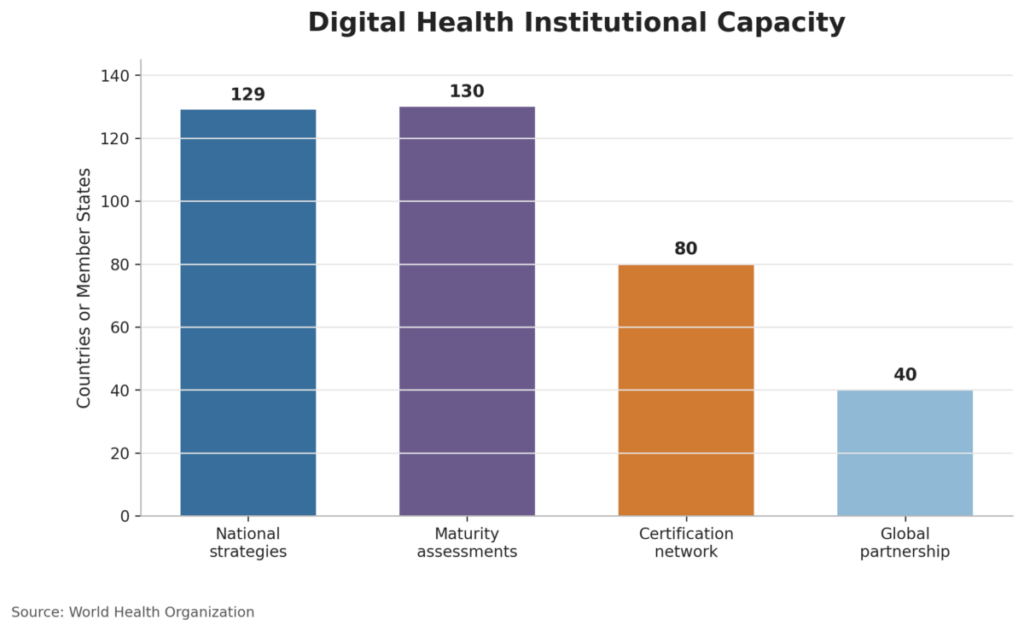
SDG 17 becomes particularly important because absorption is structurally collaborative. WHO reported in 2025 that 129 countries had established national digital-health strategies and 130 Member States had conducted maturity assessments. Its Global Digital Health Certification Network had reached 1.8 billion people across 80 countries. Digital health has moved deeply into national planning, but strategy does not guarantee routine clinical performance.
Digital health affects sustainable development when those institutional pieces reinforce one another strongly enough to change whether care reaches people in time. Better reach can protect health and preserve household participation in the economy. Better coordination can allow existing clinics, professionals, medicines, and infrastructure to serve more people effectively.
The internet does not eliminate scarcity in healthcare. It changes how much existing capacity can reach the human being.
When adoption leads to integration and integration becomes absorption, digital health moves beyond modernization. It becomes part of the economic infrastructure through which health systems improve human outcomes and accelerate progress toward the Sustainable Development Goals.
The Next Divide Is the Ability to Absorb Technology
| Capability | Measurement Signal |
|---|---|
| Reach | Remote service availability and use |
| Integration | Information exchanged and incorporated into records |
| Routine use | External information used at point of care |
| Resilience | Continuity during infrastructure failure |
| Institutional capacity | Governance, skills, standards, and sustained investment |
Sources: OECD, ONC Health IT, World Health Organization
Key Takeaways
- Digital health advances SDG outcomes primarily by reducing distance, delay, information loss, and coordination failures in healthcare.
- SDG 3 provides the central human outcome, while SDG 9 supplies enabling infrastructure and SDG 17 supports institutional coordination.
- Returns differ by health-system maturity because different economies face different constraints.
- Mature systems increasingly depend on productivity and absorption rather than basic adoption.
- Developing systems can receive larger first-order gains from reach and institutional connection.
- Earlier intervention can reduce hospital use and economic disruption for households and payers.
- Health improvements create wider economic effects because health supports labor participation and household resilience.
- Interoperability increases the value of digital investment by reducing duplication and allowing information to follow patients.
- Integration also increases dependency, making resilience and governance part of healthcare economics.
- The emerging digital divide increasingly concerns institutional capacity to absorb technology rather than internet access alone.
- Digital strategies demonstrate institutional commitment but do not guarantee routine clinical performance.
- Digital health contributes most when connectivity makes existing healthcare capacity more reachable, coordinated, and productive.
Sources
Digital Health Changes What Happens Before Care Fails
- United Nations Statistics Division; The Sustainable Development Goals Report 2026 Goal 3; – Link
- ONC Health IT; Non-Federal Acute Care Hospital Electronic Health Record Adoption 2008–2024; – Link
- Institute of Internet Economics; How Digital Health Changes the Path of Care; – Link
The Value of Connectivity Depends on the Constraint It Removes
- OECD; Health at a Glance 2025 Data and Digital; – Link
- OECD; Health at a Glance 2025 Unmet Needs for Healthcare; – Link
- International Telecommunication Union; Facts and Figures 2024 Internet Use; – Link
- International Telecommunication Union; Facts and Figures 2024 Mobile Network Coverage; – Link
Better Reach Creates a Development Multiplier
- JAMA Network Open; Estimated Indirect Cost Savings of Using Telehealth Among Nonelderly Patients With Cancer; – Link
- PubMed; Effects of Remote Patient Monitoring on Health Care Utilization in Patients With Noncommunicable Diseases; – Link
- World Health Organization; Integrating HIV Viral Hepatitis and Sexually Transmitted Infections With Primary Health Care; – Link
Integration Turns Digital Tools Into Health System Capacity
- OECD; Interoperability in Healthcare; – Link
- ONC Health IT; Interoperable Exchange of Patient Health Information Among U.S. Hospitals 2023; – Link
- Institute of Internet Economics; Digital Health and the Architecture of Structured Data; – Link
The Multiplier Reaches Beyond Healthcare
- U.S. Department of Health and Human Services; Change Healthcare Cybersecurity Incident Frequently Asked Questions; – Link
- U.S. Department of Health and Human Services; HIPAA Security Rule Notice of Proposed Rulemaking; – Link
- Health Sector Coordinating Council; Healthcare Cybersecurity Working Group; – Link
The Next Divide Is the Ability to Absorb Technology
- World Health Organization; Global Strategy on Digital Health 2020–2027; – Link
- World Health Organization; World Health Assembly Endorses Extension of the Global Strategy on Digital Health to 2027; – Link
- World Health Organization; Empowering Countries to Harness Digital Health for Stronger Health Systems; – Link
- International Telecommunication Union; ICT Development Index 2024; – Link