

Although certified electronic records now operate in almost every U.S. hospital, the infrastructure created during healthcare’s first digital transition still struggles to function as one system. Predictive AI reached 71 percent of hospitals in 2024, up from 66 percent a year earlier, while nine in ten hospitals connected at least one external technology to their record systems. Modern tools have advanced faster than the information environment required to support them.
Digital health is evolving as the industry retools around artificial intelligence, cloud connectivity, advanced analytics, and structured data. These are no longer separate technology trends because each increasingly depends on the others. Their integration is exposing the barriers imposed by proprietary platforms, where data use and technical development remain constrained by vendor rules.
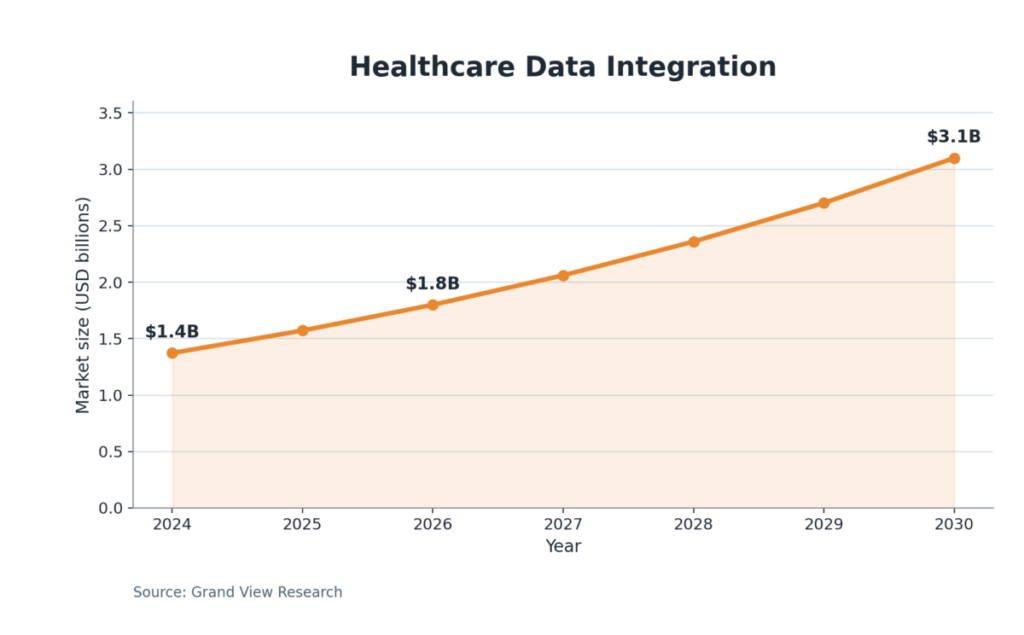
Within this transformation, open-source development is creating a more transparent environment for system design and institutional alignment. Countries and companies can shape infrastructure around their own requirements for data control, privacy, and regulation rather than accepting every technical decision as a fixed feature of a vendor platform.
Instead of beginning another cycle of isolated applications, the next phase involves building an operating environment in which clinical information can move between institutions and remain usable by cloud systems and analytical models. Open standards make that exchange possible, while open-source development changes who can inspect the architecture and influence how it evolves.
Its strategic value does not come from eliminating cost. Open platforms still require durable financing and technical capacity, but they reduce the ability of one supplier to determine how information is structured or which future services may connect to it. Open source makes infrastructure inspectable, open standards make information portable, and supplier choice determines whether either advantage produces operational resilience.
| Dimension | Earlier Digital Model | Integrated Infrastructure Model | Supporting Evidence |
|---|---|---|---|
| Primary objective | Digitize individual workflows | Connect records, services and analysis | Nine in ten hospitals connect external technology to record systems |
| System structure | Separate vendor applications | Shared information foundation | Predictive AI reached 71% of U.S. hospitals in 2024 |
| Institutional control | Technical decisions fixed by suppliers | Architecture shaped around local needs | Open platforms operate across more than 100 countries |
| Strategic value | Lower-cost software acquisition | Adaptability, portability and resilience | About 3.2 billion people live in countries using national open platforms |
Structured Data Connects the System
Clinical information was built to remain inside the application that created it. When another system needs that information, the receiving organization often has to reconstruct its meaning from fields shaped by a different vendor and workflow. Even a laboratory result can lose value when its unit, timing, or clinical context does not travel with it.
The older integration model tried to overcome this fragmentation through dedicated connections between individual systems. Each connection translated data for one commercial relationship, creating an expensive layer of custom engineering that had to be maintained whenever either platform changed. As hospitals added cloud services and analytical tools, the number of dependencies multiplied while the underlying information remained difficult to reuse.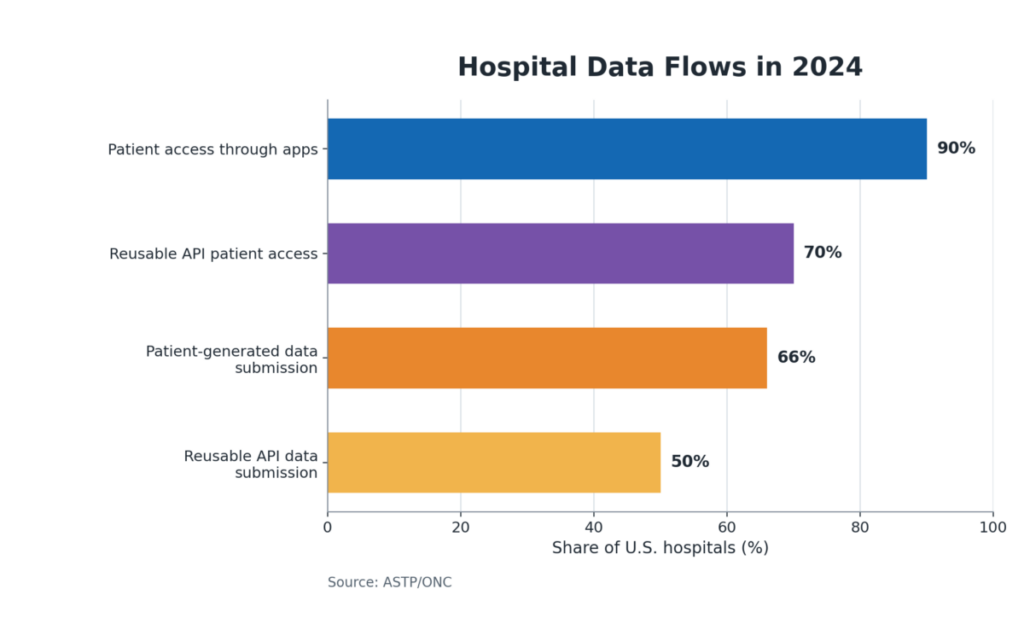
The gap reflects the obsolescence of the surrounding architecture. A platform may recognize an open standard while keeping its most important workflows behind proprietary connections. Open-source systems can reproduce the same constraint when data remains difficult to move or implementation knowledge stays concentrated with one contractor.
Structured data replaces this accumulation of custom translations with information designed for reuse. A clinical result can move from the hospital record into a cloud-based analytical system without being reinterpreted at every step. Removing that repeated reconstruction lowers integration costs and gives institutions greater freedom to introduce new services without rebuilding the information foundation beneath them.
As AI enters that workflow, provenance becomes equally important. A health organization must know whether information originated with a clinician or was transformed by an automated process before assigning it clinical authority. Cloud infrastructure gains value from the same foundation because computing capacity alone cannot reconcile inconsistent definitions.
| Information Requirement | Fragmented Environment | Structured Environment | Operational Effect |
|---|---|---|---|
| Clinical meaning | Meaning reconstructed by each receiving system | Meaning travels with the record | Fewer interpretation errors |
| System connection | Dedicated link for each commercial relationship | Reusable documented interface | Lower integration and maintenance burden |
| Clinical context | Units, timing or provenance may be lost | Context remains attached to the result | Safer reuse across care settings |
| Cloud analysis | Data translated before each analytical use | Information enters analysis in a consistent form | More reliable analytics and model inputs |
| Current adoption gap | Interfaces exist without full clinical use | Exchange becomes part of routine workflow | Interfaces span 93% of U.S. hospital markets, but only about half of hospitals use them for clinical exchange |
Sources: ASTP/ONC; HL7 Internationa
Open Infrastructure Changes the Market
Open architecture is a health system in which clinical data is structured consistently, transmitted through secure networks, and exchanged through documented interfaces that qualified systems can use. It is not the same as open-source software, although open-source components can support it. Its defining feature is that hospitals retain control of the information layer while applications and analytical services connect to it without requiring a new custom link for every vendor.
The older model tied each new capability to a dedicated integration. Every additional service introduced another technical dependency, while undocumented vendor logic made upgrades expensive and supplier replacement risky. Over time, institutions accumulated more technology but gained less freedom to change how the system worked.
Open architecture separates the data foundation from the services built above it. Common standards provide the exchange language, while open-source software can give health systems the ability to inspect code and program services around local clinical needs. The model resembles open banking in structure, but health systems require stricter controls because clinical data carries greater privacy and safety consequences.
This architecture unlocks the next stage of digital medicine. Hospitals can connect AI to governed structured data, develop local workflows, and replace individual services without rebuilding the underlying record. The same data can move into cloud-based analytical systems without being translated at every step, reducing integration costs and making advanced analysis more reliable.
Commercial value consequently shifts away from controlling hidden architecture. Vendors remain essential for hosting and implementation, but they compete increasingly on service quality and adaptability rather than on how difficult they are to replace. Supplier replaceability becomes a form of operational resilience.
Artificial intelligence is accelerating that realignment. Billing-related AI use in U.S. hospitals rose from 36 percent to 61 percent within a year, while scheduling applications increased from 51 percent to 67 percent. Predictive AI operated in 86 percent of hospitals affiliated with larger systems but only 37 percent of independent hospitals, showing how strongly adoption depends on the maturity of the surrounding data environment.
Advanced health systems must escape legacy complexity without interrupting care. Middle-income systems can establish common architecture before incompatible platforms become entrenched, while resource-constrained systems need local capacity to keep open infrastructure operational. Ethiopia’s national health information system receives data from roughly 30,000 facilities and supports planning for more than 120 million people, demonstrating what becomes possible when open architecture develops alongside institutional capability.
| Market Issue | Proprietary Integration Model | Open Architecture Model | Economic Consequence |
|---|---|---|---|
| Adding a service | New custom integration required | Service connects to the existing information layer | Lower marginal integration cost |
| Supplier replacement | Migration may require rebuilding workflows | Individual services can be replaced | Lower switching costs and stronger bargaining power |
| Source of vendor advantage | Control of hidden architecture | Quality of hosting, implementation and support | Competition shifts toward service performance |
| Local adaptation | Changes depend on the platform owner | Qualified local teams can adapt workflows | Greater institutional and domestic capability |
| Observed capability gap | Independent institutions face higher barriers | Larger systems spread infrastructure costs | Predictive AI use: 86% in system-affiliated hospitals versus 37% in independent hospitals |
Patients Experience the Architecture
The impact of the new digital-health system begins with information flow. Structured data allows clinical information to move more accurately across care settings, reducing avoidable mistakes while improving analysis and coordination. It also creates an ERP-like operating layer for healthcare by linking patient records with continuing contact, follow-up, and service management. In some countries, this architecture is developing around a national patient identifier and unified record; elsewhere, identity and record continuity remain unresolved, limiting how fully the system can function.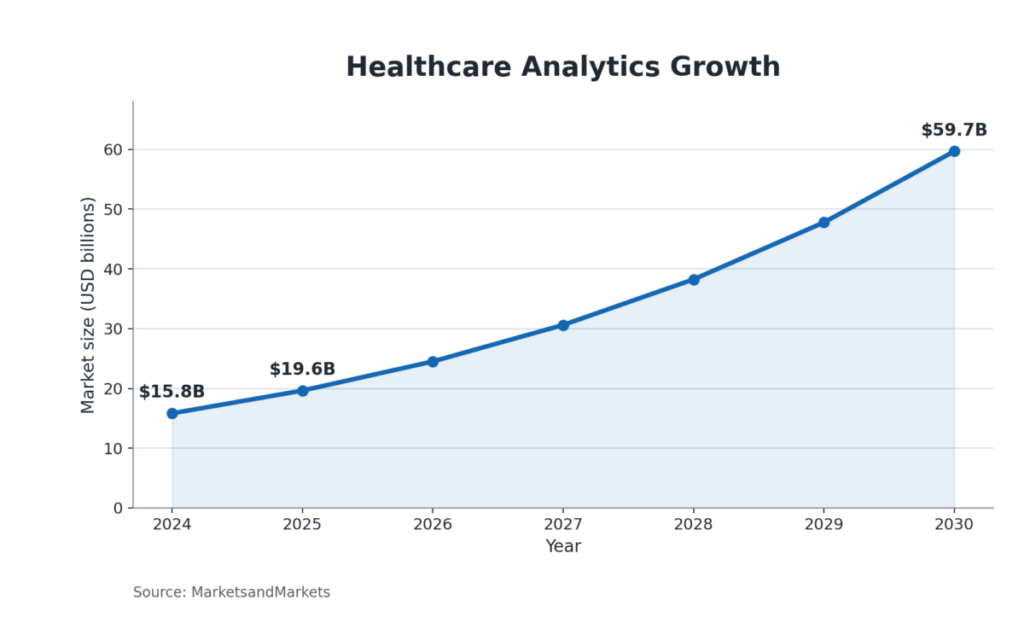
When records move with the patient, clinicians can review prior tests and treatment decisions before ordering new work. Health-information exchange has been associated with 64 percent lower odds of repeated diagnostic imaging during emergency evaluation for back pain, showing how better information flow can reduce duplication as well as clinical uncertainty.
The same structure strengthens care after discharge. Instructions can move directly into follow-up systems, allowing care teams to identify missed appointments or worsening symptoms before they lead to another emergency visit. One targeted program recorded a 30-day readmission rate of 11 percent among contacted patients, compared with 12.17 percent among those not reached.
Remote monitoring extends this model by turning periodic care into continuous observation. Measurements collected at home can enter the clinical record and alert care teams when a condition begins to deteriorate. A 2024 systematic review found improvements in patient safety and treatment adherence, alongside a broader decline in hospital admissions and length of stay.
For patients, the difference is practical. They repeat less information, gain earlier access to results, and are less likely to become the only link between disconnected providers. Patient access to online records rose from 25 percent in 2014 to 65 percent in 2024, while nine in ten hospitals enabled electronic access through an application interface.
The benefits remain uneven where patient identity is fragmented or records cannot follow a person across institutions. National identifiers can support record cohesion and long-term follow-up, but they also raise questions about privacy, access, and governance. In systems without a common identity layer, the same patient may still appear as several disconnected records.
As analytical systems begin to influence detection and clinical prioritization, the quality of the underlying record becomes more consequential. Predictive models can support earlier intervention and more targeted follow-up, but incomplete data may weaken recommendations for patients whose care has been poorly documented. Privacy and provenance therefore remain part of care quality because institutions must know where information originated and be able to explain how an automated output affected a clinical decision.
| Care Moment | Fragmented Experience | Integrated Experience | Supporting Evidence |
|---|---|---|---|
| Arrival at a new provider | Patient reconstructs medical history | Clinician receives usable prior records | Shared records were associated with 64% lower odds of repeated imaging |
| Clinical decision | Missing results increase uncertainty | Prior tests and treatment decisions remain visible | Reduced duplication and stronger continuity |
| After discharge | Follow-up depends on separate manual processes | Instructions trigger outreach and escalation | Readmission was 11% among contacted patients versus 12.17% among those not reached |
| Between visits | Care remains episodic | Home measurements support continuous observation | Remote monitoring improved safety and treatment adherence |
| Patient access | Records remain institution-controlled | Patients can review and carry information digitally | Online record access rose from 25% in 2014 to 65% in 2024 |
| Patient identity | One patient may appear as several records | Identity links information over time | National approaches vary in privacy and governance design |
The Standard Shifts From Software Ownership to System Control
As digital health becomes integrated infrastructure, governance and economics move into the system itself. The old model treated software as a product purchased from a vendor; the emerging model treats data movement, service continuity, and supplier replacement as core operating requirements.
That shift is already visible in regulation. Electronic health-data exchange is regulated in 78 percent of surveyed jurisdictions, while 73 percent formally require or recommend a common interoperability standard. What began as a technical preference is becoming an institutional expectation for how modern health systems exchange information.
Artificial intelligence reinforces the transition. Its growing adoption increases the value of structured longitudinal records while making data quality and provenance more consequential. Once models influence detection, follow-up, or resource allocation, regulators must be able to trace how information entered the system and how an automated output affected care.
The disruption extends to the commercial model. Proprietary vendors previously gained leverage through custom integrations that made migration expensive. A fully integrated environment reduces that advantage because hospitals can connect new services through a governed information layer, shifting competition toward reliability and specialist performance rather than dependence on one closed platform.
Concentration remains the countervailing risk. Change Healthcare processed about 15 billion transactions annually and touched one in three patient records before its 2024 cyberattack disrupted clinical administration and financial activity across the United States. Integration without redundancy can turn one intermediary into a point of failure for an entire market.
Procurement will increasingly determine whether integration produces control or another form of lock-in. Hospitals and governments will judge systems by whether data can be exported, cloud configurations reproduced, and AI providers replaced without rebuilding the underlying record. Contracts will therefore govern not only price and service quality, but also the institution’s ability to continue operating when a supplier fails or changes strategy.
Once fully integrated, the new model will function differently from the old one. Structured longitudinal data can follow patients across care settings, support broader health analysis, and feed new AI systems without being reconstructed for each application. Proprietary services will remain important, but they will increasingly operate inside an information environment governed by the customer.
The long-term impact lies in turning digital health from a collection of vendor products into adaptable public and institutional infrastructure. Organizations that control that foundation will be able to introduce new technology faster, regulate it more effectively, and retain greater economic leverage as digital medicine becomes the standard form of care.
| Control Issue | Traditional Assumption | Emerging Requirement | Risk if Absent |
|---|---|---|---|
| Data ownership | Access governed by the application contract | Usable export and preserved provenance | Institutional lock-in |
| Supplier continuity | One provider remains responsible indefinitely | Reproducible configurations and replacement rights | Service failure becomes system failure |
| Automated decisions | Model performance treated as a vendor function | Traceability, evaluation history and model exit rights | Unexplained or unreviewable clinical decisions |
| Concentration | Intermediaries treated as ordinary vendors | Redundancy and tested recovery | One outage spreads across an entire market |
| Market scale | Transaction volume viewed as efficiency | Scale assessed alongside systemic exposure | A major intermediary processed about 15 billion transactions annually |
| Regulatory direction | Exchange treated as a technical preference | Exchange treated as an operating obligation | 78% of surveyed jurisdictions regulate electronic health-data exchange |
| Long-term competition | Value rests in platform ownership | Value shifts toward reliability and adaptability | Customers accumulate technology without gaining control |
TL;DR Summary
- Digital health is shifting from isolated software toward integrated infrastructure built around structured data.
- Predictive AI reached 71 percent of U.S. hospitals in 2024, increasing demand for interoperable records.
- Open architecture separates the information foundation from the applications and services connected to it.
- Open source supports inspectability, while open standards make clinical information portable across systems.
- FHIR was formally required or recommended in 73 percent of surveyed jurisdictions.
- Open architecture allows hospitals to add cloud and AI services without rebuilding the underlying record.
- Commercial value is moving from proprietary integration toward implementation quality and long-term adaptability.
- Advanced, middle-income, and developing health systems face different infrastructure and capacity constraints.
- Connected records can reduce duplicate testing and improve follow-up after discharge.
- Patient access to online records rose from 25 percent in 2014 to 65 percent in 2024.
- Regulation and procurement increasingly determine whether integration produces control or another form of lock-in.
- Supplier replaceability, longitudinal data, and operational resilience are becoming core standards of digital medicine.
Sources
Digital Health Moves Toward Integrated Infrastructure
- Assistant Secretary for Technology Policy; Hospital Trends in the Use, Evaluation, and Governance of Predictive AI, 2023–2024; – Link
- DHIS2; DHIS2 in Action; – Link
- National Library of Medicine; Open-Source Electronic Health Record Systems in Low- and Lower-Middle-Income Countries: Scoping Review; – Link
Structured Data Connects the System
- Assistant Secretary for Technology Policy; Interoperable Exchange of Patient Health Information Among U.S. Hospitals: 2023; – Link
- Assistant Secretary for Technology Policy; Hospital Use of APIs to Enable Data Sharing Between EHRs and Third-Party Technology; – Link
- HL7 International; 2025 State of FHIR Survey Results; – Link
- National Library of Medicine; A Narrative Review on the Validity of Electronic Health Record Data for Epidemiological Research; – Link
Open Infrastructure Changes the Market
- DHIS2; Evidence of DHIS2 Impact; – Link
- DHIS2; Enhancing Healthcare Performance in Ethiopia Using DHIS2; – Link
- National Library of Medicine; Open-Source Electronic Health Record Systems for Low-Resource Settings: Systematic Review; – Link
- Assistant Secretary for Technology Policy; Electronic Health Information Exchange by Hospitals; – Link
Patients Experience the Architecture
- National Library of Medicine; Health Information Exchange Reduces Repeated Diagnostic Imaging for Back Pain; – Link
- National Library of Medicine; Postdischarge Follow-Up and Thirty-Day Readmission; – Link
- npj Digital Medicine; A Systematic Review of the Impacts of Remote Patient Monitoring Interventions on Safety, Adherence, Quality of Life and Cost-Related Outcomes; – Link
- Assistant Secretary for Technology Policy; Individuals’ Access and Use of Patient Portals and Smartphone Health Apps, 2024; – Link
The Standard Shifts From Software Ownership to System Control
- Associated Press; A Large U.S. Health Care Technology Company Was Hacked, Causing Billing Delays and Security Concerns; – Link
- Reuters; U.S. Insurers Expedite Payments to Health Care Providers After Change Healthcare Attack; – Link
- Reuters; UnitedHealth Technology Unit’s Rivals Retain Customers Gained After Cyberattack; – Link
- Assistant Secretary for Technology Policy; Hospital Trends in the Use, Evaluation, and Governance of Predictive AI, 2023–2024; – Link
Keywords: E-Health, Digital Health, Open Source, Structured Health Data, Digital Health Infrastructure