
Stablecoins – Part 2 of 2 Part Series – See Part 1 (Here)
Banking Protects Money While Stablecoins Help Fintech Move It
Money must work across time and in use. Traditional banking became central to the first function because deposits safeguard savings, support intermediation, and fund credit. Fintech increasingly specializes in the second, making money easier to access and move. Stablecoins strengthen that specialization by giving fintech a monetary instrument designed for continuous digital movement while preserving a familiar monetary reference.
Internet behavior is making that difference more important. Seventy-eight percent of U.S. consumers prefer faster payments, roughly six in ten consider instant payments important from their financial institution, and the share rises to 78 percent among Gen Z. Half of consumers also hold balances with nonbank providers. These figures do not establish stablecoin demand, but they show that financial services increasingly compete against expectations formed elsewhere in the digital economy.
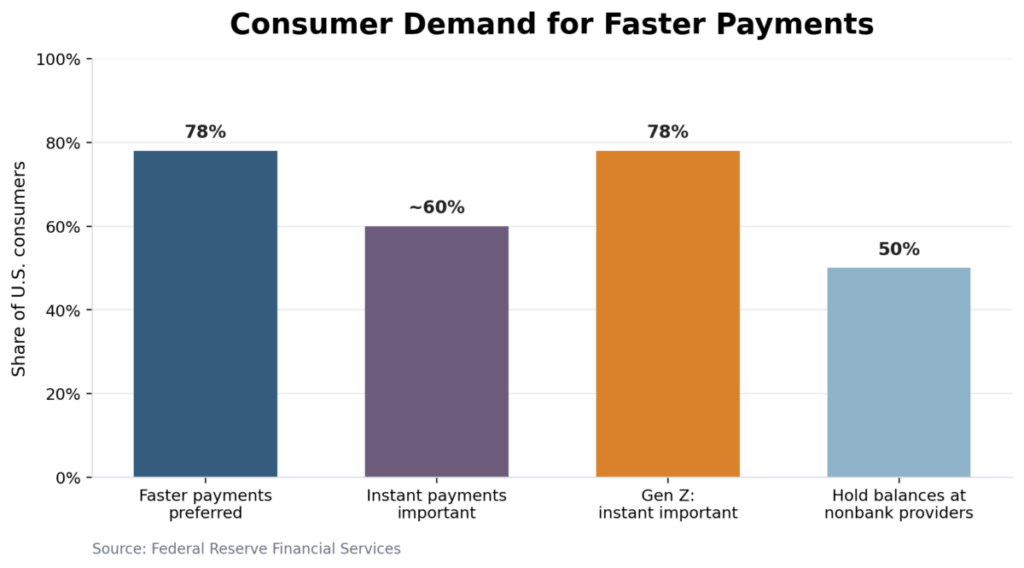
Reference dependence, habituation to immediacy, and friction avoidance reinforce the shift. Users compare financial services with faster digital experiences, normalize improvements quickly, and become less tolerant of delay. Fintech responds because much of its economic value lies in shortening the distance between intent and transaction. Stablecoins extend that logic beneath the interface by giving fintech a dollar-referenced mechanism that can move continuously through software-based systems.
Money across time and money in use therefore represent different financial needs rather than competing institutions. Banks remain essential for safeguarding savings, intermediating funds, managing liquidity, and creating credit. Fintech becomes more important when consumers and businesses want money to move. Stablecoins connect those functions by helping fintech handle money in motion without eliminating the banking system that protects and intermediates it.
| Consumer Payment Measure | U.S. Average |
|---|---|
| Total payments per month | 47 |
| Credit card payments | 16 per month |
| Debit card payments | 15 per month |
| Cash payments | 6 per month |
| Debit + credit share | About two-thirds |
Sources: Federal Reserve Financial Services
Stablecoins Give Fintech Money That Behaves Like the Internet
Stablecoins separate monetary denomination from the infrastructure used to transfer value. Prices, invoices, balances, and obligations can remain expressed in dollars while their digital representation moves through internet-native systems. The innovation is not a new monetary unit. It is a new way for fintech to move an existing one.
The internet may therefore be creating its own monetary layer rather than its own monetary unit. Stablecoins are one candidate for the de facto transactional currency, or currency peg, of that layer because they combine familiar dollar denomination with infrastructure suited to continuous digital movement. The proposition is forward-looking, not a claim that stablecoins already dominate internet commerce.
Scale shows both the opportunity and its limits. Global stablecoin market capitalization reached about $315 billion in early April 2026, compared with roughly $8 trillion in U.S. bank deposits. Stablecoin transaction volume totaled about $35 trillion in 2025, yet only around $390 billion was estimated to be payment-related. Approximately 98 percent of stablecoins were dollar-denominated.
Those figures suggest that structural fit matters more than headline volume. Stablecoins have reached meaningful financial scale, but ordinary payments remain only part of their use. Their longer-term significance depends on whether fintech repeatedly chooses them because they move familiar dollar value with fewer timing and settlement constraints than conventional rails.
| Capability | Reach |
|---|---|
| Additional stablecoin payment markets | 32 |
| Stablecoin-backed card countries | 30 |
| Marketplace seller payout coverage | 100+ countries |
| Supported on/off-ramp currencies | 6 major currencies |
Sources: Stripe
The Strongest Stablecoin May Be the One the Customer Never Notices
Stablecoins become more useful to fintech when users no longer need to behave like crypto users. A business should not have to understand blockchain settlement or reorganize its accounting merely to benefit from faster movement. The technology becomes more valuable when complexity moves beneath the interface while the user continues to see familiar dollar balances.
The partnership between fintech leaders Ramp and Stripe illustrates that direction. Ramp can use Stripe’s stablecoin infrastructure beneath conventional dollar-based financial products, allowing conversion and settlement to occur behind the interface. The stablecoin becomes part of the underlying machinery rather than the product itself.
That model resembles earlier payment technologies. Consumers do not need to understand card-network clearing to use a card, and businesses do not study settlement architecture each time they make a payment. Stablecoins could follow the same path if fintech applications use them as one mechanism for moving dollar-denominated value without requiring users to understand the underlying rail.
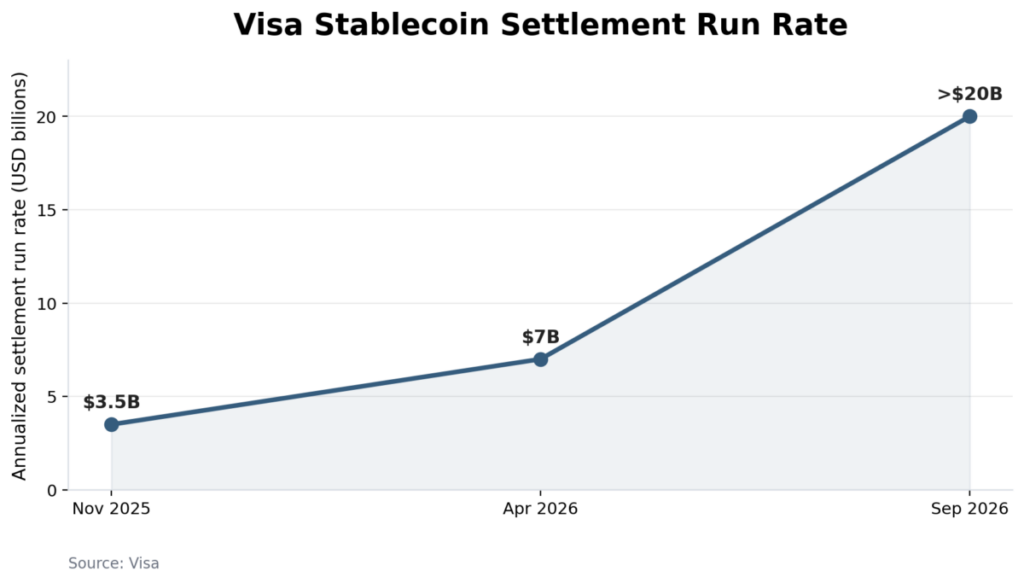
Institutional adoption increasingly reflects that model. By September 2026, more than 160 stablecoin-linked Visa card programs were live globally, payment volume across those programs had risen nearly 200 percent year over year, and stablecoin settlement volume had surpassed a $20 billion annualized run rate. Earlier in the year, Visa’s settlement pilot had been running at about $7 billion annually across nine blockchains.
Users do not need to prefer stablecoins for that transition to matter. They need to prefer financial services that are faster, easier, and continuously available. Stablecoins become important when fintech can satisfy those expectations because the monetary layer beneath the service moves differently.
| Payment Step | Typical Timing / Scale |
|---|---|
| Traditional marketplace settlement | About 5 days |
| Stablecoin payout after funds received | Effectively instant |
| Stablecoin-to-local-bank off-ramp | About 1 day |
| Seller payout availability | 100+ countries |
Sources: Stripe
When Money Moves Differently Banks Feel the Difference
The difference between fintech and banking becomes economically significant when transactional balances begin to separate from savings balances. Deposits fund bank liquidity and lending. If stablecoins make transactional money more portable, technology designed to improve movement can eventually affect institutions responsible for safekeeping and credit.
New York Fed research identifies that transmission mechanism. Banks directly involved with stablecoin deposits subsequently held about $1.5 billion more in reserve balances, while their loan share of assets fell by roughly 14 percentage points relative to a control group. The findings do not establish an economy-wide credit contraction, but they show how payment technology can alter bank balance-sheet behavior.
The connection becomes more important as stablecoins grow. Dollar stablecoin capitalization increased by about $71 billion, or 30 percent, between April 2025 and mid-2026, reaching roughly $308 billion. The two largest issuers accounted for more than 80 percent of industry assets, concentrating a substantial share of stablecoin activity in a small number of reserve structures and banking relationships.
Consumers and businesses may therefore use one institution for money across time and another system for money in motion. A business can still depend on a bank for deposits, borrowing, and regulated custody while using fintech infrastructure for transactions that must move continuously. Stablecoins do not remove banks from finance, but they can change which part of the financial relationship remains inside the traditional deposit account.
Banks are responding to the same pressure. FedNow accelerates conventional account-to-account payments, while tokenized deposits give bank liabilities digital characteristics without changing their legal identity. Stablecoins take a different route by giving fintech a transferable dollar-linked instrument that can operate outside conventional account structures before reconnecting with regulated finance.
The difference remains functional rather than absolute. Banking cannot optimize solely for transaction speed because safekeeping and intermediation carry obligations that payment applications do not bear in the same way. Fintech creates much of its value by making balances easier to access and use. Stablecoins sit directly at that boundary.
| Measure | 2024 | 2025 |
|---|---|---|
| FedNow payments settled | 1.5 million | 8.4 million |
| Annual payment growth | — | 459% |
| FedNow settlement value | Lower base | About $853 billion |
| Operating availability | 24/7/365 | 24/7/365 |
Sources: Federal Reserve Financial Services
A De Facto Internet Currency Can Still Be the Dollar
An internet monetary layer does not require a new monetary standard. The dollar can remain the unit of account while fintech develops new ways to represent and move it. Stablecoins fit that model because their innovation lies primarily in transactional form.
They are also competing against rapidly improving bank-native infrastructure. FedNow processed 8.4 million payments worth approximately $853 billion during 2025. Payment volume increased 459 percent from 2024, while settled value rose more than twentyfold. Faster conventional bank money is therefore advancing at the same time stablecoins are expanding into fintech and payment networks.
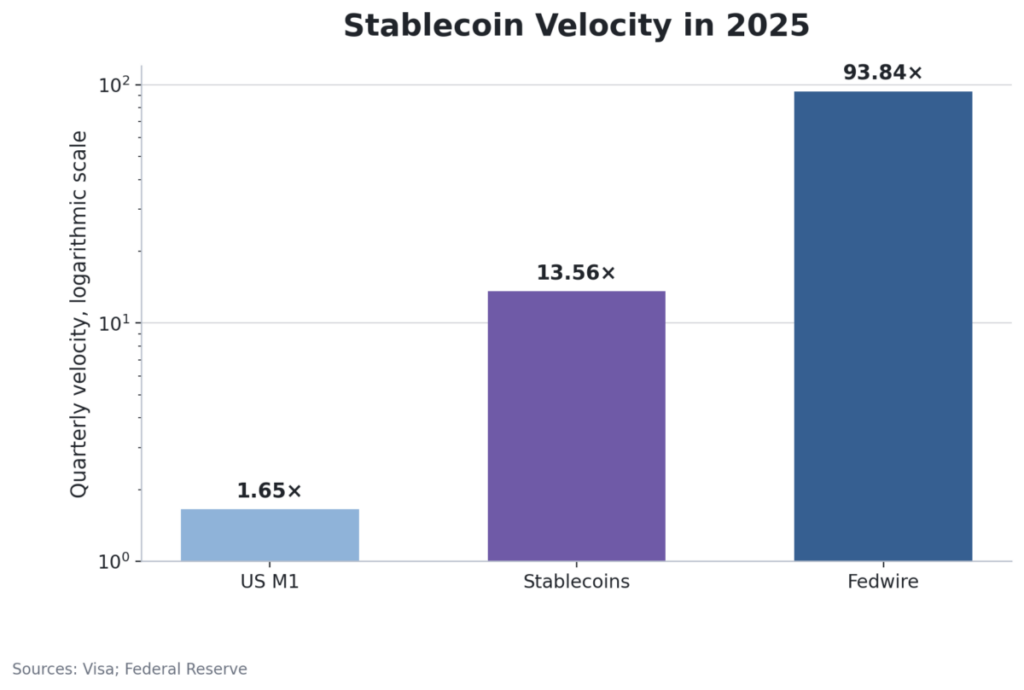
Financial markets are already pricing the possibility that stablecoins could alter that competitive balance. Around the decisive congressional vote on the GENIUS Act, listed incumbent payment companies underperformed other financial firms by about 1.3 percentage points, equivalent to roughly $21.5 billion in market capitalization. A broader IMF estimate placed the potential competitive effect at about $300 billion, though that figure is explicitly model-dependent.
Regulation reinforces rather than erases the difference between speed and safekeeping. Payment stablecoins must be backed by liquid reserve assets and supported by regular reserve disclosures, drawing internet-native money closer to safeguards historically associated with regulated finance. Fintech may specialize in movement, but movement only works when users trust the value being moved.
The internet may therefore be creating its own monetary layer without creating its own monetary unit. Stablecoins could become a de facto transactional currency of that layer because they allow fintech to move familiar monetary value through infrastructure aligned with internet behavior. The dollar remains the peg and reference; the machinery around it changes.
A behavioral preference for speed can reach much deeper into financial architecture. Fintech develops around money in motion, and stablecoins give it a mechanism suited to that role. Traditional banking remains essential because money must also be safeguarded, intermediated, and converted into credit. Stablecoins matter not because they replace banking, but because they may allow fintech and banking to specialize more clearly in what each does differently.
| FedNow Measure | 2023 | 2024 | 2025 |
|---|---|---|---|
| Settled payments | 47,262 | 1.5 million | 8.4 million |
| Settled value | $18.4 million | $38.2 billion | $853.4 billion |
| Average payment | $390 | $25,376 | $101,435 |
| Annual volume growth | — | — | 458.9% |
Sources: Federal Reserve Financial Services
TL;DR Summary
- Banking primarily protects and intermediates money across time, while fintech increasingly specializes in moving money in use.
- Seventy-eight percent of U.S. consumers prefer faster payments, reinforcing demand for financial services that behave more like the broader internet.
- Stablecoins give fintech a dollar-linked monetary mechanism that can operate through continuously available digital infrastructure.
- The dollar can remain the unit of account while the system used to move it changes.
- Stablecoins reached roughly $315 billion in market capitalization in early April 2026, while payment-related activity remained only a fraction of total reported volume.
- Approximately 98 percent of stablecoins are dollar-denominated, reinforcing their role as a transactional representation of existing money rather than a new monetary standard.
- More than 160 stablecoin-linked Visa card programs were live globally by September 2026, with payment volume nearly tripling year over year.
- Visa stablecoin settlement surpassed a $20 billion annualized run rate, showing how stablecoin infrastructure is moving toward embedded financial use.
- New York Fed evidence links stablecoin-related banking relationships with higher reserve holdings and a lower loan share of assets.
- FedNow processed 8.4 million payments worth about $853 billion in 2025, showing that bank-native instant payments are advancing at the same time.
- Stablecoins, tokenized deposits, and faster bank payments represent competing ways to adapt money to internet-speed transactions.
- The central economic shift is the separation of money across time from money in motion.
Sources
- Federal Reserve Financial Services; 2025 Research – Consumer Payments Study; – Link
- Federal Reserve Financial Services; 2026 Diary of Consumer Payment Choice; – Link
- Federal Reserve Board; Stablecoins in 2025: Developments and Financial Stability Implications; – Link
Stablecoins Give Fintech Money That Behaves Like the Internet
- Bank for International Settlements; Stablecoins: Framing the Debate; – Link
- Stripe; The Stablecoin Advantage: Faster Growth, Fewer Borders; – Link
- Federal Reserve Board; Testimony on Innovation and Digital Assets; – Link
The Strongest Stablecoin May Be the One the Customer Never Notices
- Stripe; Ramp Uses Stripe to Power Stablecoin Payments and Accounts; – Link
- Visa; Visa Accelerates Stablecoin Momentum: Adding Five Blockchains for Settlement; – Link
- Visa; Financing a Hundred Stablecoin-Linked Card Programs; – Link
- Stripe; Everything We Announced at Sessions 2026; – Link
When Money Moves Differently Banks Feel the Difference
- Federal Reserve Bank of New York; Stablecoin Disintermediation; – Link
- Federal Reserve Board; Banks in the Age of Stablecoins: Some Possible Implications for Deposits, Credit, and Financial Intermediation; – Link
- Bank for International Settlements; BIS Annual Economic Report 2026; – Link
A De Facto Internet Currency Can Still Be the Dollar
- Federal Reserve Financial Services; FedNow Service Volume and Value Statistics; – Link
- International Monetary Fund; Stablecoins and the Future of Payments: Evidence from Financial Markets; – Link
- Federal Deposit Insurance Corporation; GENIUS Act Requirements and Standards for Payment Stablecoin Issuers and Insured Depository Institutions; – Link
- Federal Reserve Board; New Forms of Money and the U.S. Monetary Aggregates; – Link