
The Online Store Is Now Part of the Decision
Branding once carried much of the work required to move a consumer toward a purchase. Advertising created awareness, repetition built familiarity, and a recognizable name reduced uncertainty. Retailers influenced placement and availability, but the brand remained one of the strongest shortcuts consumers used to organize choice. In markets where information was harder to obtain, brand identity could stand in for a longer investigation of quality, reliability, or value.
E-commerce has redistributed those functions. Search determines which products appear. Reviews provide independent reassurance, while recommendation systems narrow the field before serious consideration begins. Advertising has moved inside the transaction environment, and AI increasingly influences comparison before consumers reach a conventional storefront. The result is not the disappearance of branding, but a change in the economic work branding must perform.
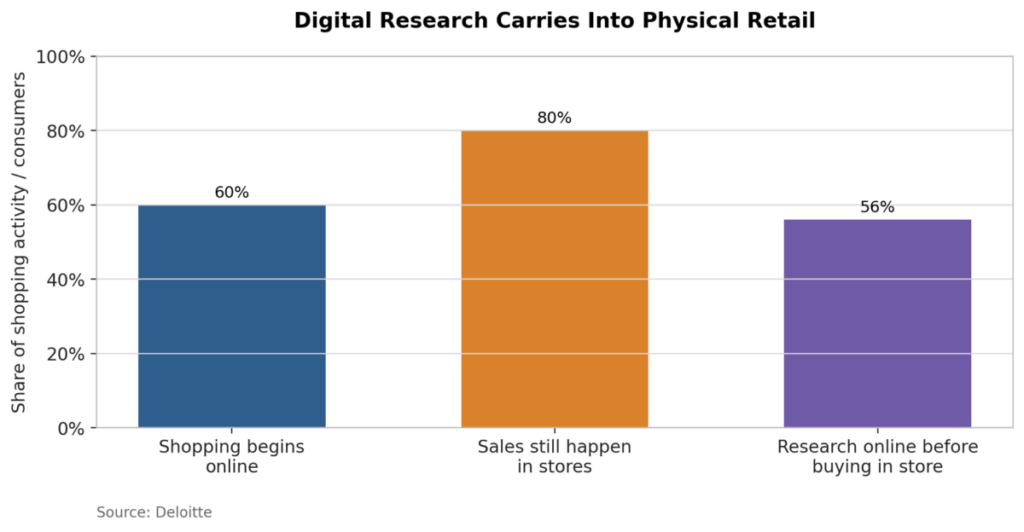
The scale makes the shift structural. U.S. retail e-commerce sales reached $340.2 billion in the second quarter of 2026, up 12.2 percent from a year earlier and equal to 17.1 percent of total retail sales on a seasonally adjusted basis. A significant share of consumer choice now occurs inside systems where discovery, comparison, trust, and purchase converge.
For brands, preference must increasingly survive comparison. Advertising has a different role: securing access to the consumer’s consideration set. That separation matters because the two functions can no longer be treated as interchangeable.
The Store Is Now Part of the Decision
| Consumer Journey Measure | Share |
|---|---|
| Online purchase journeys using multiple touchpoints | 80% |
| Shopping journeys beginning online | 60% |
| Consumers researching online before buying in store | 56% |
| Retail sales still occurring in physical stores | 80% |
Sources: Google, Deloitte
Comparison Changes the Economics of Differentiation
Traditional branding developed in markets where consumers faced meaningful information gaps. Quality was harder to verify, prices took effort to compare, and alternatives were less visible. A known brand reduced uncertainty while creating reputational and symbolic differentiation. The consumer often bought not only a product but also a shorthand for expected quality, social meaning, and reduced risk.
By lowering comparison costs, e-commerce weakens some of that protection. Retail markets do not become perfectly competitive because products remain differentiated and consumers still value reputation, design, identity, and service. Easier discovery of substitutes nevertheless pushes parts of the buying process toward more competitive conditions because differences can be tested more quickly and alternatives become more credible.
Consumers do not need products to become identical. They need enough information to judge substitutes against common criteria. In a 2025 U.S. Ipsos survey commissioned by Temu, 68 percent of online shoppers said they always or often compare prices, while 47 percent identified affordable quality as an important consideration. Brand symbolism therefore competes more directly with evidence about what the buyer is likely to receive.
Comparison remains imperfect. Consumers still pay more than the lowest available price, and seller differentiation remains an important source of market power in e-commerce. Digital markets have not erased differentiation; they have made weaker forms of it easier to challenge. Reputation still matters because it reduces uncertainty, but symbolism becomes more exposed when consumers can quickly compare price, quality signals, and credible substitutes.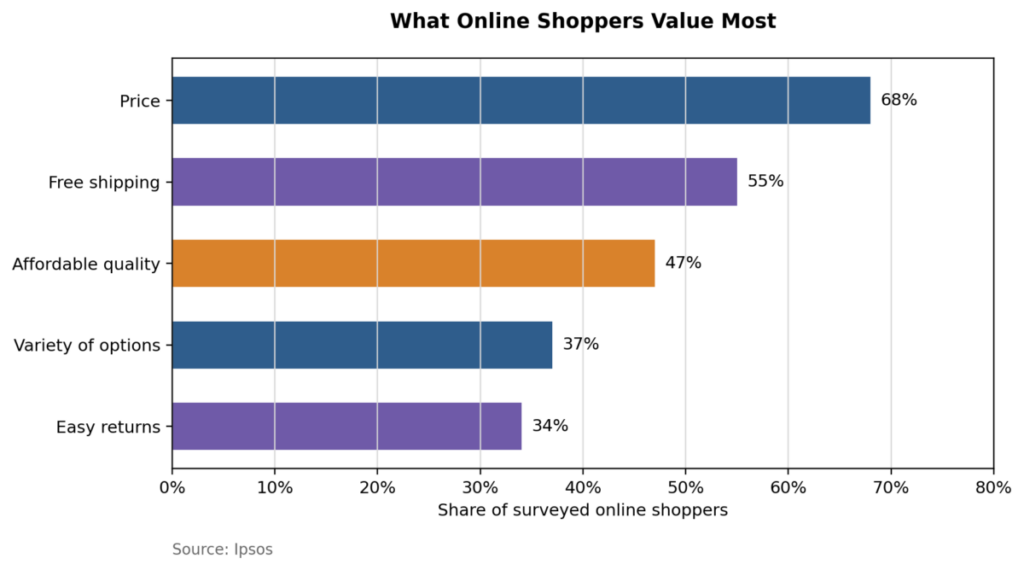
This does not make brand symbolism irrelevant. In categories where identity, status, design, or community are part of the product’s value, symbolic meaning can remain a strong source of demand. The change is that symbolic value now competes in a market where more functional evidence is immediately visible. Branding must therefore do more than create recognition; it must sustain a preference that remains defensible when the consumer can test the promise against competing evidence.
As substitutes become more visible, firms face greater pressure to justify price differences through demonstrable value. Brand power increasingly depends on whether preference survives scrutiny rather than whether the brand can avoid it.
Comparison Changes the Economics of Differentiation
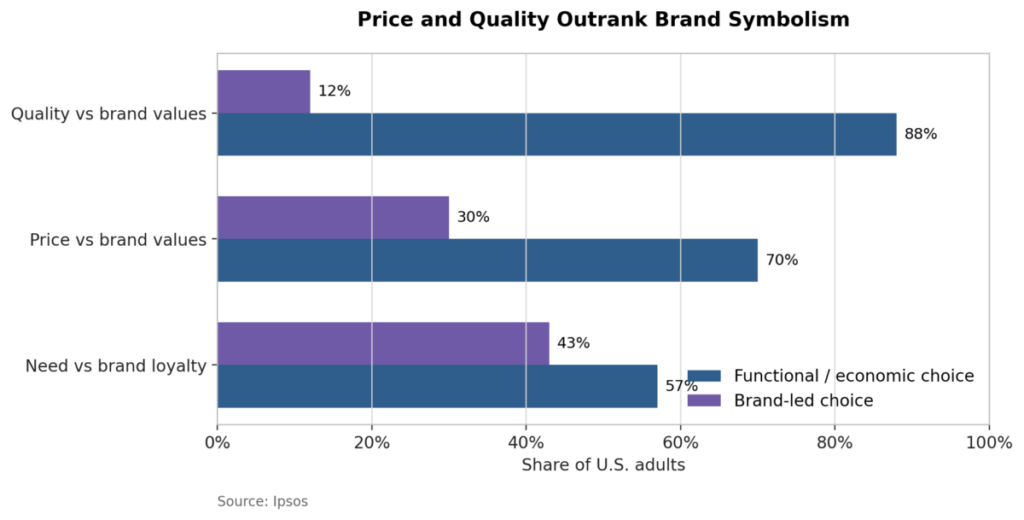
| Consumer Choice Measure | Share |
|---|---|
| Choose quality over what a brand stands for | 88% |
| Choose price over brand values | 70% |
| Say private labels satisfy needs as well as brands | 72% |
| Would choose another brand if preferred brand unavailable | 71% |
| Would switch brands for a better price | 65% |
Sources: Ipsos, EY
Advertising Moves Closer to the Purchase
Advertising has always operated at different distances from the transaction. Mass advertising competed for attention, search advertising moved closer to intent, and marketplace advertising now reaches consumers while they are actively comparing products. The economic shift is from buying exposure to buying access at the moment of consideration.
Amazon illustrates the value of that proximity. Advertising-services revenue rose from $46.9 billion in 2023 to $56.2 billion in 2024 and $68.6 billion in 2025. In two years, the business added more than $21 billion in annual advertising revenue, demonstrating the commercial value of controlling visibility near purchase.
Branding and advertising therefore perform increasingly distinct economic functions. Branding builds preference before the transaction. Marketplace advertising buys visibility after the consumer enters the decision environment. One raises the probability of being chosen; the other raises the probability of being considered.
The distinction changes spending logic. Heavy dependence on marketplace placement can leave firms repeatedly paying to reacquire consumers who hold little durable preference for their products. Strong brand preference without adequate visibility creates the opposite problem: the consumer may never encounter the product when the decision is being made. Retail media monetizes this tension by selling access to increasingly valuable decision space.
The strategic implication is not to shift every dollar toward marketplace media. It is to distinguish between spending that builds durable preference and spending that captures demand already close to purchase. Firms that confuse the two can mistake rented visibility for brand strength, or mistake brand awareness for guaranteed consideration.
Advertising Moves Closer to the Purchase
| Advertising Channel | 2025 Expected Spend Growth |
|---|---|
| Retail media | 15.6% |
| Connected TV | 13.8% |
| Social media | 11.9% |
| Overall advertising | 7.3% |
Sources: Interactive Advertising Bureau
Reviews Carry Competition Beyond E Commerce
Reviews have become part of the market’s trust infrastructure. Consumers rarely require perfect information before buying; they need enough confidence to stop searching. A familiar brand can provide that confidence, but credible customer evidence can make an unfamiliar alternative feel safe enough to consider.
The effect is substantial. In BrightLocal’s 2026 U.S. consumer survey, positive reviews made 85 percent of respondents more likely to use a business, while negative reviews deterred 77 percent. Nearly half, 49 percent, trusted online reviews as much as personal recommendations. Although the survey concerns local businesses, the behavioral mechanism is broader: independent experience can compete with signals controlled by the brand.
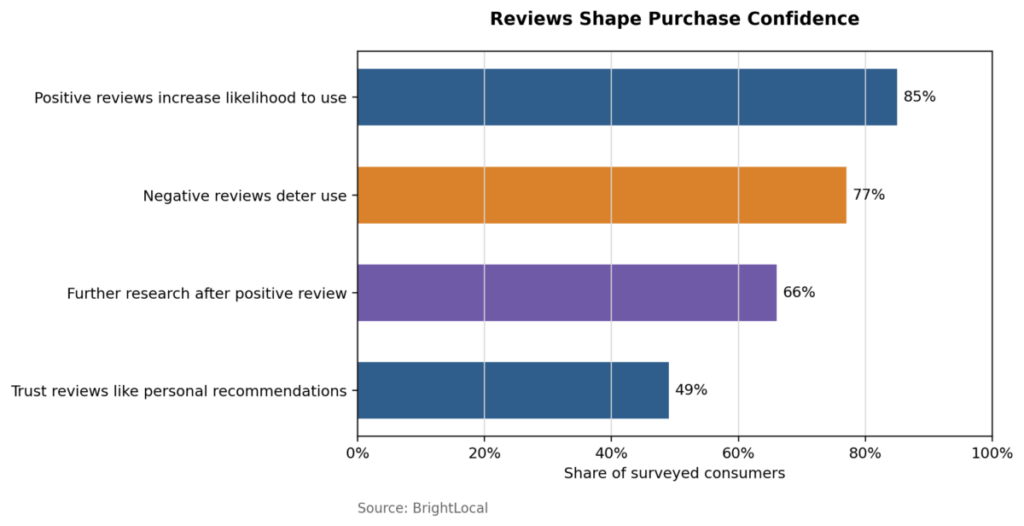
Reputation still lowers perceived risk, but it no longer monopolizes reassurance. Reviews and platform evidence allow consumers to test claims against the accumulated experience of other buyers. The Federal Trade Commission’s Consumer Reviews and Testimonials Rule, effective October 21, 2024, reflects the economic importance of those signals because fabricated trust can redirect demand just as misleading advertising can.
Consumer learning also travels across channels. Buyers develop expectations about price, quality, and alternatives online, then carry that knowledge into physical stores. Shelf position and symbolism offer less protection when shoppers arrive already informed and can continue comparing from a phone. Digital commerce therefore affects competition beyond purchases completed online because it changes what consumers know before they enter the market.
Reviews Carry Competition Beyond E Commerce
| Behavior After Reading Reviews | Share |
|---|---|
| Use reviews to guide purchase decisions | 97% |
| Have purchased after reading reviews | 93% |
| Conduct further research after positive reviews | 66% |
| Visit the business website after positive reviews | 54% |
| Ready to purchase or book after positive reviews | 34% |
Sources: BrightLocal
AI Extends the Comparison Layer
AI extends the same mechanism by lowering the effort required to screen alternatives. Shopping tools can summarize reviews, compare specifications, and narrow large product sets before a consumer examines individual listings.
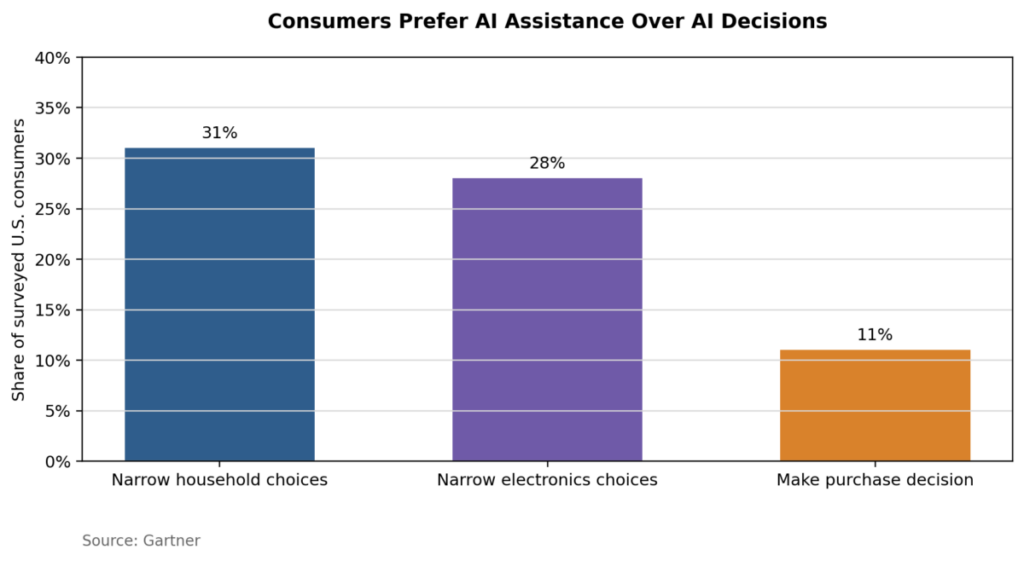
Consumer willingness still stops well short of surrendering the purchase decision. In a January 2026 Gartner survey of 322 U.S. consumers, 31 percent were willing to let AI narrow choices for household supplies and 28 percent for personal electronics. Only 11 percent were willing to let AI make the final purchase decision in lower-stakes categories.
The distinction captures AI shopping’s immediate economic significance. Consumers are outsourcing part of the cognitive cost of search, not surrendering preference. Products can therefore be filtered on observable characteristics before reputation or symbolism has an opportunity to influence choice. AI may not replace the consumer, but it can decide which alternatives the consumer seriously considers.
That raises the standard for differentiation again. Branding must create preference that remains meaningful after comparison. Advertising must secure access to consideration. Product performance must validate both.
E-commerce has not removed differentiation from the market. It has reduced the shelter around differentiation that cannot withstand scrutiny, and the same behavioral shift now reaches online marketplaces, physical retail, and AI-mediated shopping.
The marketplace can decide what gets seen. Comparison increasingly shapes what gets believed. Durable preference still has to be earned.
AI Extends the Comparison Layer
| AI Shopping Behavior | Share |
|---|---|
| Double-check all AI shopping information | 54% |
| Say AI shopping information wasted their time | 62% |
| Spend more time searching after AI summaries | 31% |
| Spend less time searching after AI summaries | 16% |
| Use AI summaries for product or service information | 17% |
| Use AI chatbots to search for products or services to buy | 16% |
Sources: Gartner
TL;DR Summary
- E-commerce changes competition by reducing the behavioral cost of comparing alternatives.
- U.S. e-commerce reached $340.2 billion in the second quarter of 2026 and accounted for 17.1 percent of retail sales.
- Branding increasingly must create preference that survives comparison rather than recognition alone.
- Easier comparison weakens some of the protection traditionally created by brand symbolism without eliminating symbolic value.
- Brand reputation remains valuable because it reduces uncertainty, although reviews and marketplace evidence increasingly challenge its exclusive role.
- Better-informed consumers can identify credible substitutes more easily, increasing competitive pressure on firms.
- Marketplace advertising increasingly purchases consideration near the transaction rather than broad awareness.
- Amazon advertising-services revenue rose from $46.9 billion in 2023 to $68.6 billion in 2025.
- Reviews have become part of the market’s trust infrastructure and can make unfamiliar alternatives more credible.
- Consumer knowledge developed online carries into physical retail and changes offline competition.
- AI currently has greater consumer acceptance as a screening tool than as an autonomous purchasing agent.
- Competitive advantage increasingly depends on differentiation that remains persuasive after comparison becomes easier.
Sources
- U.S. Census Bureau; Quarterly Retail E-Commerce Sales; – Link
- Deloitte; Connected Stores Are Reshaping Retail; – Link
- McKinsey & Company; US Consumers Send Mixed Signals in an Uncertain Economy; – Link
Comparison Changes the Economics of Differentiation
- American Economic Association; Sources of Limited Consideration and Market Power in E-Commerce; – Link
- Ipsos; When It Comes to Buying Products, Price Wins; – Link
- EY; Future Consumer Index: US Consumers Rethink Brand Loyalty as Macroeconomic Pressure Mounts; – Link
- Ipsos; Getting Value for Their Money Is Key for Online Shoppers; – Link
Advertising Moves Closer to the Purchase
- Amazon.com, Inc.; Annual Report for the Year Ended December 31 2025; – Link
- Interactive Advertising Bureau; 2025 Outlook: Ad Spend, Opportunities, and Strategies; – Link
Reviews Carry Competition Beyond E Commerce
- BrightLocal; Local Consumer Review Survey 2026; – Link
- Federal Trade Commission; The Consumer Reviews and Testimonials Rule: Questions and Answers; – Link
AI Extends the Comparison Layer
- Gartner; Consumers Want AI Shopping Help, But Not AI Purchase Decisions; – Link
- Gartner; Only One-Third of Consumers Say GenAI Rivals Search Engines; – Link
- Adobe; Generative AI-Powered Shopping Rises With Traffic to Retail Sites; – Link
- Adobe; Holiday Shopping Season Drove a Record $257.8 Billion Online With Consumers Embracing Generative AI Tools; – Link
Keywords: E-Commerce, Branding, Advertising, Consumer Behavior, Market Competition, Product Differentiation, Digital Comparison