
Medical AI changes healthcare economics when existing resources can accomplish more. Connected analytical services can support decisions across facilities, while automated examination of information can release professional time for other work. In a system short of specialists, the return may appear as additional care even when expenditure does not fall.
Because internet connectivity separates access to analytical services from the need to develop them locally, it changes the investment required to introduce medical AI. The model nevertheless remains one component of care. Its output must reach a practitioner, inform an appropriate decision, and lead to available investigation or treatment.
Early experience reveals where that transition succeeds and where it stalls. In England, a funded program covering 66 hospital trusts still had 23 awaiting clinical use by June 2025. Swedish screening released substantial reading capacity, while Kenyan primary care demonstrated that better documentation does not automatically establish improved treatment outcomes. Together, these experiences give later adopters a basis for understanding what they must finance and which benefits they can reasonably expect.
| Deployment milestone | England chest diagnostics |
|---|---|
| Planned clinical launch | December 2023 |
| First deployments at some sites | May 2024 |
| Trusts using tools clinically, November 2024 | 24 of 66 |
| Trusts using tools clinically, June 2025 | 43 of 66 |
Sources: Nuffield Trust, eClinicalMedicine
How Connectivity Extends Medical Capability
Medical AI examines information in several forms. Imaging algorithms identify suspicious features in scans; predictive models combine recorded observations to estimate risk. Language models interpret clinical text and prepare recommendations or documentation. Each function becomes economically useful through its connection to a clinical decision.
An application programming interface allows a medical record to send selected information to an analytical service and receive a response within existing software. Processing can occur remotely while the practitioner continues using the familiar record. Local deployment offers another arrangement, with connectivity supporting information exchange between services.
At Penda Health in Kenya, clinical assistance was integrated into a cloud-hosted record used across 16 facilities. When recommendations arrived after clinicians had explained the next steps, incorporating them meant reconsidering a decision already communicated to the patient. Moving the request for analysis earlier brought feedback closer to the point of choice.
Simultaneous requests created further delays during actual use. Software revisions subsequently brought average responses below three seconds, according to the implementation team. The lesson for new providers concerns the complete product: the effort and time required to obtain an answer are part of its usefulness.
Advice has to arrive while the decision is still open.
Regional imaging demonstrates another form of reach. By April 2025, approximately 1,200 chest CT scans were being processed weekly across four NHS trusts in southwest England. Radiologists received information about lung-nodule size and growth within existing examinations. Connected delivery distributed analysis across institutions; clinical interpretation determined the response.
| Operating measure | Penda deployment |
|---|---|
| Patient visits in evaluation | 39,849 |
| Participating clinicians | 106 |
| Participating clinics | 15 |
| Daily model calls available for monitoring | More than 8,000 |
| Average response after software revision | Under 3 seconds |
Sources: Penda Health, OpenAI
The Economic Return Extends Beyond Savings
Accessing an established model removes the need for each facility to finance its development independently. Reusable connections can also reduce engineering for subsequent applications. These advantages change the cost of obtaining analysis, although local evaluation and continuing support remain necessary.
England’s chest-diagnostics deployments exposed the expense of fragmented infrastructure. Different hospital imaging systems often required separate integration within the same network. A network with standardized infrastructure avoided that duplication, demonstrating how an earlier information-system decision can affect the expense of adopting later technologies.
In Kenyan primary care, estimated model use averaged US$0.04 per patient from token consumption. That amount excluded development, integration, training, and monitoring. It priced the analysis rather than the service required to apply it.
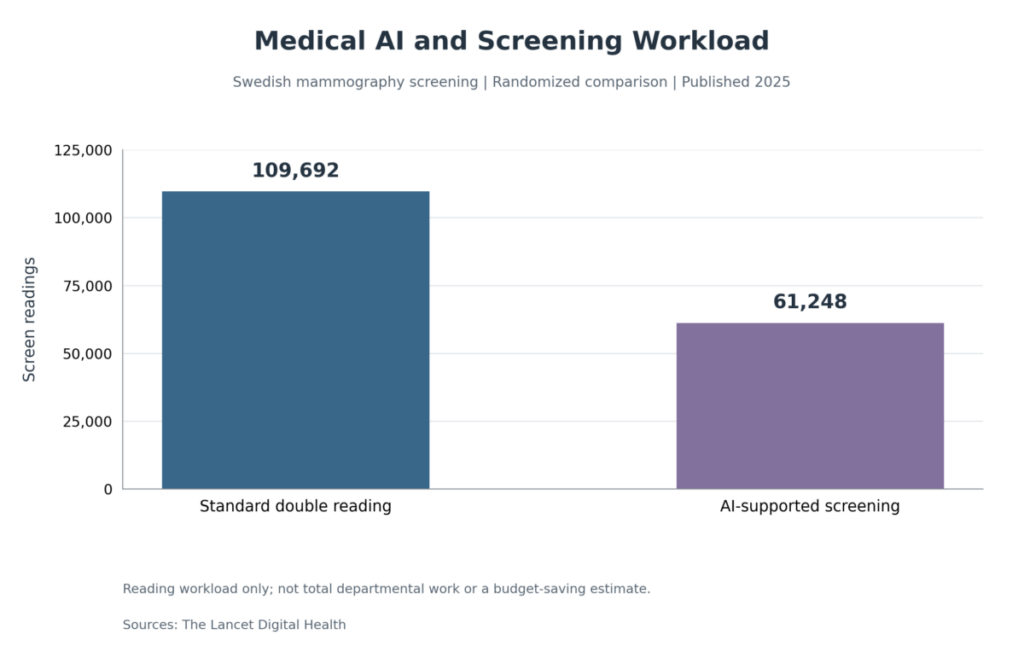
Swedish AI-supported mammography reduced screen readings by 44.2 percent in results published in 2025. Where radiologists are scarce, fewer routine readings can create time for further investigation. The investment can therefore increase useful output while staffing expenditure remains unchanged.
Released capacity is an economic return even when payroll does not fall.
Across 21 economic evaluations, value varied with examination volume, clinical performance, and pricing. Although higher throughput can spread fixed integration costs, usage charges and additional follow-up can increase expenditure as activity grows. A credible business case identifies whether the intended return is lower spending, greater capacity, or better care, then measures that result instead of treating the three as interchangeable.
| MASAI trial measure | Standard screening | AI-supported screening |
|---|---|---|
| Participants analyzed | 52,872 | 53,043 |
| Screen readings performed | 109,692 | 61,248 |
Swedish randomized trial; results published in 2025. Reading counts measure activity, not payroll savings.
Sources: The Lancet Digital Health, Lund University
Who Funds Integration and Who Receives the Return
Existing services continue while staff select tools, connect systems, and evaluate local performance. England’s funded chest-diagnostics program had tools in clinical use at 43 of 66 participating trusts by June 2025. Purchasing access had not completed the work needed to deliver care.
For developing health systems, the transferable lesson begins with those resource dependencies. Software may require information systems and staff capacity that themselves need investment, while competing demands for medicines, diagnostics, and treatment remain. Sequencing follows the constraint being addressed: analytical capability produces little return where the receiving service cannot act.
Payment becomes consequential when the organization financing integration receives only part of the benefit, because a gain for patients or another service may not replenish its operating budget. This helps explain why demonstrated usefulness alone does not ensure sustained adoption. Funding arrangements need to recognize where the costs and returns actually fall.
Clinical variation creates another continuing demand. Across 227,091 encounters in four US health systems, an updated sepsis prediction model achieved predictive discrimination ranging from 0.82 to 0.92. Better prediction coexisted with low positive predictive value and substantial alert burden. Staff still had to determine which warnings deserved attention.
Purchasing terms can assign responsibility for support and updates, while regulatory arrangements can accommodate planned changes with appropriate validation. Their economic function is practical: keeping the service useful as the software and clinical environment change, with the work required to do so financed rather than assumed.
| Health system | Threshold score | Positive predictive value |
|---|---|---|
| Michigan | 14 | 13% |
| Oregon Health & Science University | 29 | 26% |
| Emory | 37 | 25% |
| MetroHealth | 35 | 20% |
Epic Sepsis Model version 2; encounter-level results at site-specific thresholds yielding 60% sensitivity. Positive predictive value is the proportion of positive classifications meeting the study’s sepsis definition.
Sources: JAMA Network Open
When Better Information Improves Human Prosperity
Released specialist time reaches patients when another part of the service can use it. At one Swedish screening service, radiologists could devote more time to advanced investigations after AI reduced routine reading. The gain reached patients through another part of the diagnostic pathway. What mattered was how the service used the released time.
Separate randomized evidence strengthens the clinical case. Swedish screening sensitivity reached 80.5 percent with AI support versus 73.8 percent with standard double reading in follow-up published in 2026. Specificity was 98.5 percent in both groups, meaning more cancers were detected without reducing the proportion of correct negative results.
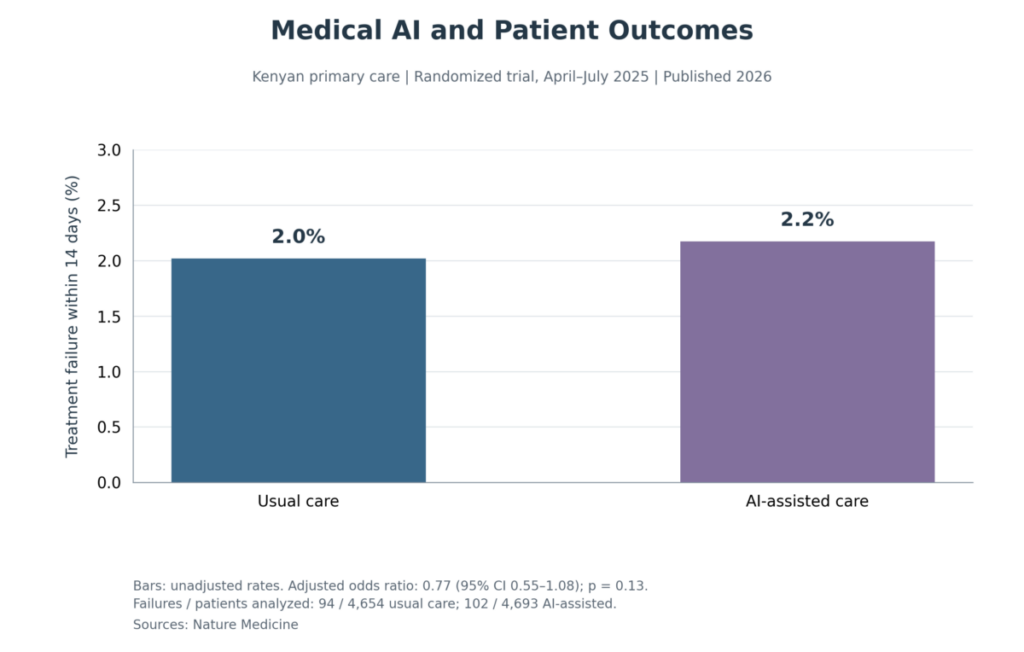
Kenyan randomized evaluation involving 9,691 patients and 103 clinical officers found better documentation but no statistically significant difference in treatment failure within 14 days. This distinguishes an improvement in recorded care from the patient outcome being sought.
Better documentation did not establish better short-term treatment outcomes.
A useful recommendation cannot supply an unavailable medicine, diagnostic test, or referral appointment. Following the benefit through these stages helps new providers and developing systems identify the contribution they can substantiate and the services on which it depends.
When effective care reduces repeated appointments or treatment delays, households may lose less working time and require less assistance from relatives, although the selected implementations do not quantify those savings. Effective access and financial protection connect this pathway to Sustainable Development Goal 3. Goal 8 becomes relevant where better health preserves productive time. Human prosperity depends on clinical gains carrying through to daily life.
| MASAI trial finding | Standard screening | AI-supported screening |
|---|---|---|
| Cancers detected per 1,000 participants | 5.0 | 6.4 |
| Invasive cancers detected | 217 | 270 |
| In situ cancers detected | 45 | 68 |
Swedish randomized trial; results published in 2025. Detection findings do not establish a mortality benefit.
Sources: The Lancet Digital Health, Lund University
“`
What Today’s Choices Mean for the Next Five Years
The cost of the next deployment will partly reflect what earlier investment leaves behind. When working interfaces and experienced teams can support another application, expansion requires less repeated engineering; where separate systems accumulate, each addition can bring another set of integration and support obligations.
Funding horizons already expose the distinction between introduction and sustained operation. The southwest England chest CT service received two years of support, after which continued use requires another financing decision. Temporary funding can establish a service without establishing how its recurring costs will be met.
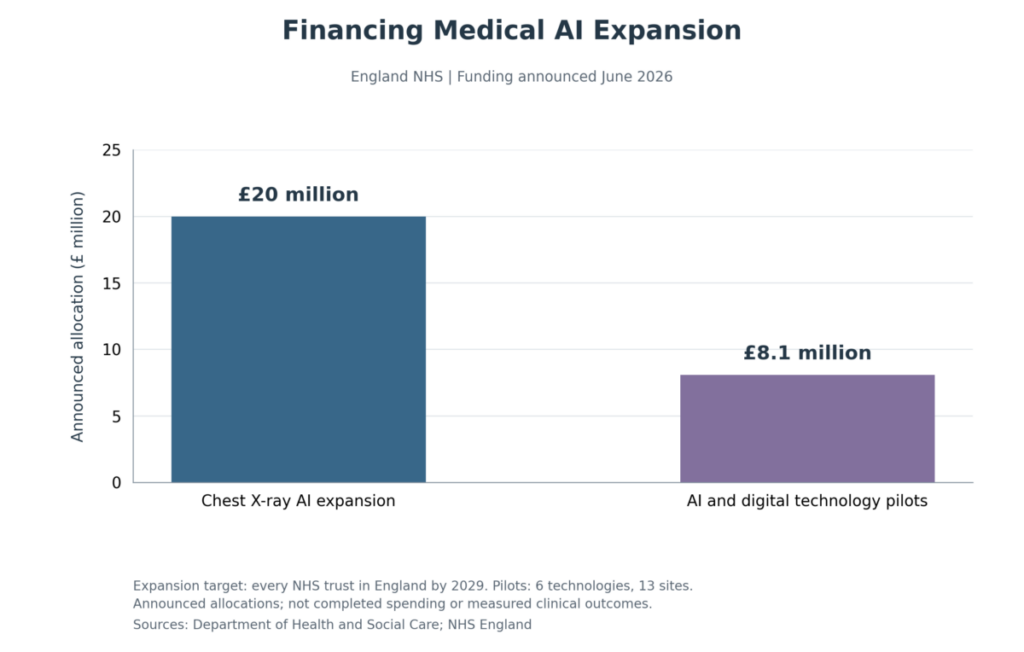
In June 2026, the English government announced £20 million for chest X-ray AI expansion, targeting rollout to every NHS trust in England by 2029. Set against the earlier deployment gap, that commitment illustrates the next challenge: turning wider funding into operational services rather than counting procurement as completed adoption.
New companies can learn from the burden their products place on customers. Developing health systems can use the same experience to identify investments that support several applications, while retaining local evaluation of each clinical use.
Over five years, adoption can build on work already financed. Reusable infrastructure lowers repeated effort, and an effective clinical response gives the analysis its return. The consequential question is whether the next investment extends dependable care at a sustainable continuing cost, with the institutions paying for it able to maintain the service.
| Funding stream | Announced allocation | Planned reach |
|---|---|---|
| Chest X-ray AI expansion | £20 million | Every NHS trust in England by 2029 |
| AI and digital technology pilots | £8.1 million | 6 technologies across 13 NHS sites |
Announced in June 2026. Allocations and rollout targets are not completed expenditure or verified clinical outcomes.
Sources: Department of Health and Social Care, NHS England
TL;DR
- Connectivity allows facilities to access analytical services without developing models locally.
- Recommendations must arrive before clinical decisions are settled.
- Shared infrastructure can reduce repeated integration work.
- Token costs represent only one component of a functioning clinical service.
- Released professional capacity can create value without reducing payroll.
- Examination volume and payment terms influence economic returns.
- Funded procurement does not establish operational adoption.
- Organizations financing integration may receive only part of its benefit.
- Model performance and alert burden require local evaluation.
- Better documentation does not establish better patient outcomes.
- Human prosperity depends on clinical gains reaching everyday life.
- Sustainable expansion requires financing maintenance alongside installation.
Sources
What Early Medical AI Expansion Reveals
- Nuffield Trust / eClinicalMedicine; Procurement and Early Deployment of Artificial Intelligence Tools for Chest Diagnostics in NHS Services in England: A Rapid, Mixed Method Evaluation; – Link
How Connectivity Extends Medical Capability
- Penda Health / OpenAI; AI-Based Clinical Decision Support for Primary Care: A Real-World Study (Preprint); – Link
- Peninsula Diagnostic Network; New AI Tool Is Helping in the Treatment of Lung Cancer; – Link
The Economic Return Extends Beyond Savings
- Radiology: Artificial Intelligence; Economic Value of AI in Radiology: A Systematic Review; – Link
- The Lancet Digital Health / Lund University; Screening Performance and Characteristics of Breast Cancer Detected in the Mammography Screening With Artificial Intelligence Trial (MASAI): A Randomised, Controlled, Parallel-Group, Non-Inferiority, Single-Blinded, Screening Accuracy Study; – Link
Who Funds Integration and Who Receives the Return
- JAMA Network Open; Multicenter Prospective Validation of an Updated Proprietary Sepsis Prediction Model; – Link
- US Food and Drug Administration; Marketing Submission Recommendations for a Predetermined Change Control Plan for Artificial Intelligence-Enabled Device Software Functions; – Link
When Better Information Improves Human Prosperity
- The Lancet / Lund University; Interval Cancer, Sensitivity, and Specificity Comparing AI-Supported Mammography Screening With Standard Double Reading Without AI in the MASAI Study: A Randomised, Controlled, Non-Inferiority, Single-Blinded, Population-Based, Screening-Accuracy Trial; – Link
- Nature Medicine / University of Birmingham; Generative AI-Enabled Clinical Decision Support System in Primary Care: A Pragmatic, Cluster-Randomized Trial; – Link
- Karolinska Institutet; The AI Frenzy in Healthcare; – Link
- United Nations; The 17 Goals; – Link
What Today’s Choices Mean for the Next Five Years
-
- Department of Health and Social Care / NHS England; AI to Speed Up Cancer Diagnosis for Millions of NHS Patients; – Link