

In your grandmother’s classroom, education revolved around textbooks, lectures, library visits, handwritten notes, and assignments physically handed to the teacher. Questions were answered during class or at the next scheduled meeting. Feedback could take days, and the teacher largely controlled the pace and sequence of instruction.
Today’s connected platforms distribute lessons, organize work, shape attention, and automate guidance. Global internet use rose from about 16 percent in 2005 to 66 percent in 2022, while participation in massive open online courses grew from almost nothing in 2012 to at least 220 million learners by 2021. The classroom is no longer the only place where formal or informal learning occurs.
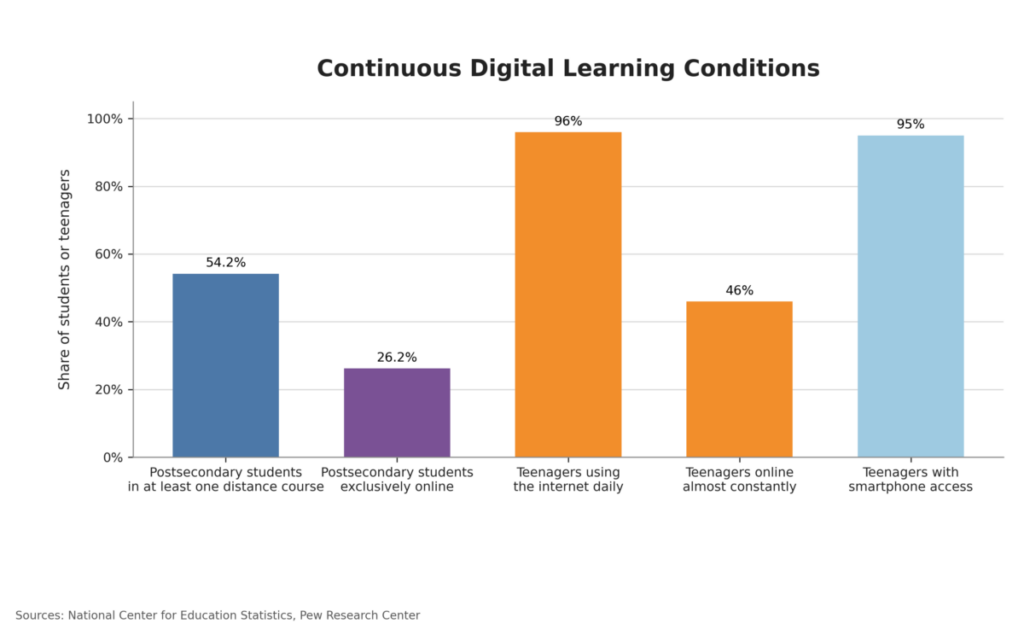
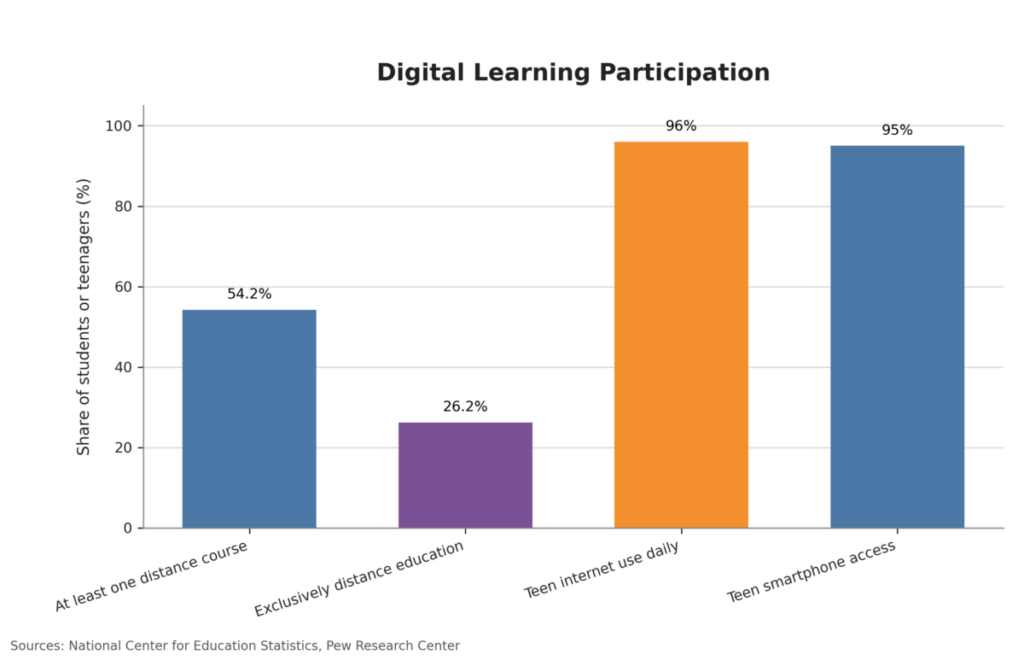
Digital education has also become ordinary institutional infrastructure. In fall 2023, 54.2 percent of students at U.S. degree-granting institutions took at least one distance-education course, while 26.2 percent studied exclusively online. Among American teenagers in 2024, 96 percent used the internet daily and 46 percent said they were online almost constantly. Smartphone access reached 95 percent.
| Learning Function | Earlier Model | Digital Model | Learner Responsibility |
|---|---|---|---|
| Access | Scheduled and local | Continuous and distributed | Set boundaries |
| Authority | Teacher-centered | Distributed across people and systems | Judge credibility |
| Feedback | Delayed | Immediate or automated | Interpret before acting |
| Memory | Primarily internal | Shared with external systems | Retain foundations |
| Sequence | Instructor-directed | Platform-guided | Choose when to diverge |
Sources: UNESCO, National Center for Education Statistics, Pew Research Center
━━━━━━━━━━━━━━━━━━━━━━━━━━━━━━━━━━━━━━━━
Continuous Access and the Competition for Attention
Once learning extends across devices and locations, education no longer belongs to a fixed classroom period. Assignments and feedback can move with the student, while collaboration continues beyond scheduled class time. This flexibility can help a student who misses class, a working adult studying at night, or a learner using adaptive tools. Technology can also expand participation when it is integrated with teaching. One televised secondary-education program, supported by classroom instruction and teacher preparation, increased enrollment by 21 percent.
Continuous access also weakens the boundaries around education. A student may receive an assignment notification during dinner, a group message at midnight, and feedback before breakfast. The same device used for coursework also delivers entertainment, games, and social interaction. In 2024, one-third of U.S. teenagers used at least one major social platform almost constantly, creating a persistent source of competition for academic attention.
| Digital Condition | Attention Pattern | Observed Educational Signal |
|---|---|---|
| Structured educational use | Task-focused | Benefits depend on activity and design |
| Mixed-use device access | Frequent switching | Higher distraction risk |
| Problematic smartphone use | Compulsive checking | Modest negative academic association |
| Phone-separated instruction | Reduced interruption | Stronger comprehension and mindfulness |
| Continuous notifications | Reactive attention | Learning competes with immediate rewards |
Sources: OECD, PubMed, Pew Research Center
━━━━━━━━━━━━━━━━━━━━━━━━━━━━━━━━━━━━━━━━
Information, Memory, and Automated Choice
Once attention becomes scarce, the next question is which explanation receives it. Learners now encounter competing information from search engines, videos, digital libraries, social platforms, and AI. Up to 95 percent of adolescents use social media, nearly two-thirds use it daily, and about one-third report almost constant use. Education therefore operates beside a dense system of peer influence and automated selection.
For the learner, the challenge has shifted from finding information to deciding what deserves trust. Search rankings and follower counts can make one explanation appear authoritative even when stronger evidence belongs to a less visible source. Social proof allows popularity and familiarity to become shortcuts for credibility, reducing the effort of independent evaluation.
Recommendation systems extend that influence by deciding what appears next. They reduce information overload by selecting material according to relevance and prior behavior. In education, these systems can personalize resources, but most research has focused on prediction and engagement rather than long-term effects on intellectual independence or exposure to competing views.
The same environment also changes what people remember. Four experiments found that expected future access reduced recall of information itself while improving memory for where it could be found. Digital tools therefore expand cognitive offloading beyond simple storage into retrieval and organization.
The problem is not that external memory exists. The problem is treating internal knowledge as unnecessary.
External tools allow people to manage more information than unaided memory can hold, but internal knowledge still supports judgment. Learners need enough subject understanding to detect contradictions, evaluate explanations, and recognize implausible answers. When systems also schedule reviews or determine what comes next, they begin to perform parts of self-regulation. Their educational value depends on whether that guidance develops independence or becomes permanently necessary.
| Stage | System Function | Potential Gain | Capability to Preserve |
|---|---|---|---|
| Discovery | Ranks results | Faster access | Independent search |
| Selection | Prioritizes visibility | Lower choice burden | Source evaluation |
| Retention | Stores retrievable information | Reduced memory load | Foundational knowledge |
| Sequencing | Recommends the next step | Sustained momentum | Planning and priority-setting |
| Verification | Supplies synthesized answers | Rapid orientation | Contradiction detection |
Sources: PubMed, OECD, Pew Research Center
━━━━━━━━━━━━━━━━━━━━━━━━━━━━━━━━━━━━━━━━
Social Reinforcement, Media, and Artificial Intelligence
| Stage | System Function | Potential Gain | Capability to Preserve |
|---|---|---|---|
| Discovery | Ranks results | Faster access | Independent search |
| Selection | Prioritizes visibility | Lower choice burden | Source evaluation |
| Retention | Stores retrievable information | Reduced memory load | Foundational knowledge |
| Sequencing | Recommends the next step | Sustained momentum | Planning and priority-setting |
| Verification | Supplies synthesized answers | Rapid orientation | Contradiction detection |
Sources: PubMed, OECD, Pew Research Center
━━━━━━━━━━━━━━━━━━━━━━━━━━━━━━━━━━━━━━━━
Assessment Across the Learning Lifecycle
When AI can perform much of the process behind an assignment, the finished product becomes a weaker measure of competence. Search tools can locate sources, software can correct language, and AI can generate explanations or drafts. A polished result may therefore reveal little about what the learner can do independently.
Assessment increasingly needs to expose reasoning. That can include oral defense, source selection, unfamiliar application, or verification against original evidence. In one randomized summer-school experiment, frequent teacher-family messages increased the odds of homework completion by 40 percent and class participation by 15 percent, while reducing the need for redirection by 25 percent. A separate trial across 132 schools found that use declined after implementation support ended, showing how quickly an effective intervention can weaken when institutional capacity disappears.
Separating assisted from unassisted performance offers one practical response. A student may use AI to develop an argument and then defend it without assistance, or consult a summary before checking its claims against original sources. The abilities that should remain independent will vary by developmental stage and the purpose of learning.
For young children, technology enters while attention, language, persistence, and tolerance for frustration are still developing. A 2024 analysis of 100 studies involving 176,742 children under age six found that outcomes depended heavily on context. Adult-child co-use was associated with stronger cognitive outcomes, while background television and poorly matched content were associated with weaker ones. Technology should support learning without replacing conversation, play, storytelling, or exploration.
For adolescents, academic work competes with peer approval and constant novelty. A study of 48,490 participants found a modest academic penalty from problematic smartphone use, while a much larger analysis found no overall penalty from total screen time alone. The distinction makes attention management, source evaluation, and self-regulation part of ordinary academic instruction.
Higher education faces a different problem: protecting disciplinary judgment at scale. More than half of U.S. postsecondary students took at least one online course in fall 2023. Adults face a related challenge. In 2021, only 54 percent of adults in the European Union had at least basic digital skills, and participation in further learning remained lower among people with fewer skills or less education. Access can expand opportunity, but prior knowledge and institutional support still determine who can turn that access into usable capability.
| Form of Assistance | Effort Reduced | Learning Signal | Design Safeguard |
|---|---|---|---|
| Social rankings and streaks | Motivation and persistence | Activity may exceed mastery | Reward explanation and revision |
| Compressed explanations | Initial comprehension | Familiarity may exceed transfer | Require unaided application |
| Standard generative AI | Problem setup and completion | Higher assisted performance | Test later without assistance |
| Guarded AI tutoring | Search and feedback delay | Lower risk of skill substitution | Use staged hints |
| Raw AI-generated hints | Teacher authoring time | 32% failed quality checks | Review before delivery |
Sources: OECD, Pew Research Center, Digital Education Outlook research
━━━━━━━━━━━━━━━━━━━━━━━━━━━━━━━━━━━━━━━━
Designing Education for the Learner Who Exists
The economic consequences are substantial. An analysis of roughly 7,000 education tools costing about $13 billion found that 85 percent were poorly matched to their setting or implemented incorrectly. Educational value emerges through the relationship among curriculum, teacher preparation, institutional support, and the behavior a tool encourages.
The causal structure remains direct:
Technology ecosystem → behavioral adaptation → educational consequence → teaching response
Assistance should build independence, evidence should remain visible, and assessment should preserve productive effort. Digital and AI literacy must extend beyond technical operation so learners understand how systems rank information, establish defaults, collect data, and direct behavior.
Matching tools to developmental purpose requires recognizing the economic value of durable knowledge, independent judgment, and institutional capacity.
The central challenge is no longer how to place technology in the classroom. It is how to teach human beings whose habits of attention, memory, trust, and inquiry have already been reorganized by it.
| Learning Context | Capability to Protect | Appropriate Assistance | Evidence of Learning |
|---|---|---|---|
| Young children | Language, attention, persistence | Adult-guided co-use | Conversation, recall, exploration |
| Adolescents | Self-regulation and source judgment | Structured prompts and feedback | Sustained unaided reasoning |
| Higher education | Disciplinary judgment | Research and analytical tools | Oral defense and source trails |
| Adult learning | Calibrated trust | Flexible, searchable guidance | Application in a real task |
Sources: PubMed, National Center for Education Statistics, OECD
TL;DR Summary
- Education now operates through a continuous digital environment rather than a classroom bounded by time and place.
- Global connectivity and online enrollment have made digitally mediated learning ordinary.
- Access and flexibility have expanded, but learning competes with systems designed to capture attention.
- Classroom distraction is measurable, although total screen time alone does not predict academic performance.
- Information abundance has shifted teaching from delivery toward evaluation, selection, and credibility.
- Social proof and recommendation systems influence which explanations learners encounter and trust.
- External memory expands capability but cannot replace the knowledge required for judgment.
- AI can improve immediate performance while reducing practice in the processes that produce durable learning.
- Assessment must separate polished output from independently demonstrated reasoning.
- Technology affects children, adolescents, university students, and adults differently.
- Digital access does not eliminate inequalities in prior knowledge, skills, time, or institutional support.
- Educational value depends on pedagogy, evidence, implementation quality, and productive effort.
Sources
- UNESCO; Global Education Monitoring Report 2023 Technology in Education; – Link
- National Center for Education Statistics; Distance Education Participation in Degree Granting Postsecondary Institutions; – Link
- Pew Research Center; Teens Social Media and Technology 2024; – Link
Continuous Access and the Competition for Attention
- OECD; PISA 2022 Results Volume II Life at School and Support from Home; – Link
- OECD; Managing Screen Time How to Protect and Equip Students Against Distraction; – Link
- JAMA Pediatrics; Association Between Screen Media Use and Academic Performance Among Children and Adolescents; – Link
- International Journal of Educational Research; Problematic Smartphone Use and Academic Achievement; – Link
Information, Memory, and Automated Choice
- Science; Google Effects on Memory Cognitive Consequences of Having Information at Our Fingertips; – Link
- International Journal of Educational Technology in Higher Education; Recommender Systems to Support Learners’ Agency in a Learning Context; – Link
- Education and Information Technologies; A Systematic Literature Review on Educational Recommender Systems; – Link
- Computers in Human Behavior Reports; Learning Outcomes Assessment and Evaluation in Educational Recommender Systems; – Link
Social Reinforcement, Media, and Artificial Intelligence
- OECD; Digital Education Outlook 2026 Exploring Effective Uses of Generative AI in Education; – Link
- Proceedings of the National Academy of Sciences; Generative AI Without Guardrails Can Harm Learning; – Link
- International Journal of Artificial Intelligence in Education; ChatGPT Generated Help Produces Learning Gains Equivalent to Human Tutor Authored Help on Mathematics Skills; – Link
- OECD; Teaching for Today’s World Results from TALIS 2024; – Link
Assessment Across the Learning Lifecycle
- JAMA Pediatrics; Early Childhood Screen Use Contexts and Cognitive and Psychosocial Outcomes; – Link
- Educational Evaluation and Policy Analysis; The Effect of Teacher Family Communication on Student Engagement; – Link
- Eurostat; Our Progress Towards the European Union Digital Decade Targets; – Link
- European Commission Joint Research Centre; A Closer Look at the Digital Skills Index; – Link
Designing Education for the Learner Who Exists
- UNESCO; Four Questions to Ask Before Choosing Technology in Education; – Link
- UNESCO; Global Education Monitoring Report 2023 Summary; – Link
- OECD; Monitoring and Evaluation of Digital Education; – Link
- OECD; Shaping Digital Education Enabling Factors for Quality Equity and Efficiency; – Link