
Robotics and the Productivity Expectations Gap
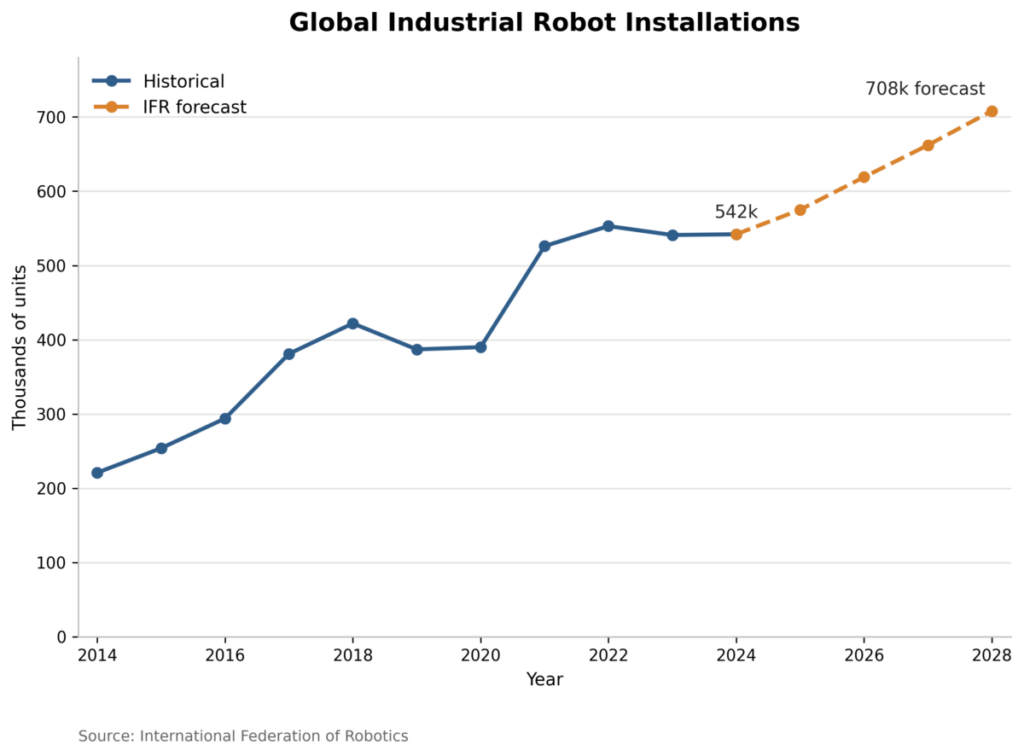
Industrial robotics has moved well beyond experimental deployment. Factories installed 542,000 industrial robots worldwide in 2024, more than twice the annual volume a decade earlier, bringing the operating stock to 4.664 million machines. Asia accounted for 74 percent of new installations, while China alone represented 54 percent with 295,000 units. Robotics is already operating at industrial scale.
Against that expansion, the productivity record is considerably less dramatic. U.S. manufacturing labor productivity grew at an annualized rate of only 0.5 percent from the fourth quarter of 2019 through the second quarter of 2026, while revised second-quarter productivity was 1.1 percent higher than a year earlier. Those figures do not establish that robotics caused weak productivity growth. They expose the central contradiction: deployment has accelerated far more visibly than broad manufacturing productivity.
Robotics was expected to improve an increasingly difficult labor equation by covering repetitive work, easing hiring pressure, removing bottlenecks, and raising output per worker. Individual installations show that these mechanisms are real. Reproducing those economics across firms with different production systems, capital constraints, technical capabilities, and management quality has proved much harder.
The expectations gap is therefore not whether robots work, but whether their benefits can spread widely enough to produce the labor and productivity effects associated with large-scale automation.
| Measure | Value |
|---|---|
| Europe share of 2024 installations | 16% |
| Americas share of 2024 installations | 9% |
| Growth in global operating stock during 2024 | 9% |
| Years above 500,000 annual installations | 4 consecutive years |
| IFR forecast for 2028 installations | 708,000 |
Sources: International Federation of Robotics
Labor Shortages Can Trigger Automation Without Being Solved by It
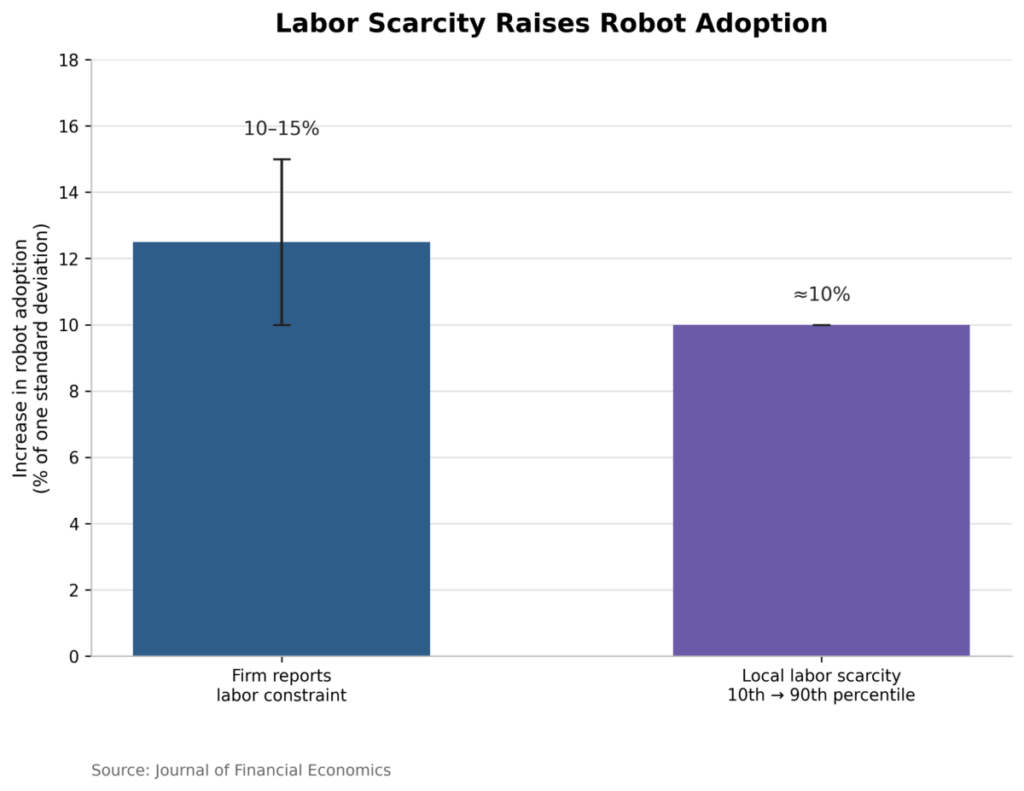
When labor becomes scarce, automation can shift from a cost-saving option to a capacity decision. About 40 percent of German firms reported difficulty finding qualified workers in 2014. A shift from no reported labor constraint to one was associated with technology adoption rising by roughly 10 to 15 percent of a standard deviation, while moving local labor scarcity from the 10th to the 90th percentile produced an increase of about 10 percent of a standard deviation.
That response remains concentrated. Robot investment represented less than 0.3 percent of aggregate equipment expenditure. Annual robot investment was equivalent to about $11 per worker, compared with roughly $1,722 for software and data and $848 for information and communications equipment. Labor pressure may be widespread while the capital response remains narrow.
Honey Baked Ham’s Holland, Ohio, facility shows what successful deployment looks like at operating scale. A robotic palletizing system took over work previously performed by three employees across two shifts after labor shortages disrupted production. Those employees moved to harder-to-automate jobs. The project involved $220,000 in investment, produced $200,000 in reported savings, created or retained two jobs, and returned its investment in eight months.
Strong returns in that case depended o
n more than the robot itself. The production process suited automation, the capital case worked, and the organization could integrate the system into daily operations. Replicating the result elsewhere requires the same alignment.
Robotics can relieve labor scarcity where those conditions exist. That is different from robotics functioning as a scalable solution to labor scarcity itself.
| Level | Observed Employment Response |
|---|---|
| Robot-adopting firms | Employment increased after investment |
| Exposed industries and regions | Negative but modest effect |
| Estimated German employment-growth effect | About −0.03% per year |
| Observed adoption motive | Difficulty finding workers |
Sources: Journal of Financial Economics
The Productivity Gains Exist but They Are Concentrated
At the firm level, robotics looks considerably more productive than aggregate statistics suggest. Among 55,390 French manufacturing firms studied between 2010 and 2015, only 598 adopted robots. Those companies represented little more than 1 percent of the sample but accounted for roughly 20 percent of manufacturing employment.
Adopters increased productivity and value added while expanding employment overall, even as labor’s share of production declined. Some gains also reflected competitive reallocation as more productive firms captured business from rivals. Strong company performance therefore does not convert automatically into an equivalent economy-wide productivity gain.
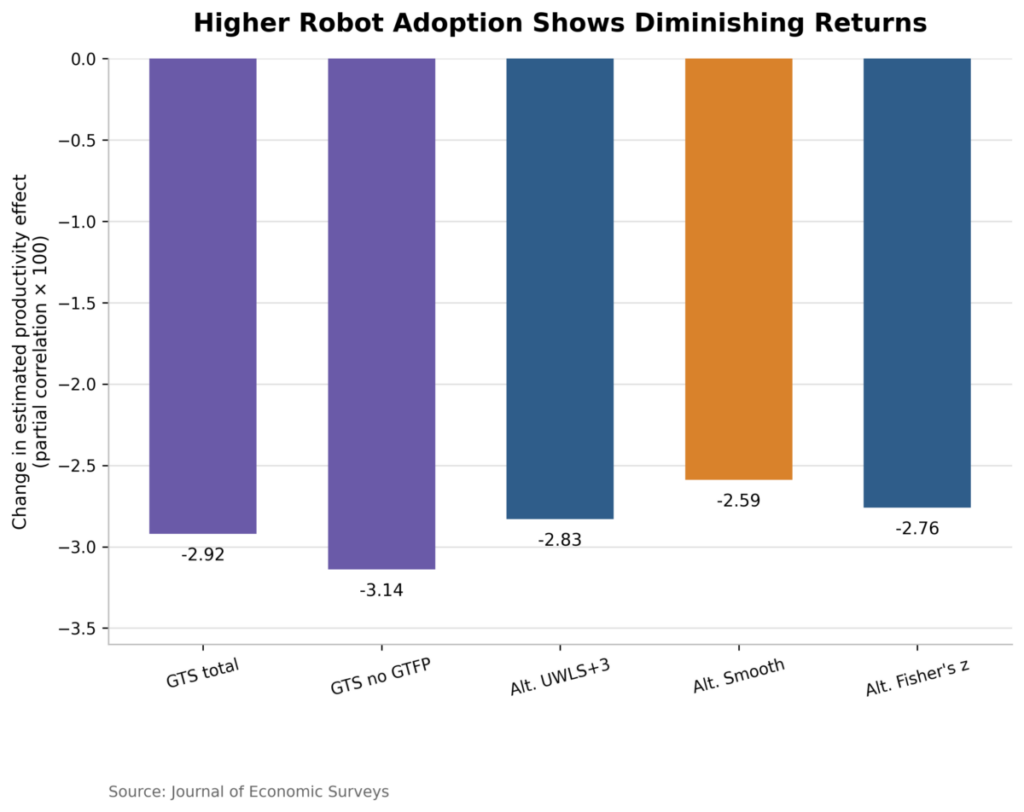
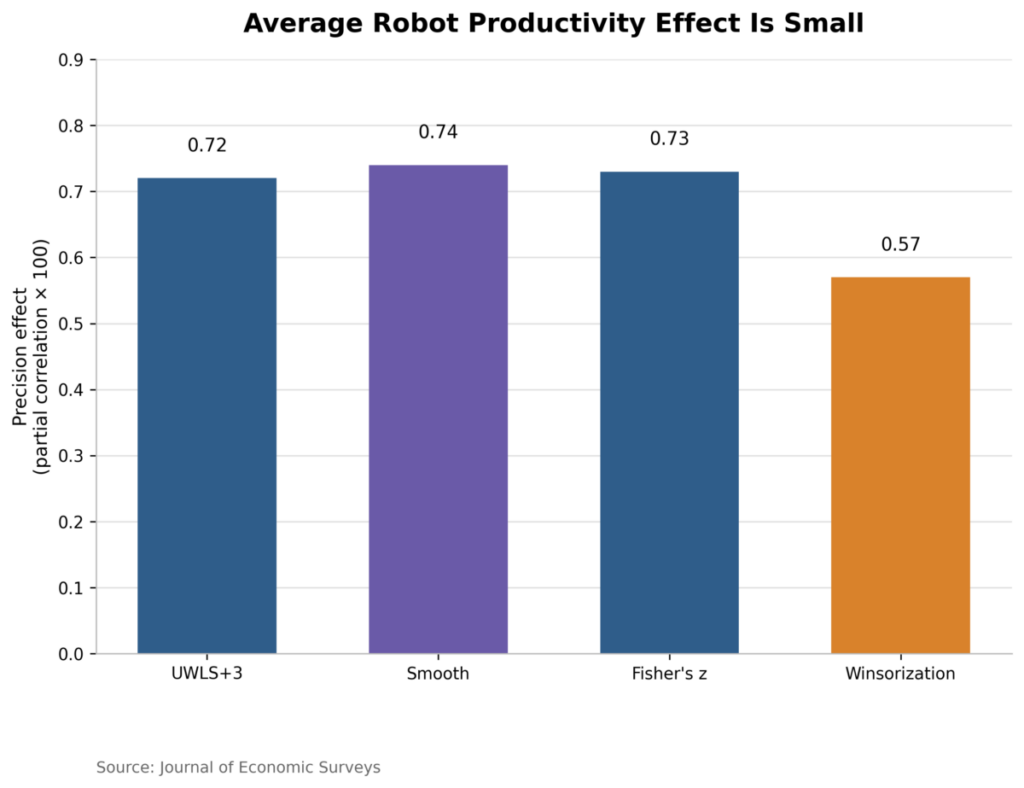
The broader evidence points in the same direction. A 2026 meta-study covering 1,847 estimates from 85 studies found only a small average productivity effect after accounting for differences across the literature and evidence of publication bias. Returns also appeared to diminish as adoption increased.
Part of the explanation is economic selection. Early automation tends to capture the clearest opportunities, particularly predictable tasks with high utilization and costly or scarce labor. Wider diffusion pushes robotics toward more variable work and firms where the business case is harder to establish.
The productivity promise was not false. The weaker assumption was that successful firm-level gains would scale proportionally with robot installations.
| Measure | Robot Adopters | Broader Market |
|---|---|---|
| Manufacturing value added represented | 20% | Concentrated among adopters |
| Productivity | Increased | Not equivalent to adopter gains |
| Firm employment | Increased | Industry effect negative |
| Labor share | Declined | Reallocation amplified impact |
| Production-worker share | Declined | Workforce composition shifted |
Sources: American Economic Association, National Bureau of Economic Research
Integration Is the Constraint Hidden Behind the Robot
Productivity is created by the operation around the machine, not by the machine alone. Production may need redesign, employees require training, and automation must fit existing workflow without creating new bottlenecks. Maintenance and engineering capacity also become part of the investment even when they do not appear in the purchase price.
Management quality materially affects the return. A 2026 Technovation study found a baseline association between robot adoption and a 6.2 percent increase in total factor productivity, but the gains were concentrated entirely among firms with above-median management quality. Firms below the median showed no significant productivity improvement. A separate difference-in-differences test covering firms in Guangdong and Hubei from 2013 through 2017 continued to find positive effects.
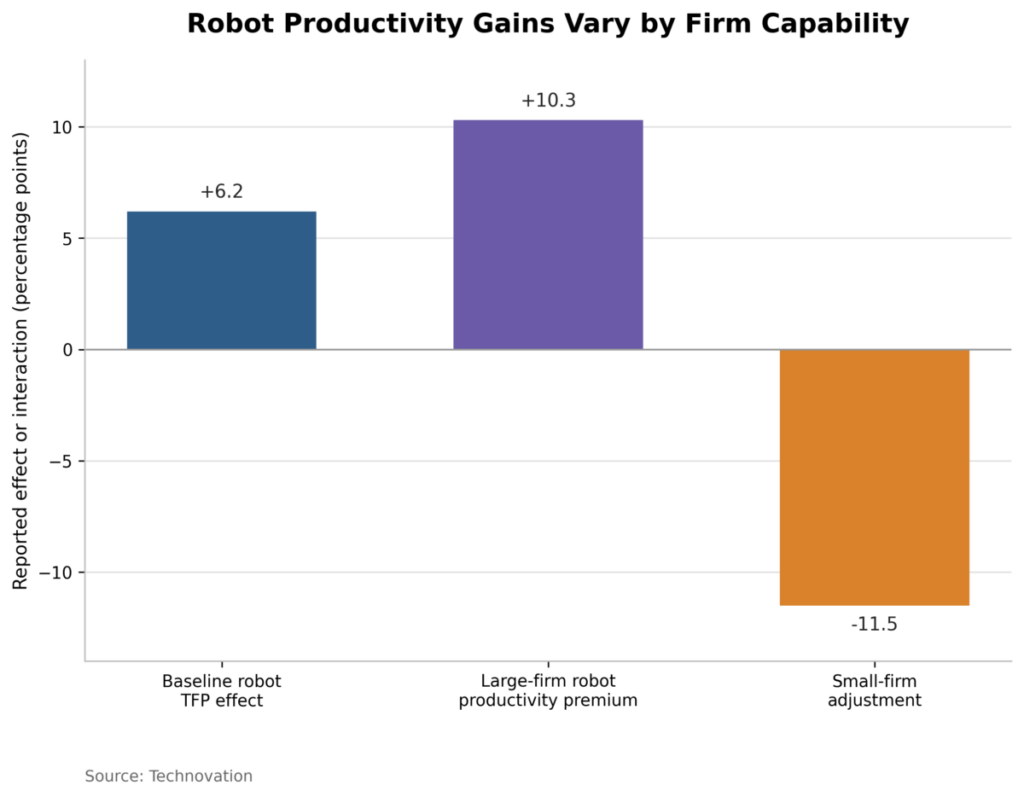
The same study found smaller productivity gains among small firms than large firms, but that size gap disappeared among businesses with high management scores. The machinery was not the only dividing line. Management capability determined whether firms of different sizes could convert similar technology into comparable productive gains.
Large manufacturers therefore begin with structural advantages because they can spread integration costs across greater output and maintain internal engineering expertise. Smaller firms may face the same labor pressure without the technical or managerial capacity needed to convert a robot into a reliable productive asset.
The constraint is not robot supply alone. It is scalable integration.
Technical performance proves what a machine can accomplish under appropriate conditions. Economic performance depends on whether ordinary firms can reproduce those conditions reliably and cheaply enough for automation to become routine rather than exceptional.
| Integration Factor | Measured Result |
|---|---|
| Large-firm robot productivity premium | +10.3 percentage points |
| Small-firm interaction | −11.5 percentage points |
| High management quality | Firm-size productivity gap disappears |
| Monitoring systems | Positive complement to robot adoption |
| Target setting | Positive complement to robot adoption |
| Managerial incentives | Positive complement to robot adoption |
| Non-manager incentives | No significant moderating effect |
Sources: Technovation
Better Robots Do Not Automatically Create a Robot Economy
Artificial intelligence is pushing robotics toward greater perception and adaptability in less structured environments. That shift matters because traditional industrial robots perform best where tasks and surroundings can be tightly controlled, limiting the range of economically attractive applications.
The installed base is already large enough to test whether capability alone produces economic transformation. Annual industrial robot installations exceeded 500,000 units for four consecutive years through 2024. In China, domestic robot manufacturers increased their home-market share to 57 percent in 2024 from roughly 28 percent over the preceding decade, showing that manufacturing capacity and supplier depth are expanding alongside deployment.
More adaptable machines may reduce part of the integration burden, but they do not remove the economics surrounding deployment. A capable robot still needs sufficient utilization, dependable operation, process compatibility, maintenance, and an investment return strong enough to compete with other uses of capital.
The next phase of robotics will therefore test whether machines become easier to integrate rather than simply more capable. Lower engineering requirements and more reusable deployment methods could broaden the population of firms able to automate profitably. If integration remains costly, increasingly capable machines may continue generating concentrated gains without producing the broad productivity effect expected from a general transformation of work.
The myth is not that robots can improve productivity or relieve labor constraints. They demonstrably can.
The weaker assumption is that technical capability naturally becomes scalable economic impact. Industrial robotics is already showing the difference.
| Diffusion Measure | Observed Research Signal |
|---|---|
| Robot adoption above median | Productivity effect lower by about 0.026–0.028 PCC |
| Earlier vs. recent study periods | Earlier-period effects are larger |
| Longer study horizons | Estimated effects become slightly smaller |
| Industry-level analysis | Effects tend to be below firm-level estimates |
| Developing and emerging economies | Larger gains than advanced economies |
| Publication bias | Bias runs toward larger positive estimates |
Sources: Journal of Economic Surveys
TL;DR Summary
- Industrial robotics has reached substantial scale, with 542,000 installations in 2024 and 4.664 million machines operating worldwide.
- Labor scarcity can encourage automation without making robotics a general solution to labor shortages.
- About 40 percent of German firms reported difficulty finding qualified workers, while robot investment remained below 0.3 percent of equipment spending.
- Successful deployments can generate strong firm-level returns when the application and integration are appropriate.
- Adoption remains concentrated among firms with sufficient scale, capital, technical expertise, and management capability.
- Only 598 of 55,390 French manufacturers in one major study adopted robots, although they represented roughly 20 percent of manufacturing employment.
- A 2026 meta-study covering 1,847 estimates from 85 studies found only a small average productivity effect.
- Management quality materially affects whether robot investment produces measurable productivity gains.
- A recent Chinese firm study found a 6.2 percent baseline productivity gain from robot adoption, concentrated among firms with stronger management.
- Integration costs help explain why hardware deployment can expand faster than economic impact.
- AI-enabled robotics may reduce some barriers, but broad productivity effects remain unproven.
- The central challenge is turning technically successful robotics into repeatable economic deployment across ordinary firms.
Sources
- International Federation of Robotics; World Robotics 2025 Industrial Robots; – Link
- U.S. Bureau of Labor Statistics; Productivity and Costs Second Quarter 2026 Revised; – Link
- OECD; OECD Compendium of Productivity Indicators 2026; – Link
- MIT Press, Review of Economics and Statistics; Robots at Work; – Link
Labor Shortages Can Trigger Automation Without Being Solved by It
- Journal of Financial Economics; Robots and Firm Investment; – Link
- OECD; The Firm Side of Labour Shortages; – Link
- National Bureau of Economic Research; Minimum Wages and Rise of the Robots; – Link
- National Institute of Standards and Technology; CIFT Assists Honeybaked Ham with Automation; – Link
The Productivity Gains Exist but They Are Concentrated
- American Economic Association; Competing with Robots: Firm-Level Evidence from France; – Link
- The Economic Journal; Robots and Firms; – Link
- The Economic Journal; Robot Imports and Firm-Level Outcomes; – Link
- National Bureau of Economic Research; Automation and the Workforce: A Firm-Level View from the 2019 Annual Business Survey; – Link
Integration Is the Constraint Hidden Behind the Robot
- Technovation; Do Industrial Robots Improve Firm Productivity in China? The Role of Management Practices; – Link
- National Bureau of Economic Research; The Characteristics and Geographic Distribution of Robot Hubs in U.S. Manufacturing Establishments; – Link
- Journal of the Knowledge Economy; Robots, Firms, and Regions: Explaining Spanish Manufacturing Firms’ Productivity and Exports; – Link
Better Robots Do Not Automatically Create a Robot Economy
- Journal of Economic Surveys; Do Robots Boost Productivity? A Quantitative Meta-Study; – Link
- National Bureau of Economic Research; The Microstructure of AI Diffusion: Evidence from Firms, Business Functions, and Worker Tasks; – Link
- Financial Times; Robots Only Half as Efficient as Humans, Says Leading Chinese Producer; – Link
- Institute of Internet Economics; Simple Humanoid Robots, Not Androids: Physical AI Is Helping the Leap; – Link