
In the 1600s, spinning wool was a familiar household skill in many European communities. Preserving food, making clothing and maintaining household tools required knowledge acquired through observation and practice. Industrialization gradually transferred these activities to specialized producers, transforming once-common capabilities into increasingly uncommon skills. Today, reading maps, remembering telephone numbers and conducting independent research are undergoing a similar transformation.
The Internet has accelerated this process while extending it into intellectual activities. Navigation no longer requires detailed geographical understanding, information can be retrieved without remembering it, and artificial intelligence can explain complex subjects without requiring individuals to investigate the underlying material. In 2026, approximately 6.3 billion people, representing 76% of humanity, use the Internet. Digital alternatives now reach into activities that generations once learned by doing.
What makes this transformation different is the separation between accomplishing a task and acquiring the knowledge once needed to perform it. The Internet is changing not only how humanity accesses information, but also what we consider necessary to know, practice, remember, preserve and teach subsequent generations. What are we gradually relinquishing in exchange for digital convenience?
The Economics of Relinquishment
Digital technologies have substantially reduced the costs of finding, reproducing and distributing information. Spending an afternoon researching a subject becomes difficult to justify when a reasonable answer can be obtained within seconds. The opportunity cost of independent inquiry has changed, influencing what people consider worth learning.
Historically, many everyday activities produced two outcomes. Reading a map provided directions while developing spatial awareness. Managing household accounts strengthened financial understanding through repeated transactions. People acquired knowledge without deliberately setting out to learn.
When technology assumes responsibility for the task, some of this incidental learning disappears with it.
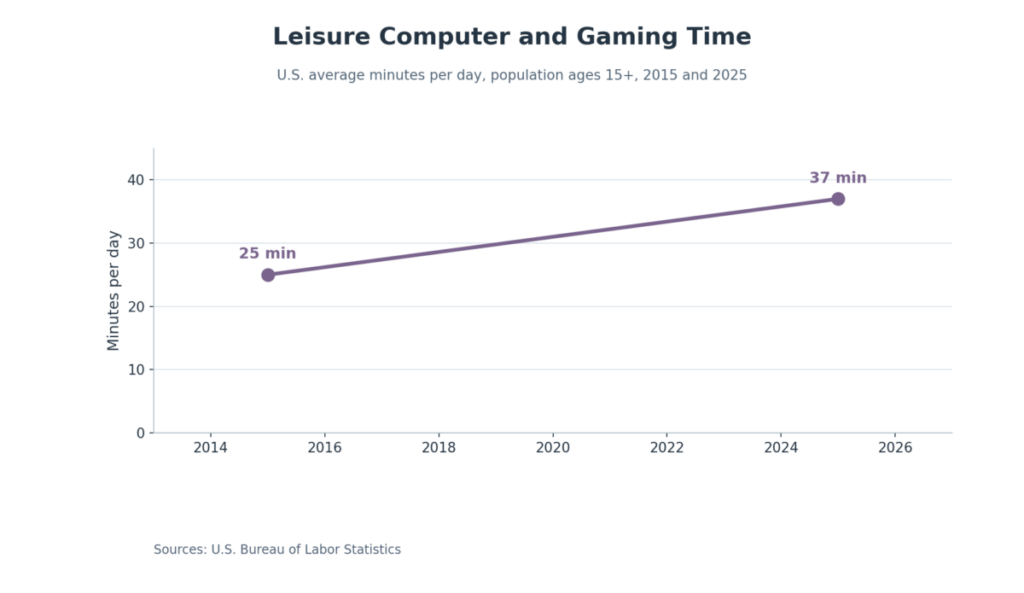
Time presents another constraint. In 2025, Americans aged 15 and older spent an average of 16 minutes daily reading for personal interest, compared with 37 minutes playing games or using computers recreationally. Television occupied another 2.6 hours. Recreational gaming and computer use had increased from 25 minutes in 2015. These figures do not establish that digital entertainment displaced reading, but illustrate competing demands upon everyday attention.
Few individuals consciously decide to abandon traditional knowledge. They make economically reasonable decisions about their time. Yet when millions choose alternatives that eliminate opportunities for practice, the consequences accumulate. Knowledge once acquired through everyday life becomes something that must be learned deliberately, if it is learned at all.
| Activity | Ages 15–24 | Ages 65+ |
|---|---|---|
| Reading for interest | 10 min | 32 min |
| Playing games | 53 min | 16 min |
| Leisure computer use, excluding games | 25 min | 11 min |
Sources: U.S. Bureau of Labor Statistics
Knowledge Without Competence
A 2020 investigation involving 50 regular drivers associated habitual GPS use with poorer spatial memory during independent navigation. Follow-up observations involving 13 participants found that more extensive GPS use was associated with greater deterioration over three years. Although the longitudinal sample was small, the findings suggest convenient assistance can influence the retention of geographical knowledge.
Psychologists describe the delegation of mental activities to external systems as cognitive offloading. Across nine experiments published in 2015, searching the Internet increased people’s estimates of their own knowledge. Earlier research found that when individuals expected information to remain accessible, they were more likely to remember where it could be retrieved than the information itself.
The economic advantages of external memory are substantial. Memorizing hundreds of telephone numbers is rarely necessary when digital directories provide reliable access. Financial applications can reconcile household expenditure accurately, but the corresponding understanding does not necessarily develop alongside these improvements. Online repair instructions likewise cannot reproduce the judgment acquired through years of working with tools and materials.
Independent knowledge proves its value when familiar systems fail. Recognizing an incorrect calculation or navigating without electronic assistance requires capabilities that may no longer be exercised routinely. Technology can expand what individuals accomplish while leaving them less prepared to perform those activities independently. Efficiency and competence, once developed together, increasingly follow different paths.
| Adult competency | Low proficiency |
|---|---|
| Literacy | 26% |
| Numeracy | 25% |
| Adaptive problem-solving | 29% |
Sources: OECD
The Changing Nature of Intellectual Development
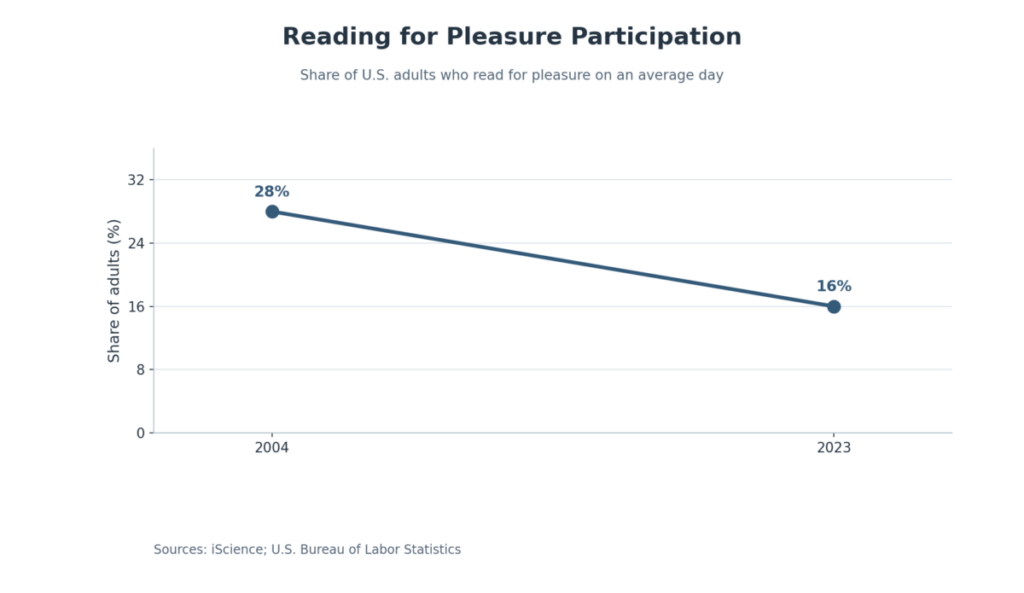
Between 2004 and 2023, the proportion of Americans reading for pleasure on an average day declined from approximately 28% to 16%. Those who continued reading, however, devoted more time to the activity. Participation diminished while the commitment of remaining readers strengthened. Although the decline cannot be attributed exclusively to the Internet, it reveals a significant change in sustained reading.
Complete books expose readers to ideas they might never encounter through a targeted search. Independent research develops judgment through investigation, source comparison and the discovery that an original question was incomplete. Digital summaries can deliver useful conclusions without reproducing the intellectual work behind them.
A controlled experiment involving secondary-school students in Turkey found that unrestricted AI assistance improved mathematics practice performance by 48%. When assistance was removed, students performed 17% worse than those who practiced independently. A guided AI tutoring system produced a 127% improvement during practice without the same statistically significant disadvantage in subsequent testing.
The distinction lies in how technology participates in learning. Providing answers can improve immediate performance while reducing opportunities to develop independent competence. Guiding students through problems can instead strengthen those capabilities.
As intellectual work becomes easier to delegate, the quality of a finished assignment may reveal less about the expertise of its author. The economic value of verified competence could grow even as the cost of producing acceptable work declines.
| U.S. book readership | 2011 | 2025 |
|---|---|---|
| Read a print book | 72% | 64% |
| Read an e-book | 17% | 31% |
Sources: Pew Research Center
The Disappearance of Cultural Distinctiveness
Knowledge also develops through participation in communities that preserve it. Local customs, storytelling and regional entertainment evolved within particular social environments. Their continuation depended upon shared activities inherited across generations.
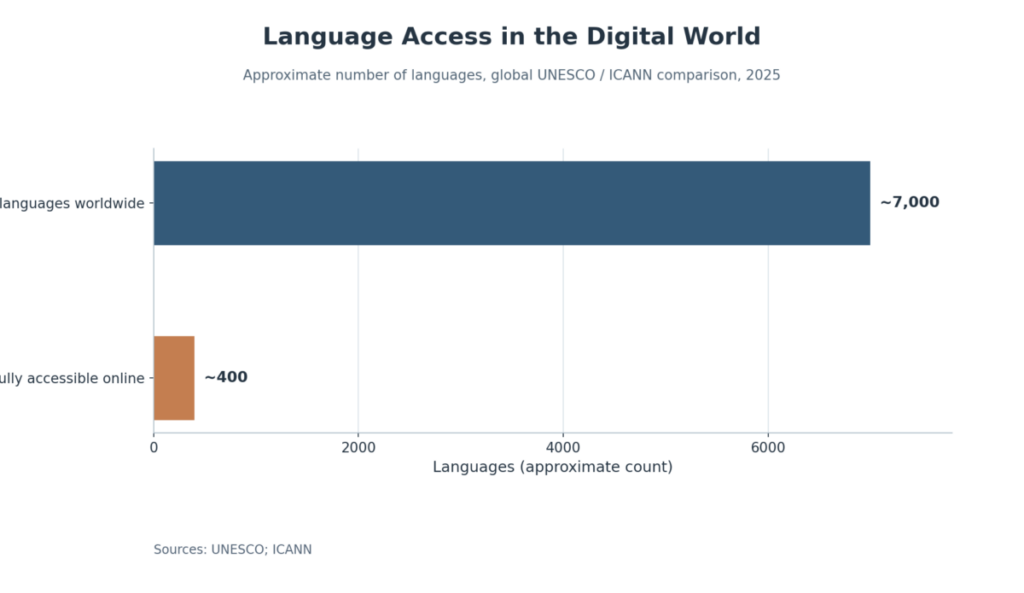
The Internet has changed the economics of cultural distribution. Entertainment and written material can reach international audiences at little additional cost, exposing local traditions to competition from larger markets. Minority languages face difficulties where dominant languages offer greater commercial opportunities and access to information. Nearly half of the world’s approximately 7,000 documented languages are endangered, and projections suggest at least 1,500 could disappear by century’s end without intervention. Industrialization, migration and demographic change remain major influences, making the Internet one contributor to a longer historical process.
Cultural convergence is not inevitable. Research examining global music streaming between 2014 and 2019 found that preferences for local music strengthened despite greater international access. Indigenous communities also use digital dictionaries and cultural archives to preserve linguistic and historical knowledge.
A traditional song may survive indefinitely as a recording after people have stopped singing it.
The recording preserves the music, but not necessarily the occasion for its performance. Songs may have accompanied community gatherings or the teaching of local history. When those activities disappear, cultural knowledge survives as information while losing its place in everyday life. Preservation requires a record, but continuity requires people who practice what has been preserved.
| Digital language access | Coverage |
|---|---|
| Languages fully accessible online | ~400 |
| Top 1,000 websites accepting internationalized domain names | 10% |
| Email services supporting local-language addresses* | 22% |
*Services under generic top-level domains.
Sources: UNESCO, ICANN
The Transformation of Religious and Philosophical Traditions
Religious and philosophical traditions have long depended upon the relationship between knowledge and participation. Their teachings have passed through textual study and relationships between experienced interpreters and learners. Examining difficult passages or competing interpretations was itself part of intellectual development.
The Internet has expanded access to religious scholarship beyond traditional institutions. In the United States, 30% of adults search online for religious information, while 21% use websites or applications to assist with scripture reading. Traditional participation remains substantial. Among highly religious Americans, 61% attend prayer or scripture study groups in person, compared with 19% participating online.
Religious authority is also changing elsewhere. Research published in 2025 involving two Indonesian Islamic universities identified religious organizations’ websites, scholars’ online publications and social media as increasingly important sources of Islamic knowledge. Students can consult interpretations outside their immediate institutions, changing relationships between learners and religious teachers.
A searchable religious library can support extensive scholarship, while an isolated answer may satisfy a question without requiring broader theological or historical understanding. Where immediate explanations replace sustained study, opportunities to investigate competing interpretations diminish. Digital resources can broaden religious learning, but accessibility alone does not preserve the depth of understanding developed through study and discussion.
| U.S. religious book reading | Ages 18–29 | Ages 65+ |
|---|---|---|
| Ever read religion-focused books | 23% | 42% |
| Read at least weekly | 11% | 23% |
Sources: Pew Research Center
What Future Generations May Not Inherit
Much of humanity’s accumulated knowledge has passed through shared work rather than formal education. A child learns by watching an experienced relative, an apprentice develops judgment through practice, and communities preserve practical understanding through activities performed together.
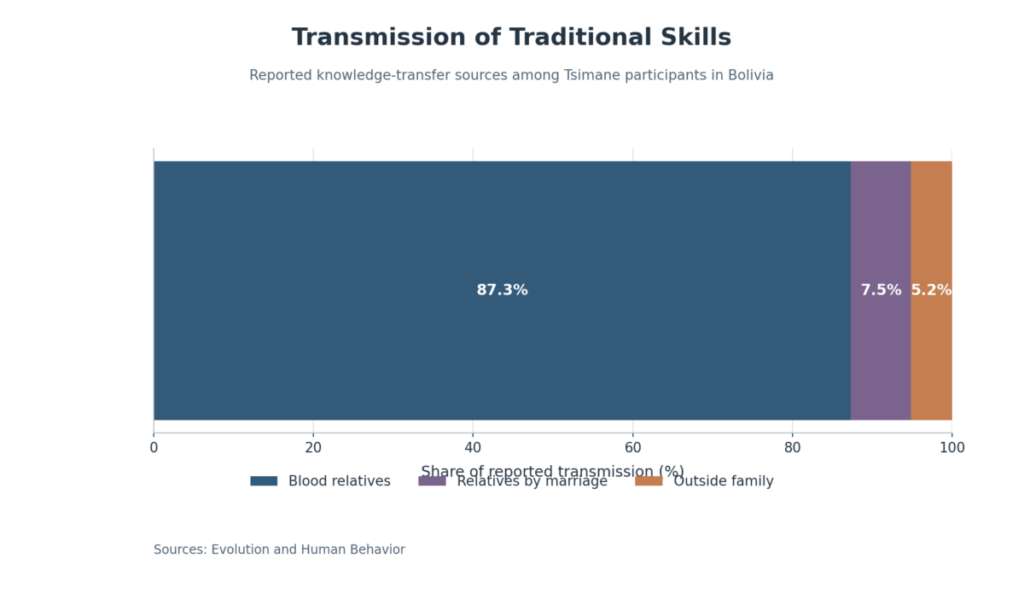
Among the Tsimane people of Bolivia, 94.8% of reported cultural knowledge and skill transmission occurred within families, with 75% attributed to older kin. These relationships demonstrate how acquiring essential capabilities can depend upon direct participation across generations.
Traditional learning pathways are also vulnerable in industrialized societies. Britain’s 2025 Red List of Endangered Crafts identified 20 additional crafts at risk, bringing the total to 165 at-risk crafts. Rising operating costs, changing markets and limited training opportunities threaten skills historically passed between generations. Although these difficulties are not principally caused by the Internet, they reveal how valuable knowledge can become economically difficult to maintain.
Professional expertise faces a different pressure. Junior accountants and programmers have traditionally acquired skills through assignments increasingly susceptible to automation. Eliminating routine work improves productivity but can remove the experience through which employees develop professional judgment. Businesses may need to invest in training that previously occurred during ordinary productive activity.
Research examining German businesses between 2019 and 2023 associated sustained AI adoption with a 14% increase in new apprenticeships among firms already providing such training. Established training institutions can adapt as technological requirements change.
For families and communities without comparable institutions, replacing traditional learning is more difficult. As everyday activities disappear, younger generations lose opportunities to learn from experienced practitioners. Over time, fewer people possess the experience necessary to teach those who follow. The loss extends beyond individual activities to the continuity of knowledge once developed naturally through community life.
| Measurement | Indicator |
|---|---|
| Knowledge retention | Active skilled practitioners |
| Knowledge transfer | Current trainees and apprentices |
| Economic continuity | Viability of professional practice |
| Generational survival | Likelihood of continued practice |
Sources: Heritage Crafts
Knowledge in the Internet Age
Human progress has always involved abandoning certain skills and traditions. Some become economically unnecessary, others evolve, and many are strengthened through technological advancement. The transition from household spinning to industrial textile production brought enormous productivity gains while reducing the need for traditional spinning skills. Digital substitutions follow a recognizable economic pattern, but their reach into intellectual and cultural life creates a more complicated inheritance.
What distinguishes the Internet age is the breadth and speed of these changes. As traditional activities become less economically necessary, incentives to acquire their associated knowledge diminish. Preserving that knowledge increasingly requires deliberate learning where everyday economic life no longer provides it.
Future generations may inherit the most extensive repository of information ever assembled. The more consequential question is how much of humanity’s accumulated knowledge, experience, understanding and cultural identity they will continue to possess themselves.
TL;DR
-
The Internet is changing what humanity considers necessary to learn, remember and preserve.
-
Digital convenience reduces incentives to develop capabilities traditionally acquired through everyday activities.
-
Incidental learning can disappear when technology assumes responsibility for human tasks.
-
Habitual GPS use has been associated with poorer independent spatial memory.
-
Internet searches can inflate perceived knowledge without improving personal understanding.
-
Recreational reading participation declined from 28% to 16% between 2004 and 2023.
-
Educational AI can improve immediate performance while weakening independent learning when poorly implemented.
-
Digital distribution creates both competition for and opportunities to preserve regional cultures.
-
Digital archives can preserve cultural information without sustaining living traditions.
-
Online religious resources are transforming traditional study and interpretation.
-
Automation can eliminate routine professional assignments that historically developed expertise.
-
Intergenerational knowledge transfer depends upon maintaining opportunities for direct learning and participation.
Sources
- Economic History Review; Th’ancient Distaff and Whirling Spindle: Measuring the Contribution of Spinning to Household Earnings and the National Economy in England, 1550–1770; – Link
- International Telecommunication Union; Facts and Figures 2026; – Link
The Economics of Relinquishment
- American Economic Association; Digital Economics; – Link
- U.S. Bureau of Labor Statistics; American Time Use Survey 2025; – Link
Knowledge Without Competence
- Scientific Reports; Habitual Use of GPS Negatively Impacts Spatial Memory During Self-Guided Navigation; – Link
- Journal of Experimental Psychology: General; Searching for Explanations: How the Internet Inflates Estimates of Internal Knowledge; – Link
- Science; Google Effects on Memory: Cognitive Consequences of Having Information at Our Fingertips; – Link
The Changing Nature of Intellectual Development
- iScience; The Decline in Reading for Pleasure Over 20 Years of the American Time Use Survey; – Link
- Proceedings of the National Academy of Sciences; Generative AI Without Guardrails Can Harm Learning: Evidence From High School Mathematics; – Link
- Pew Research Center; Americans Still Opt for Print Books Over Digital or Audio Versions; – Link
The Disappearance of Cultural Distinctiveness
- Nature Ecology & Evolution; Global Predictors of Language Endangerment and the Future of Linguistic Diversity; – Link
- Association for the Advancement of Artificial Intelligence; Local Trends in Global Music Streaming; – Link
- UNESCO; Internet Access: UNESCO and ICANN Join Forces to Improve Linguistic Diversity Online; – Link
- ICANN; Universal Acceptance Readiness Evaluations; – Link
The Transformation of Religious and Philosophical Traditions
- Pew Research Center; Use of Apps and Websites in Religious Life; – Link
- Cogent Education; Online Islamic Knowledge Sources and Their Authority in Islamic Learning: A Case Study of Indonesian Muslim Universities; – Link
What Future Generations May Not Inherit
- Evolution and Human Behavior; Cultural Transmission Vectors of Essential Knowledge and Skills Among Tsimane Forager-Farmers; – Link
- Heritage Crafts; Craft Skills Remain Under Threat With 20 New Additions to the Red List of Endangered Crafts; – Link
- Journal of Economic Behavior & Organization; Artificial Intelligence Adoption and Workplace Training; – Link
Knowledge in the Internet Age
- OECD; Do Adults Have the Skills They Need to Thrive in a Changing World? Literacy, Numeracy and Adaptive Problem Solving Among Adults in 2023; – Link
Keywords: Behavioral Economics, Human Knowledge, Cultural Heritage, Cognitive Offloading, Intergenerational Knowledge Transfer