
Agriculture accounts for 72% of global freshwater withdrawals, while approximately 13.4% of food production is lost between harvest and retail. These figures reveal opportunities to improve the global food supply through more efficient production and preservation. In northern Ghana, approximately 40 women cultivating vegetable plots have gained access to solar-powered irrigation through a local service provider. Water previously carried more than 500 meters is now pumped to their fields, reducing physical labor and supporting dry-season cultivation. Although not robotics, the arrangement demonstrates how agricultural technology can improve production without requiring farmers to purchase expensive equipment.
Connected agricultural robotics is extending these possibilities. Autonomous tractors cultivate fields after dark, intelligent irrigation systems respond to changing soil conditions, and computer vision enables machines to distinguish crops from weeds. Research has demonstrated irrigation water savings of up to 38%, while experimental laser-weeding systems have reduced weed biomass by at least 97%. These technologies help farmers respond to agricultural conditions more precisely and make better use of limited resources.
Early implementations have also revealed that technological capability does not guarantee agricultural improvement. Equipment must accommodate local crops, terrain and farming practices, while its economic benefits must justify operating costs. Shared services, technical training and machinery capable of functioning with limited connectivity offer practical pathways for adoption across different agricultural economies. Applying these lessons over the next decade could increase food production, reduce losses and strengthen agricultural livelihoods, improving food availability and affordability.
The Future of the Global Food Supply
| Region | Food Lost Before Retail |
|---|---|
| Sub-Saharan Africa | 23.0% |
| Northern America and Europe | 10.0% |
Sources: Food and Agriculture Organization
Technology Transforming the Farm
A few days of unfavorable weather during planting or harvesting can disrupt an entire growing season. Connected tractors extend the hours available for fieldwork, and remote monitoring allows producers to coordinate machinery across multiple fields. The economic value of an autonomous tractor may therefore lie as much in when it operates as in the labor it replaces.
Precision irrigation brings similar control to water management. Soil sensors transmit measurements to controllers that regulate water delivery according to growing conditions. Sensor-based irrigation scheduling has demonstrated average water savings ranging from 1% against canopy temperature methods to 38% against traditional practices, with comparable or higher crop yields. Aerial monitoring with drones complements these systems, locating areas of crop stress before conditions deteriorate.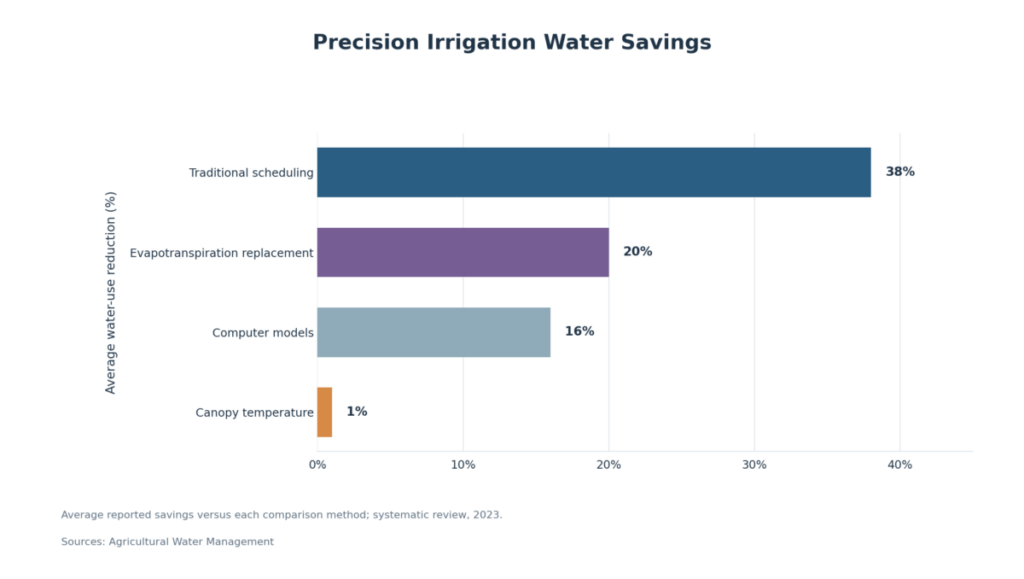
Agricultural management is moving from the field to the individual plant.
With machine vision, harvesting equipment identifies mature produce while leaving younger plants to continue growing. Machinery equipped with positioning systems records where crops require nutrients or treatment, allowing subsequent operations to concentrate resources where they are needed.
Laser weeding demonstrates this precision at work. A camera identifies unwanted vegetation, and a laser delivers concentrated energy to a specific weed. Vegetable field trials in New York and New Jersey recorded reductions in weed biomass of at least 97% against untreated crops. Crop biomass was at least 30% greater in laser-treated plots than in herbicide-treated plots, although increased plant biomass does not necessarily represent an equivalent increase in marketable produce.
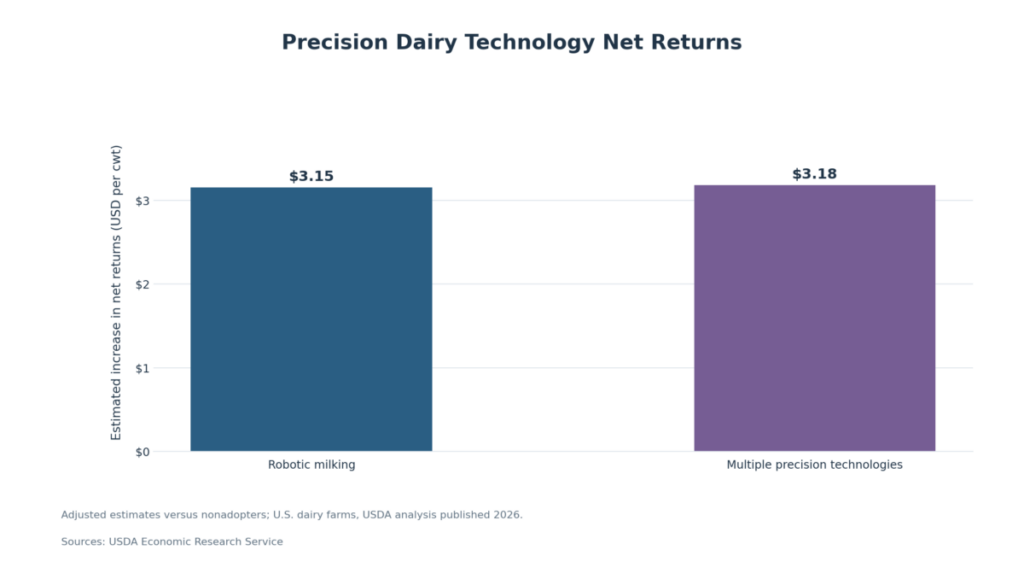
Individualized management is proving economically useful in livestock production as well. Connected animal sensors, automated feeding and robotic milking help farmers respond to the requirements of individual animals. Robotic milking or the combined adoption of multiple precision dairy technologies increased estimated US dairy net returns by an average of 13%. Inside connected greenhouses, automated environmental controls help sustain production throughout the year, directing resources toward crop requirements as conditions change.
Technology Transforming the Farm
| Robotic Milking Indicator | Year | Share |
|---|---|---|
| US milk produced using robots | 2016 | 4% |
| US milk produced using robots | 2021 | 6% |
| Midsized dairy farms using robots (150–499 cows) | 2021 | 13% |
Sources: USDA Economic Research Service
Lessons from the Field
The economic case for autonomous machinery begins with understanding the farm’s production cycle. Equipment that saves relatively little labor may nevertheless protect a substantial portion of the harvest by completing essential work within a narrow weather window. Conventional labor-cost comparisons alone will not capture this value.
An international examination of 27 agricultural automation initiatives, complemented by research involving 10 cases across developing economies, identified difficulties associated with investment costs, infrastructure and technical knowledge. Successful implementation depends on matching equipment capabilities with the resources available to operate and maintain them.
Take robotic weed control. Research involving organic sugar beet production in Germany demonstrated the importance of farmer participation in equipment development. Field trials exposed limitations in operating speed and plant recognition while helping engineers identify appropriate weeding tools. Machinery developed under controlled conditions must ultimately contend with variations in soil and planting arrangements familiar to the farmer.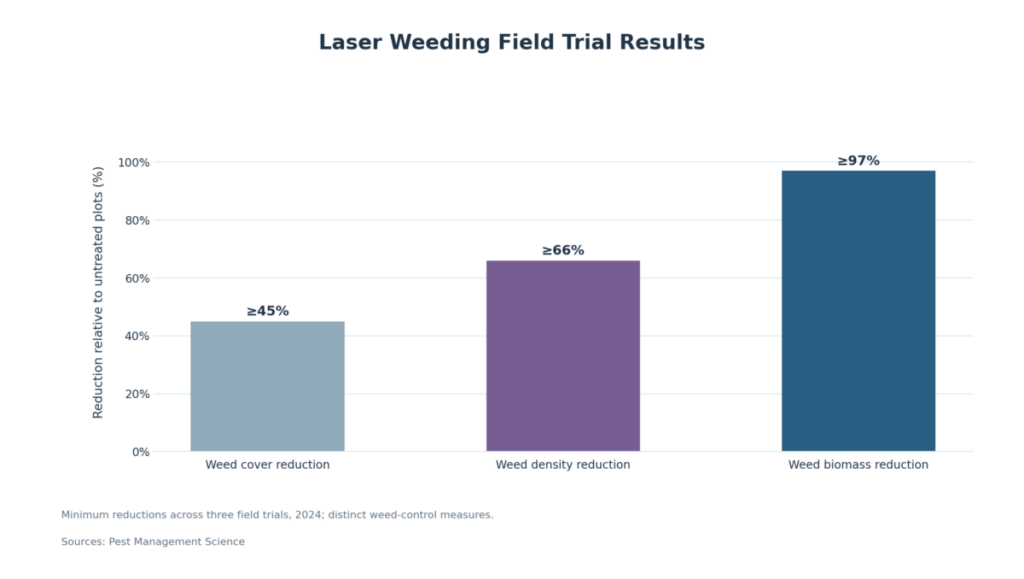
There is also the question of who will maintain the machine several years after its purchase. In 2025, an American precision-weeding developer announced plans to wind down operations despite having developed commercially ready technology. The availability of replacement components and continued software support belongs in the original investment calculation.
For a producer experiencing crop losses through inadequate irrigation, intelligent water management may deliver a greater return than an autonomous tractor. Successful deployment begins with the production problem. Equipment selection follows from the improvement sought and the cost of achieving it.
Lessons from the Field
| Farm Size / Labor Type | With Robots | Without Robots |
|---|---|---|
| 50–149 cows Unpaid labor |
$5.30 | $9.22 |
| 150–499 cows Paid labor |
$1.17 | $2.10 |
US dollars per hundredweight of milk, 2021. Unpaid labor is valued at estimated opportunity cost; rows use different labor measures.
Sources: USDA Economic Research Service
Implementing Connected Agriculture
A smallholder who needs aerial crop monitoring several times during a growing season has little economic reason to purchase a specialized drone. A regional service provider, however, can operate the same equipment across dozens of farms. Spreading capital and maintenance costs across a larger customer base converts an otherwise prohibitive investment into an affordable operating expense. The arrangement becomes more economical as equipment utilization increases.
An assessment of more than 100 agricultural drone initiatives across Europe and Central Asia in 2026 identified shared services, trained operators and practical demonstrations as important contributors to smallholder adoption. Establishing these services locally allows operators to develop expertise in regional crops and growing conditions.
The economics extend beyond the initial equipment purchase. Service providers must maintain machinery, organize operations around seasonal demand and establish pricing that farmers can afford. Reliable access to equipment can be more valuable than ownership when its use is concentrated within a few critical weeks. Local operators also have an opportunity to expand their services as agricultural communities adopt more advanced monitoring and automation.
Continuous Internet access is not essential for every intelligent machine.
In 2025, 85% of the world’s urban population used the Internet, compared with 58% of rural inhabitants. Among rural populations in low-income countries, usage was just 14%. Equipment capable of processing sensor readings locally and synchronizing information when connectivity becomes available offers a practical means of introducing intelligent machinery before comprehensive communications infrastructure is established.
Regional technology centers can help producers share equipment and technical expertise. Financing arrangements suited to seasonal farm incomes, alongside retrofits that introduce intelligent capabilities into existing machinery, can reduce the expense of modernization. Local maintenance services provide the technical support needed to keep these investments productive.
Implementing Connected Agriculture
| Drone Application | Currently Using | Planning Adoption |
|---|---|---|
| Crop monitoring | 3% | 9% |
| Crop spraying | 3% | 11% |
Surveyed farmers in selected EU Member States. Planned adoption refers to the following five years, not completed deployment.
Sources: European Commission Joint Research Centre, Food and Agriculture Organization
Food Security and Human Prosperity
Animal-source foods, fruits and vegetables account for nearly 70% of the global cost of a healthy diet. Robotic milking, precision harvesting and connected environmental management are finding practical applications across these agricultural sectors. Greater output from existing resources can lower production costs per unit, creating scope for more affordable food. Whether those savings reach consumers depends on distribution costs and agricultural market conditions.
Local equipment-service businesses create economic opportunities beyond the farm. As machinery assumes some of agriculture’s most physically demanding work, technical training allows rural workers to participate in its operation and maintenance. In regions experiencing labor shortages, automation may also help keep productive farmland in use, protecting agricultural output and the economic activity it supports.
Approximately 1.2 billion people live in agricultural areas experiencing severe water constraints. Intelligent irrigation offers a means of protecting production under these conditions, although improved delivery efficiency must translate into reduced water consumption where resources are being depleted. Controlled-environment farming presents a different calculation: the value of additional food produced must justify its energy requirements.
An estimated 13.3% of global food production was lost between harvest and retail in 2023, rising to 25.4% for fruits and vegetables. Extending connected monitoring into storage allows producers to detect unfavorable conditions and intervene before produce deteriorates. Recovering part of these losses would increase the food reaching consumers without expanding cultivation.
These agricultural gains contribute to the United Nations’ objective of Zero Hunger (SDG 2), with broader benefits for rural livelihoods, water security and sustainable food production.
Food Security and Human Prosperity
| Global Irrigation Indicator | Value |
|---|---|
| Cropland equipped for irrigation | 23% |
| Share of global crop value from irrigated land | 48% |
| Average irrigated yield advantage | 76% |
| Irrigated land under high or very high water stress | Over 60% |
Yield advantage is relative to rainfed farming.
Sources: Food and Agriculture Organization
The Next Decade of Agriculture
Between 2026 and 2028, connected irrigation and drone-based monitoring offer accessible starting points for agricultural modernization, while specialized robotics can address more demanding production constraints. Early investments should demonstrate measurable returns and establish the local expertise needed for subsequent development.
The difference between livestock and crop robotics illustrates how agricultural conditions influence adoption. Approximately 14,000 robotic milking systems were operating in France in 2023. Crop robots, which must navigate uneven terrain and distinguish plants under changing outdoor conditions, remain far less established. Their numbers nevertheless increased from approximately 100 in 2018 to 600 in 2023, while commercially available models increased from five to 25. Adoption follows the practical demands of each application rather than a uniform technological progression.
By 2031, improvements in machinery design and interoperability could make specialized equipment useful across more crops and production environments. Greater utilization would improve the economics of shared robotic services, extending productive capabilities into communities unable to finance sophisticated machinery independently. Experience suggests that affordability and local adaptation will remain as important as technical performance.
By 2036, observations collected across farms could inform regional responses to emerging crop diseases or water shortages. Connected machinery would give producers the means to act on that intelligence. Building these systems from practical agricultural experience offers a pathway toward protecting regional food production against conditions that individual farmers have limited capacity to manage alone.
The future of farming need not be defined by the replacement of farmers with machines. It can instead be defined by the expansion of what farmers are capable of accomplishing. By applying lessons from contemporary agricultural robotics, communities can begin building more productive, accessible and resilient agricultural systems today. The ultimate measure of these technologies will be their contribution to the food humanity can produce, the livelihoods agriculture can sustain and the natural resources future generations will inherit.
The Next Decade of Agriculture
| Agricultural Objective | Measurement | Unit |
|---|---|---|
| Increase food production | Marketable crop yield | Tonnes/hectare |
| Improve affordability | Production cost per unit | Currency/tonne |
| Conserve water | Water consumed per unit produced | m³/tonne |
| Reduce food losses | Post-harvest loss rate | % |
| Improve rural livelihoods | Net farm income | Currency/farm |
Proposed measurement framework; indicators are not reported results or forecasts.
Sources: Food and Agriculture Organization, USDA Economic Research Service
TL;DR
-
Agriculture accounts for 72% of global freshwater withdrawals, while approximately 13.4% of food production is lost before retail.
-
Shared irrigation services in northern Ghana demonstrate how agricultural improvements can reach smallholders without individual equipment ownership.
-
Autonomous machinery extends productive operating hours during critical planting and harvesting periods.
-
Sensor-based irrigation has demonstrated water savings ranging from 1% to 38%, depending on the comparison method.
-
Laser-weeding trials achieved reductions in weed biomass of at least 97% against untreated crops.
-
Robotic milking and combined precision dairy technologies increased estimated US dairy net returns by an average of 13%.
-
Farmer participation in equipment development improves adaptation to local agricultural conditions.
-
Shared equipment services distribute capital costs across farms, improving the economics of specialized machinery.
-
Locally processed agricultural intelligence offers implementation opportunities where Internet connectivity remains limited.
-
Rural technical training and maintenance services can strengthen agricultural employment and equipment reliability.
-
Connected storage monitoring can help reduce post-harvest losses and improve food availability.
Incremental implementation through 2036 offers opportunities to improve agricultural productivity, affordability and food security.
Sources:
- Food and Agriculture Organization; SDG Indicator 6.4.2 — Water Stress; – Link
- Food and Agriculture Organization; SDG Indicator 12.3.1 — Global Food Losses; – Link
- International Food Policy Research Institute; Irrigation as a Service: Expanding Water Access for Smallholder and Women Farmers; – Link
Technology Transforming the Farm
- Agricultural Water Management; Soil Water Sensors for Irrigation Scheduling in the United States: A Systematic Review of Literature; – Link
- Pest Management Science; Deep Learning-Based Laser Weed Control Compared to Conventional Herbicide Application Across Three Vegetable Production Systems; – Link
- USDA Economic Research Service; Precision Dairy Farming, Robotic Milking, and Profitability in the United States; – Link
Lessons from the Field
- Food and Agriculture Organization; The State of Food and Agriculture 2022: Leveraging Agricultural Automation for Transforming Agrifood Systems; – Link
- Food and Agriculture Organization; Agricultural Digitalization and Automation in Low- and Middle-Income Countries: Evidence from Ten Case Studies; – Link
- The Journal of Agricultural Education and Extension; Co-designing a Digital Farming Technology: A Case Study of Developing a Weeding Robot; – Link
- AgFunderNews; FarmWise AI-Powered Weeding Tech Commercially Ready Despite Company Restructuring and Wind Down; – Link
Implementing Connected Agriculture
- Food and Agriculture Organization; AgriTech Observer: Drones for Smallholders — Six Lessons on What Works in Practice; – Link
- International Telecommunication Union; Facts and Figures 2025: Internet Use in Urban and Rural Areas; – Link
- European Commission, Joint Research Centre; Survey-Based Study on the State of Play of Digitalisation in EU Agriculture; – Link
Food Security and Human Prosperity
- Food and Agriculture Organization, IFAD, UNICEF, WFP and WHO; The State of Food Security and Nutrition in the World 2026: Understanding and Addressing the High Cost of a Healthy Diet; – Link
- Food and Agriculture Organization; Agricultural Water Management and Water Scarcity; – Link
- Food and Agriculture Organization; Irrigation: Land, Soil and Water; – Link
The Next Decade of Agriculture
- French Ministry of Agriculture; The Development of Digital Agriculture in France; – Link
- Eurostat; 43% of EU Farms with Internet Access; – Link
- USDA Economic Research Service; Robotic Milking Gains Ground, Especially Among Midsized Dairies; – Link
Keywords: Robotics, Agriculture, Food Security, Precision Agricultural Automation, Connected Agricultural Systems