
For much of the past two years, the labor debate around artificial intelligence has centered on a visible event: the layoff. Companies have announced restructuring, executives have invoked AI, and forecasts have counted occupations that models could theoretically automate. The implied sequence has been straightforward. AI arrives, workers leave, unemployment rises.
A year into meaningful integration, the evidence points somewhere more interesting.
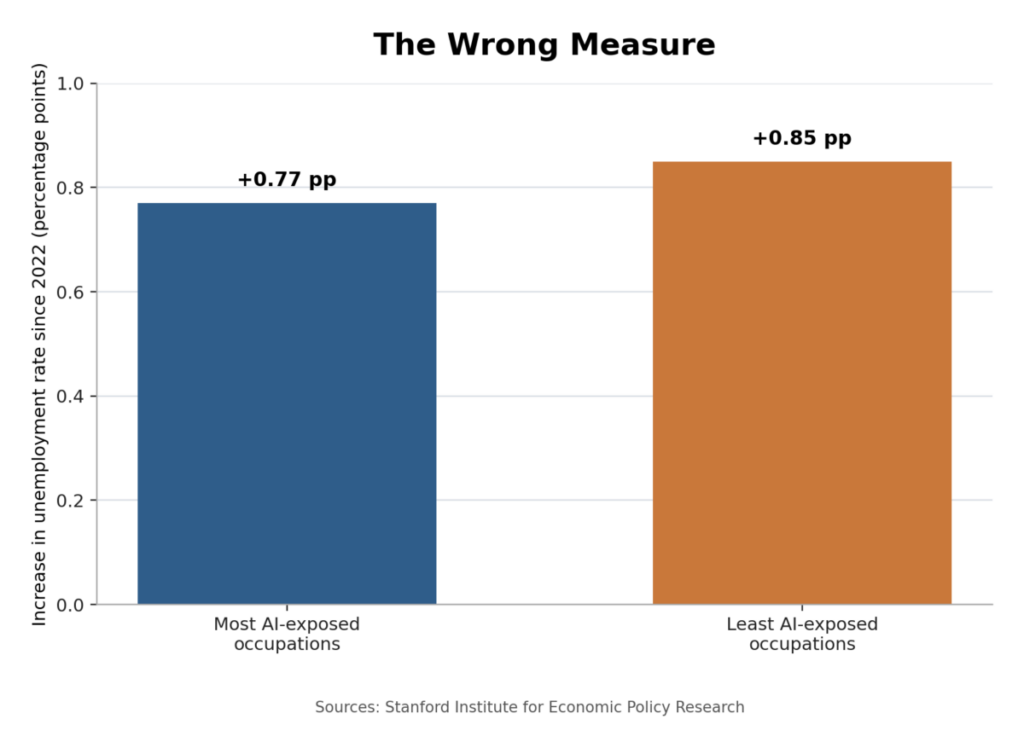
Since 2022, unemployment among workers in the most AI-exposed occupations has risen by about 0.77 percentage points, slightly less than the 0.85-point increase among workers with low exposure. Firms adopting enterprise AI have also recorded employment growth of roughly 10 percent during the two years after adoption, although stronger companies may simply be more likely to invest and hire. The economy has not produced the broad AI unemployment shock that early narratives implied.
Yet the absence of mass displacement does not mean labor demand has remained unchanged. A more consequential adjustment can occur before anyone receives a termination notice.
A growing business once had a familiar response to additional customers, more analysis, or heavier administrative volume: hire another person. AI changes that calculation by giving existing employees more productive capacity. A manager can absorb basic analysis that once moved to a junior employee, while a small business can perform routine marketing or financial work that previously required outside support. Growth continues, but the next worker becomes less necessary.
The economic question therefore shifts away from how many jobs AI destroys and toward how much additional labor firms require to produce the next unit of output. AI increasingly operates as a labor-intensity technology, expanding what existing workers and organizations can produce before entire occupations become replaceable.
The missing job may become more economically important than the eliminated one.
| Signal | Current Evidence | Labor Effect |
|---|---|---|
| Most AI-exposed occupations | Unemployment +0.77 pp since 2022 | No broad AI-specific unemployment shock |
| Least AI-exposed occupations | Unemployment +0.85 pp since 2022 | Broader labor-market softening |
| Enterprise AI adopters | Employment +10% over two years | Adoption can coexist with hiring |
| Observed firm response | Role consolidation and hiring avoidance | Pressure can appear before layoffs |
Sources: Stanford Institute for Economic Policy Research
Growth Can Require Less Labor
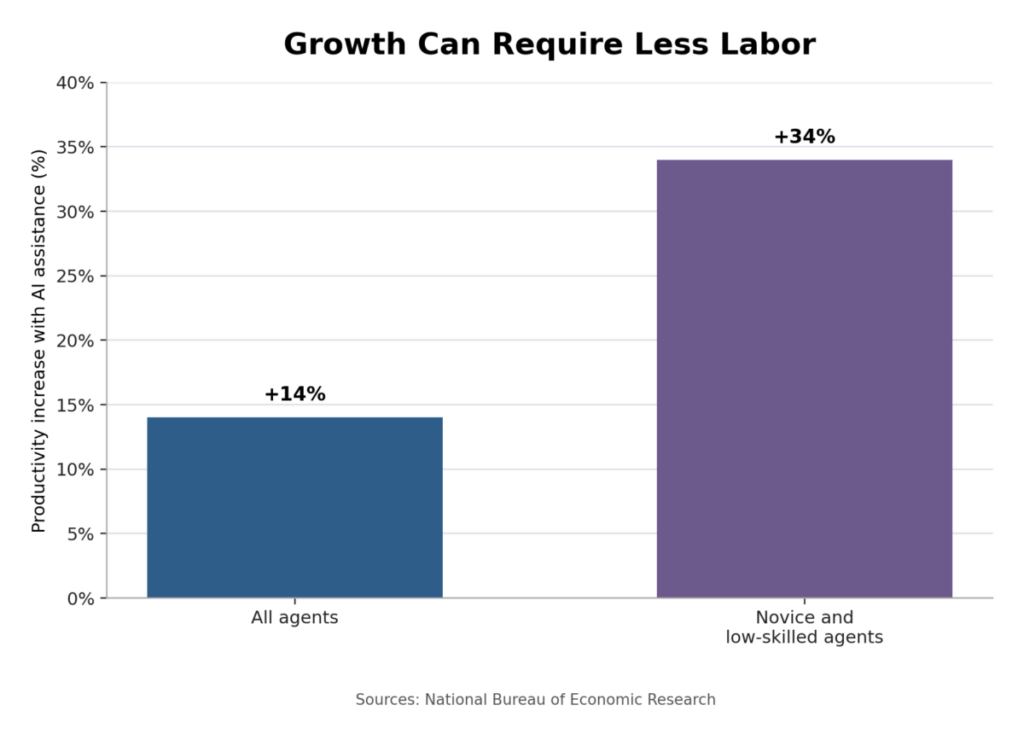
Productivity improvements reveal how the change begins. AI assistance raised output by about 15 percent in a large customer-support implementation, with gains near 30 percent among novice and lower-performing workers. In controlled software work, AI assistance has produced task-level time reductions approaching 50 percent or more. Results narrow when tools encounter real workflows, but the productivity direction is already commercially meaningful.
A company does not need a 50 percent productivity gain to alter its hiring plans. An organization gaining 8 or 10 percent across recurring knowledge work can handle additional business with fewer incremental employees. Attrition provides an easy point to consolidate responsibilities, and a position that once would have been replaced can quietly disappear.
Employment elasticity captures the underlying economic relationship by measuring how strongly employment changes as output changes. AI raises the possibility that the relationship weakens in exposed sectors. Revenue can rise, productivity can improve, and employment can remain healthy while each percentage point of growth creates fewer jobs than before.
Conventional labor indicators may reveal the transformation slowly. Unemployment records people who lost work, while payroll data count people who have work. Neither directly captures a business that grows 15 percent and hires 3 percent more employees where it might previously have hired 8 percent.
The gains involved are no longer trivial. Current global AI usage implies an indicative labor-cost equivalent of roughly $2.7 trillion a year, equal to about 3.4 percent of GDP across the economies examined in a recent global study. The estimate measures the labor value of time saved rather than additional GDP, but it indicates the scale of productive capacity already moving through AI systems.
Who captures that saved labor value becomes an economic question in its own right. The gain can emerge as lower costs, higher margins, greater output, improved wages, or more competitive prices. Nothing inherent in the technology determines its distribution.
AI also remains far from frictionless capital. Reliable automation requires usable company data, integration with operating systems, tolerable error rates, and people capable of recognizing when the model is wrong. A tool can outperform a worker on an isolated task while remaining uneconomic as a replacement for the complete job.
The first transformation is therefore not labor disappearing. It is a change in the marginal value of adding another worker.
| Productivity Channel | Evidence | Possible Firm Response |
|---|---|---|
| Customer support | Productivity +14% overall | More volume per worker |
| Novice and lower-skilled workers | Productivity +34% | Faster capability gains |
| Recurring knowledge work | AI reduces task time | Slower incremental hiring |
| Output growth | Can outpace headcount growth | Lower employment elasticity |
Sources: National Bureau of Economic Research, Stanford Institute for Economic Policy Research
Skill Compression Creates an Apprenticeship Problem
Rising individual capacity also alters the boundary between skill levels. AI gives a generalist access to parts of specialized knowledge without making that generalist an expert. Routine analysis becomes easier to produce, drafting becomes faster, and workers can approach unfamiliar tasks with a capable first layer of assistance.
The compression can raise productivity precisely where experience is weakest. The strongest gains in customer support occurred among workers who initially performed below the median, suggesting that AI can distribute pieces of accumulated organizational knowledge more widely. A less experienced employee does not need to reproduce years of exposure before benefiting from patterns learned elsewhere.
The same mechanism has begun to alter entry into professional work. Among workers aged 22 to 24, employment in the most AI-exposed U.S. industry and state combinations fell 12 percent over the ten quarters after ChatGPT appeared, with reduced hiring accounting for most of the decline. Hiring later recovered substantially, but the early effect concentrated among workers trying to enter the labor market rather than experienced workers already established inside it.
The pattern creates an apprenticeship deficit.
Professional economies have traditionally produced expertise through layers. Junior employees handle basic research and initial analysis; experience gradually moves them toward interpretation and judgment. As AI absorbs a growing share of the first layer, organizations can become more efficient today while reducing the number of people accumulating the experience needed tomorrow.
The resulting premium is unlikely to belong simply to people who know how to use AI. Tools are becoming easier to operate. Scarcity increasingly moves toward the worker who understands the underlying domain well enough to question the output, recognize the exception, and accept responsibility for the result.
Over time, the labor pool may become less centered on narrow task production and more centered on operators controlling wider productive systems. Individual leverage rises, but so does the minimum capability expected from each worker.
| Career Layer | AI Effect | Workforce Change |
|---|---|---|
| Junior work | Routine drafting and analysis become easier | Fewer traditional entry tasks |
| Early-career workers age 22–24 | Employment −12% in most exposed cells over 10 quarters | Hiring drove most of the decline |
| Mid-level work | More first-stage work can be absorbed | Broader role scope |
| Senior work | Greater emphasis on judgment and review | Higher value on domain expertise |
Sources: U.S. Census Bureau, National Bureau of Economic Research
The Hiring Funnel Is Changing Too
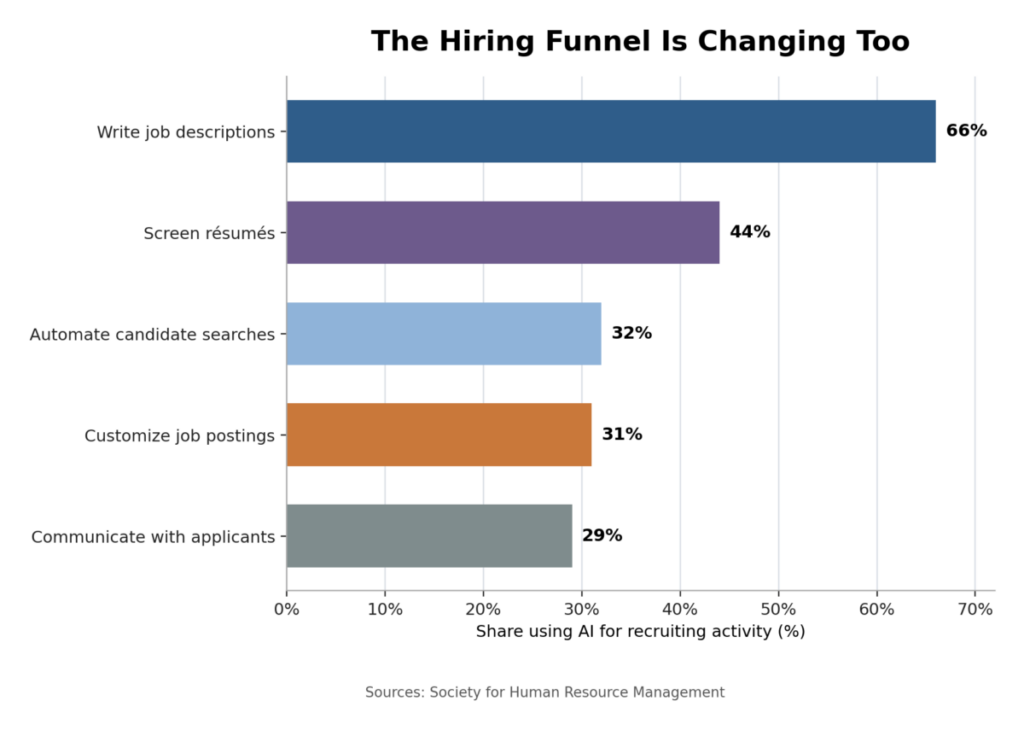
AI is also changing who reaches the workplace in the first place. Recruiting is now the most common HR function supported by AI: 51 percent of organizations using AI in HR apply it to recruiting, while 44 percent use it to screen résumés. Among HR professionals using AI for recruiting, 89 percent report time or efficiency gains, and 24 percent say it improves their ability to identify top candidates.
The advantage is clear. Employers can process larger applicant pools, enforce minimum qualifications more consistently, and spend less recruiter time on obviously poor matches. At scale, automated screening lowers the cost of searching for labor.
The tradeoff is that efficient screening favors what can be measured cleanly. Credentials, experience patterns, skills, and career progression are easy to rank. Judgment, adaptability, learning speed, interpersonal ability, and unconventional experience are much harder to recognize before a human conversation takes place.
A candidate can therefore be qualified and still become invisible to the organization.
That can push firms toward a narrower corporate prototype: applicants whose experience and presentation closely match an established definition of success. For standardized roles, that may improve consistency. For roles that depend on adaptation, creativity, or unusual combinations of experience, the same process can reduce exploratory hiring and make the workforce more uniform.
The economic issue is not merely that some candidates are rejected. Automated hiring can lower the cost of finding conventional talent while raising the effective cost of being unconventional.
For younger workers, that compounds the apprenticeship problem. There may be fewer entry positions, higher capability expectations for those positions, and a more automated screening process deciding who becomes visible enough to compete for them. One randomized recruitment study involving 37,000 applicants found an AI-assisted pipeline advanced candidates who later passed a common human interview at a higher rate than traditional résumé screening, demonstrating that automation can improve selection even as it changes the criteria through which people enter the funnel.
AI is therefore changing labor matching as well as labor demand.
| Hiring Activity | AI Use or Benefit | Tradeoff |
|---|---|---|
| Recruiting | 51% of organizations using AI in HR | More automated candidate processing |
| Résumé screening | 44% use AI for screening | More reliance on measurable signals |
| Recruiter efficiency | 89% report time or efficiency gains | Less manual review |
| Candidate identification | 24% report better identification of top candidates | Nonstandard profiles can be harder to surface |
Sources: Society for Human Resource Management
Comparative Advantage Is Moving
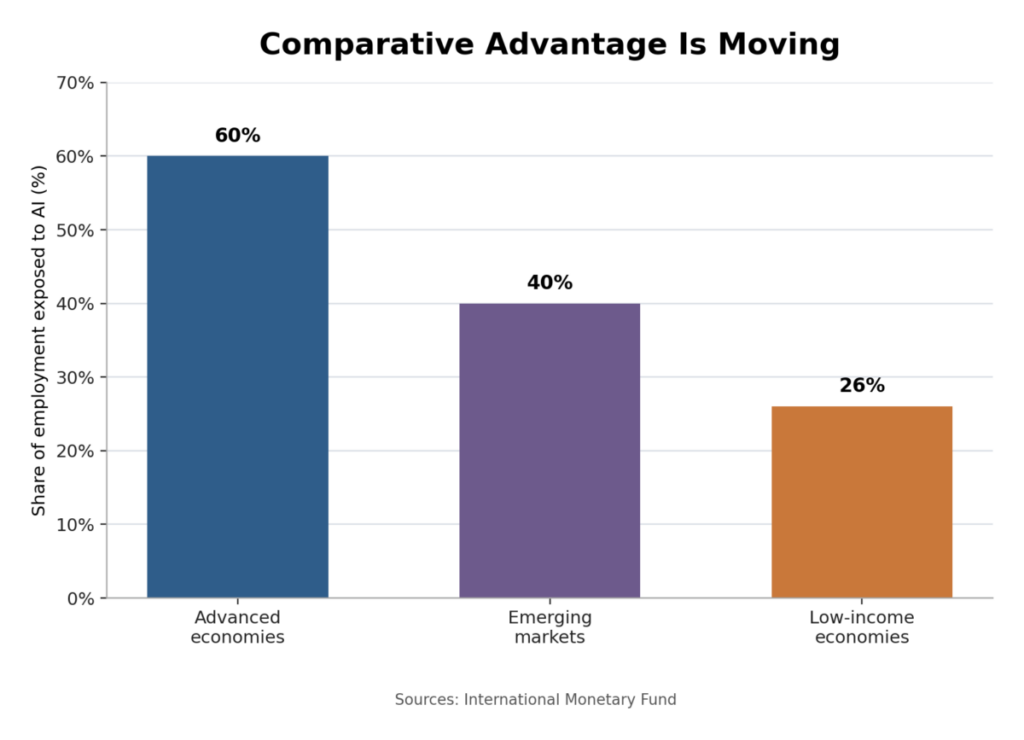
The increase in worker leverage produces different economic consequences across development tiers. Roughly 60 percent of employment in advanced economies is exposed to AI, compared with about 40 percent in emerging markets and 26 percent in low-income economies. Lower exposure does not necessarily mean greater protection because the value of AI depends on what an economy produces, what labor costs, and whether businesses can capture the productivity gain.
For advanced economies, expensive cognitive labor makes augmentation unusually valuable. A smaller professional team equipped with AI can absorb work once divided among more employees or purchased from contractors abroad. Portions of service activity can effectively return to high-wage economies without restoring the employment structure once attached to them. Production can be repatriated without jobs returning at the same rate.
Middle-income economies built around outsourced services face the inverse pressure. Their advantage has often combined educated workers with lower wages. As AI enables a smaller high-wage team to perform work previously assigned to a larger offshore group, wage arbitrage loses some of its force. Business-process outsourcing does not disappear suddenly, but routine cognitive labor becomes less powerful as a development strategy.
More complex operations remain defensible because judgment, relationships, local knowledge, and accountability are harder to commoditize. The economic race increasingly runs between the declining value of standardized services and the ability to move workers toward higher-value operation of AI-enhanced systems.
Developing economies encounter another possibility. AI can function as a form of synthetic expertise where professional capacity is scarce. A small firm without access to a consultant can obtain useful first-stage analysis, while a technician can approach more complex equipment with intelligent diagnostic support. Some countries may acquire pieces of professional capability without first reproducing the full institutional structure through which advanced economies built it.
Leapfrogging, however, is not automatic. Research across 135 countries finds that developing economies can face disruption before equivalent productivity gains arrive because digital infrastructure and the composition of work differ sharply. Current AI-derived value in many developing economies is also concentrated among a narrow professional group rather than spreading broadly through the workforce.
The global divide may therefore shift from who has access to AI toward who can translate AI into widespread productive capacity.
| Economic Group | AI Exposure | Primary Labor Dynamic |
|---|---|---|
| Advanced economies | About 60% | High-value augmentation and lower incremental hiring |
| Emerging markets | About 40% | Pressure on routine cognitive cost advantages |
| Low-income economies | About 26% | Lower exposure but weaker readiness |
| Developing economies | 135-country evidence base | Disruption can precede productivity gains |
Sources: International Monetary Fund, International Labour Organization, World Bank
The New Labor Equation
As these effects accumulate, the familiar argument over whether AI creates or destroys jobs becomes increasingly inadequate. Both outcomes can occur while the deeper relationship between output and labor changes underneath them.
BCG estimates that 50 to 55 percent of U.S. jobs could be materially reshaped within several years, while 10 to 15 percent may eventually be vulnerable to elimination. Employer surveys similarly show more organizations planning to retrain workers than remove them, although 41 percent expect reductions where AI can automate existing tasks. These figures remain forecasts rather than measured outcomes, but they reflect an emerging business assumption that transformation will be broader than outright replacement.
The operator economy is the practical expression of that transformation. One office worker can supervise more information, one technician can manage more capable machinery, and one entrepreneur can access forms of analysis that once required a larger organization. The worker remains essential, but the productive radius around that worker expands.
For advanced economies, the shift can mean growth with weaker incremental hiring and greater returns to capital and specialized judgment. For middle-income economies, it can alter the comparative advantage of inexpensive cognitive labor. For developing economies, it can provide missing expertise while creating dependence on infrastructure and technology controlled elsewhere.
Those differences are likely to appear in employment systems long before they produce a universal unemployment story. Education systems may find that the first rung of professional training has narrowed. Hiring systems may increasingly determine employability through standardized, machine-readable signals. Companies may become leaner while depending more heavily on a smaller pool of experienced workers capable of detecting failures that automated systems cannot resolve.
The useful economic indicator may ultimately be less dramatic than a layoff count. The more revealing signal is how much employment accompanies each additional unit of output in AI-exposed sectors. If production and revenue repeatedly outpace hiring, declining employment elasticity will reveal a labor transformation that unemployment alone cannot capture.
AI has not produced the workforce collapse once forecast. It may instead be producing something more structural: an economy in which growth requires progressively less additional human labor while access to the remaining opportunities becomes more selective.
| Labor Shift | Scale or Direction | Emerging Structure |
|---|---|---|
| Jobs reshaped by AI | 50–55% of U.S. jobs within 2–3 years | Work changes before jobs disappear |
| Jobs potentially eliminated | 10–15% over roughly 4–5 years | Substitution remains narrower than transformation |
| Worker role | More supervision and exception handling | Operator-centered work |
| Firm growth | Output can rise faster than headcount | Lower labor intensity of growth |
Sources: Boston Consulting Group, Stanford Institute for Economic Policy Research
TL;DR Summary
- The early AI labor narrative focused too heavily on layoffs and direct job replacement.
- Aggregate employment data still do not show a broad AI unemployment shock.
- AI is beginning to reduce the amount of additional labor required as firms grow.
- Suppressed hiring can create displacement without an existing worker losing a job.
- Employment elasticity may become a more useful AI-era measure than layoff counts alone.
- Skill compression raises worker capacity while weakening some entry-level hiring.
- Reduced junior hiring can create an apprenticeship deficit in the production of future expertise.
- AI-assisted recruiting lowers hiring costs and improves screening efficiency, but can narrow which candidates become visible to employers.
- Younger workers may face fewer openings, higher entry expectations, and more automated filtering at the same time.
- Advanced economies may internalize more work without recreating the employment previously attached to it.
- Middle-income economies face pressure where development models depend heavily on low-cost routine cognitive services.
- Developing economies can gain synthetic expertise, but infrastructure determines whether those gains spread broadly.
Sources
- Stanford Institute for Economic Policy Research; What Is Really Happening to Jobs? Separating AI Hype From Reality; – Link
- Federal Reserve Board; AI Adoption and Firms’ Job-Posting Behavior; – Link
Growth Can Require Less Labor
- National Bureau of Economic Research; Generative AI at Work; – Link
- International Monetary Fund; Aggregate Gains from AI and Their Distribution: Global Evidence from Usage Data; – Link
- Federal Reserve Board; The AI Buildout and the Economy: Publicly Available Data to Assess AI’s Impact; – Link
- Federal Reserve Board; Monitoring AI Adoption in the US Economy; – Link
Skill Compression Creates an Apprenticeship Problem
- U.S. Census Bureau; You’re (Not) Hired: Artificial Intelligence and Early Career Hiring in the Quarterly Workforce Indicators; – Link
The Hiring Funnel Is Changing Too
- Society for Human Resource Management; 2025 Talent Trends: AI in HR; – Link
- Industrial and Labor Relations Review via Rutgers University; When AI Enters the Hiring Funnel: Variation in Employer Use of AI-Enabled Hiring Practices Within and Across Organizations; – Link
- Ada Aka, Emil Palikot, Ali Ansari, and Nima Yazdani; Better Together: Quantifying the Benefits of AI-Assisted Recruitment; – Link
Comparative Advantage Is Moving
- International Monetary Fund; AI Will Transform the Global Economy. Let’s Make Sure It Benefits Humanity; – Link
- International Labour Organization; Disruption Without Dividend? How the Digital Divide and Task Differences Split GenAI’s Global Impact; – Link
The New Labor Equation
- Boston Consulting Group; AI Will Reshape More Jobs Than It Replaces; – Link
- World Economic Forum; The Future of Jobs Report 2025; – Link
- World Economic Forum; Future of Jobs Report 2025: Workforce Strategies; – Link
Keywords: Artificial Intelligence, Labor Markets, Economic Growth, Labor Intensity, Employment Elasticity, Comparative Advantage, Workforce Transformation