

Connected technology has advanced so quickly and broadly that many of its breakthroughs are becoming ordinary before they become memorable. The world ended 2025 with roughly 21.1 billion connected IoT devices, 14 percent more than a year earlier. Enterprise use accounted for about 45 percent of those connections, while cellular IoT reached approximately 4.7 billion. These figures describe an infrastructure layer already embedded in business operations and consumer life, not a technology waiting for its economic moment.
Technological booms are usually recognized through rupture. An industry collapses, a dominant platform reorganizes a market, or automation removes enough labor to make the transition politically unavoidable. IoT has produced no comparable breakpoint. Its progress has moved at the speed of modern life through normal investment cycles, gradual service improvements, and changing consumer behavior. Businesses, institutions, and households have advanced at the same time, allowing a major transformation to blend into the natural evolution of economic life.
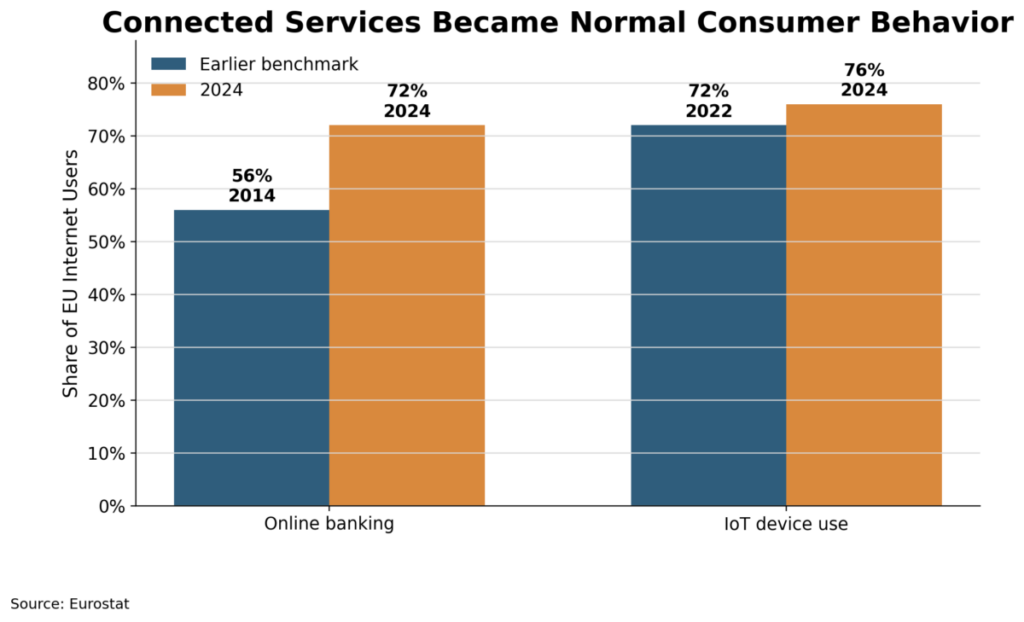
A decade ago, continuous visibility into machinery or commercial assets often required specialist infrastructure. Today, connected monitoring is increasingly treated as a normal feature of competent operations. In 2024, 70.9 percent of people in the European Union used at least one connected device, while online banking use had risen from 56 percent of internet users in 2014 to 72 percent. Formerly exceptional capabilities have become ordinary expectations before the wider transformation has been named.
| Indicator | Latest Evidence | Economic Meaning |
|---|---|---|
| Global IoT connections | 21.1 billion devices in 2025, up 14 percent | Connected capability has reached infrastructure scale. |
| Enterprise share | About 45 percent of IoT connections | Commercial and industrial use now defines much of the market. |
| Cellular IoT | Approximately 4.7 billion connections | Persistent connectivity is becoming routine across distributed assets. |
| Consumer adoption | 70.9 percent of EU residents used a connected device in 2024 | Connected services increasingly shape ordinary consumer expectations. |
| Sources: IoT Analytics; Eurostat | ||
How the Physical Economy Became Observable
Rather than beginning with a device, the practical IoT system begins with a changing physical condition that must be recognized early enough to influence an outcome. A sensor identifies the change, connectivity carries the signal, and local or cloud software interprets its significance. The economic result still depends on whether the organization has given the system enough authority to trigger a response.
That operating chain explains why latency and interoperability matter. Information that arrives after equipment has failed cannot prevent downtime, while data trapped inside incompatible systems cannot easily influence wider planning. Falling connectivity costs and shared computing infrastructure have reduced these frictions, allowing connected functions to enter during routine equipment replacement or broader software modernization.
U.S. utilities operated 128.4 million advanced meters in 2023, covering 76.8 percent of the national meter base. At that scale, connected metering is no longer an experimental technology category. It is part of the ordinary information infrastructure through which utilities detect changing demand and manage service more precisely.
Progress becomes least visible when it becomes operationally normal.
| Operating Stage | System Function | Main Constraint | Business Consequence |
|---|---|---|---|
| Observation | Sensors detect a physical change. | Accuracy and asset coverage | Previously hidden conditions become measurable. |
| Transmission | Connectivity moves the signal to a decision system. | Latency and network reliability | Information arrives early enough to influence an outcome. |
| Interpretation | Local or cloud software identifies operational significance. | Data quality and interoperability | Signals become recommendations rather than raw data. |
| Response | A person or automated system changes the process. | Authority and workflow integration | Connected information produces measurable operating value. |
| Sources: NIST; Federal Energy Regulatory Commission | |||
When Business Advantage Becomes the Baseline
For businesses, the first economic gain comes from reducing the time between a changing condition and a management response. Predictive maintenance offers the clearest mechanism. A shift in vibration or temperature can indicate that machinery is deteriorating, allowing maintenance to occur before production stops. Repeated operating data can then influence replacement timing and reduce the amount of backup capacity held against uncertainty.
Industry 4.0 adoption has been associated with an average labor-productivity gain of about 7 percent, although performance varies with the depth of integration. The figure reflects a broader principle: connectivity expands what a company can know, but organizational absorption determines whether that knowledge improves output. A business can receive accurate equipment alerts and still achieve little when maintenance approval remains tied to an unchanged calendar.
As more firms adopt similar capabilities, an initial advantage becomes a market expectation. Faster response and dependable service do not lose their economic value, but they stop appearing innovative once competitors provide them as well. The disappearance of the technology’s identity is therefore evidence of maturity. Like earlier infrastructure systems, IoT is increasingly evaluated through the reliability and responsiveness it enables rather than through the label attached to it.
Unequal adoption complicates that progress. Large enterprises can distribute technical and security costs across broad operations, while smaller firms face the same rising service baseline with fewer resources. Synchronized advancement can conceal both rapid improvement and a widening capability gap.
The strategic threshold arrives when operating information moves beyond the maintenance dashboard. Consistent evidence about asset performance can influence capital planning and allow suppliers to guarantee availability rather than sell equipment without continuing responsibility. Connected information begins to carry financial authority because it changes how risk and commercial responsibility are assigned.
IoT becomes strategic when connected evidence gains authority over capital, risk, and performance.
| Business Stage | Connected Capability | Economic Result | Supporting Evidence |
|---|---|---|---|
| Operational visibility | Asset conditions are monitored continuously. | Earlier detection and lower uncertainty | 128.4 million U.S. advanced meters in 2023 |
| Operational integration | Signals alter maintenance and production decisions. | Higher output from existing labor and capital | Average productivity gain of about 7 percent |
| Market normalization | Competitors adopt similar visibility and response standards. | Former advantages become minimum market expectations. | Enterprise use represents about 45 percent of IoT connections. |
| Strategic authority | Operating evidence informs capital and service commitments. | Risk shifts toward measurable performance guarantees. | Digital servitization and firm-level adoption evidence |
| Sources: Federal Energy Regulatory Commission; Small Business Economics; IoT Analytics; Industrial Marketing Management | |||
The Human Standard of Continuous Awareness
Across daily life, IoT has changed the social meaning of waiting and uncertainty. People increasingly expect service providers to know where a delivery is, whether infrastructure is operating, and when an interruption will be resolved. The underlying technology recedes because the benefit is experienced as fewer surprises and a higher standard of institutional competence.
Connected utility systems show how the improvement extends beyond convenience. Continuous monitoring can reveal abnormal consumption or a developing failure before citizens must report the problem themselves. Limited repair capacity can then be directed toward the most urgent intervention, reducing service interruption and the time households spend waiting for an institution to identify what has already gone wrong.
Within the workplace, connected systems can shift labor away from searching for problems and toward interpreting or resolving them. A technician can arrive with diagnostic evidence rather than begin with an open-ended inspection. A manager can respond to deterioration before it appears through lost output. These changes often augment work rather than remove it outright.
The same visibility can also increase managerial control. Infrastructure designed to observe machinery can be extended toward continuous worker monitoring, while automated recommendations may become difficult to challenge. Convenience and productivity therefore depend partly on whether people retain meaningful authority over decisions that affect their work and access to services.
| Area of Impact | Earlier Condition | Connected Baseline | Human Consequence |
|---|---|---|---|
| Service awareness | Status became known only after delay or inquiry. | Continuous service visibility is increasingly expected. | Less waiting and lower uncertainty |
| Essential infrastructure | Failures often depended on public reporting. | Remote monitoring identifies abnormal conditions earlier. | Faster intervention and improved reliability |
| Technical work | Workers searched broadly for emerging problems. | Diagnostics direct attention toward likely causes. | More time for interpretation and repair |
| Workplace authority | Observation was periodic and locally controlled. | Continuous monitoring can centralize oversight. | Greater efficiency alongside privacy and control risks |
| Sources: Eurostat; United Nations Development Programme; OECD | |||
One Technology Across Unequal Economies
Although the technology is global, its most important constraint changes with the maturity of the surrounding system. These tiers describe dominant conditions rather than uniform national categories, and more than one can exist within the same economy.
High-income economies entered 2025 with about 94 percent of their populations online, compared with 23 percent in low-income economies. Mature systems are therefore less constrained by basic access than by integration and trust. Their challenge is to make abundant connected information secure, interoperable, and useful across institutional boundaries.
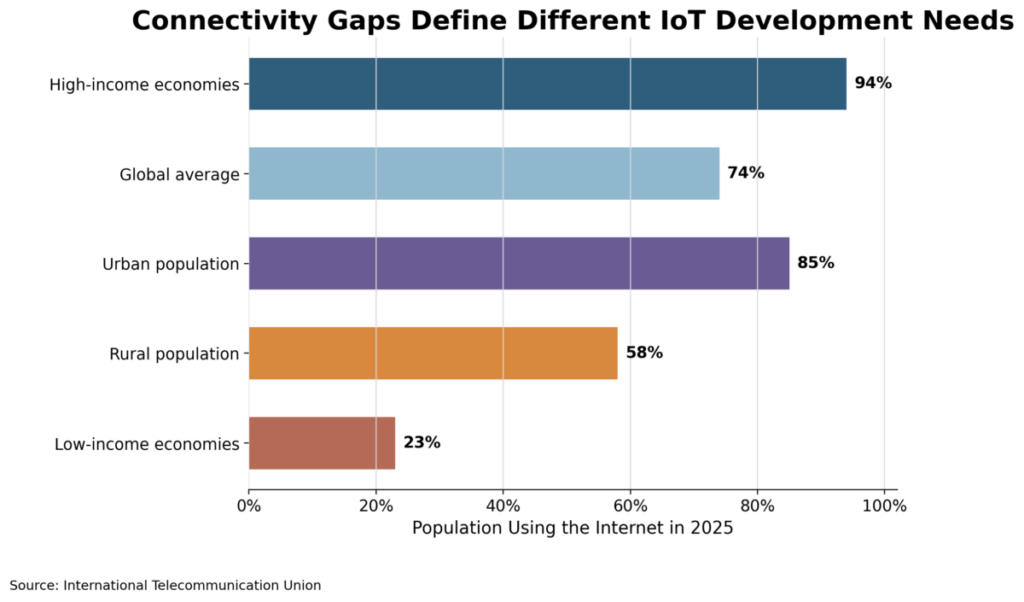
Middle-tier systems face a diffusion problem. Sophisticated firms and connected urban projects may coexist with smaller businesses that cannot finance integration or maintain specialized systems. The next economic gain depends on extending capability beyond frontier organizations without allowing maintenance costs or vendor dependence to undermine adoption.
In lower-capacity systems, targeted observation can be more valuable than comprehensive automation. Connected monitoring can help limited institutions identify where intervention is most urgent, but information has little value when organizations lack reliable power, maintenance resources, or authority to respond. IoT can leapfrog weak observation more easily than it can leapfrog weak institutions.
| Development Context | Dominant Need | Main Constraint | Governance Priority | Connectivity Context |
|---|---|---|---|---|
| Modern systems | Deeper strategic integration | Fragmented systems and institutional trust | Security, interoperability, and liability | About 94 percent online in high-income economies |
| Middle-tier systems | Diffusion beyond frontier organizations | Financing and maintenance capacity | Shared standards and procurement flexibility | Broad coverage but uneven productive use |
| Developing systems | Targeted observation of essential services | Basic access and institutional response | Local maintainability and operating authority | About 23 percent online in low-income economies |
| Sources: International Telecommunication Union; GSMA; NIST | ||||
From Connected Operations to Economic Governance
Once connected systems become ordinary infrastructure, their rules become part of economic governance. Security obligations determine who must protect devices throughout their operating life. Data-access rules shape bargaining power between asset owners and technology providers, while procurement terms determine whether an institution can maintain a system locally or switch suppliers without prohibitive cost.
Security has already become a standard feature of digital operations, with 93 percent of EU enterprises using at least one ICT security measure in 2024. The regulatory question is no longer whether connected systems require protection, but how responsibility is divided when an insecure device or inaccurate signal causes physical or financial harm.
Liability becomes more difficult as automation increases. When a connected system recommends maintenance, changes resource allocation, or initiates a response, economic responsibility can be divided among the operator and the technology provider. Clear rules are needed because continuous observation changes who possesses information and who can reasonably be expected to act on it.
Artificial intelligence will increase the value of connected data by identifying patterns across larger operating environments, although true edge-AI capability remained below 1 percent of IoT connections at the end of 2025. The next phase will therefore depend on more than computing power. It will require institutions willing to trust connected evidence and governance systems capable of assigning responsibility when that trust fails.
Global IoT connections are projected to approach 39 billion by 2030, but device growth will become a less useful measure of progress. The decisive economic threshold will be whether connected information remains an operational aid or becomes a trusted input into capital allocation, service guarantees, and public infrastructure planning.
IoT has not produced a delayed or diminished revolution. Its advances are happening rapidly, but they are being absorbed into business and consumer cycles before they can register as a single historic event. The absence of mass layoffs or market collapse has made the boom harder to recognize, not less consequential.
The next decade will be defined less by how many objects become connected than by how thoroughly connected intelligence becomes part of the way economies decide, respond, and improve.
TL;DR Summary
- IoT reached roughly 21.1 billion connected devices in 2025.
- Rapid adoption has blended into normal business and consumer change.
- IoT makes physical conditions visible to software before failure occurs.
- Connectivity creates value only when organizations can act on the information.
- Predictive maintenance links sensing directly to operational and capital decisions.
- Competitive advantages become ordinary market expectations as adoption spreads.
- Connected services have reduced waiting and raised expectations for institutional awareness.
- Worker augmentation and continuous monitoring are developing through the same infrastructure.
- Development needs differ according to integration, diffusion, and response capacity.
- Regulation determines security responsibility, data control, procurement flexibility, and liability.
- AI will increase IoT’s analytical power but will not resolve institutional weaknesses.
- The next economic threshold is connected information gaining authority over major decisions.
Sources
The IoT Boom Already Underway
- IoT Analytics; Number of Connected IoT Devices Growing 14 Percent to 21.1 Billion Globally; – Link
- Eurostat; Internet Connected Devices Are Widely Used in the EU; – Link
- Institute of Internet Economics; IoT and the New Economics of Coordination; – Link
How the Physical Economy Became Observable
- Federal Energy Regulatory Commission; 2025 Assessment of Demand Response and Advanced Metering; – Link
- Eurostat; Smart Technologies in EU Enterprises AI and IoT; – Link
- National Institute of Standards and Technology; IoT Device Cybersecurity Guidance for the Federal Government; – Link
When Business Advantage Becomes the Baseline
- Small Business Economics; Is This Time Different How Industry 4.0 Affects Firms Labor Productivity; – Link
- OECD; Digital Technology Adoption Productivity Gains in Adopting Firms and Sectoral Spillovers; – Link
- Eurostat; Digitalisation in Europe 2025; – Link
- IoT Analytics; State of Enterprise IoT From IoT to Autonomous Connected Operations; – Link
The Human Standard of Continuous Awareness
- Eurostat; Digitalisation in Europe 2025 Online Activities; – Link
- United Nations Development Programme; Detecting Non Revenue Water Using the Internet of Things and Artificial Intelligence; – Link
- United Nations Development Programme; New Infrastructure and Safer Living Conditions in Srbac; – Link
- Institute of Internet Economics; Connected Living Truly Emerges; – Link
One Technology Across Unequal Economies
- International Telecommunication Union; Measuring Digital Development Facts and Figures 2025; – Link
- International Telecommunication Union; Internet Use in Urban and Rural Areas; – Link
- GSMA; IoT and Essential Utility Services in Low and Middle Income Countries; – Link
- GSMA; Water Utility Digitalisation in Low and Middle Income Countries; – Link
From Connected Operations to Economic Governance
- National Institute of Standards and Technology; IoT Device Cybersecurity Capability Core Baseline; – Link
- Eurostat; 93 Percent of EU Businesses Apply ICT Security Measures; – Link
- OECD; Digital Technology Diffusion in the Age of AI; – Link
- International Telecommunication Union; Global Connectivity Report 2025; – Link