
For most of modern banking history, financial progress followed a stable institutional logic. Formal income entered an account, accumulated over time, established creditworthiness, and eventually supported ownership or investment. Banks were built to protect that progression through regulated custody and conservative lending because their primary obligation was to preserve value over time rather than accelerate its movement.
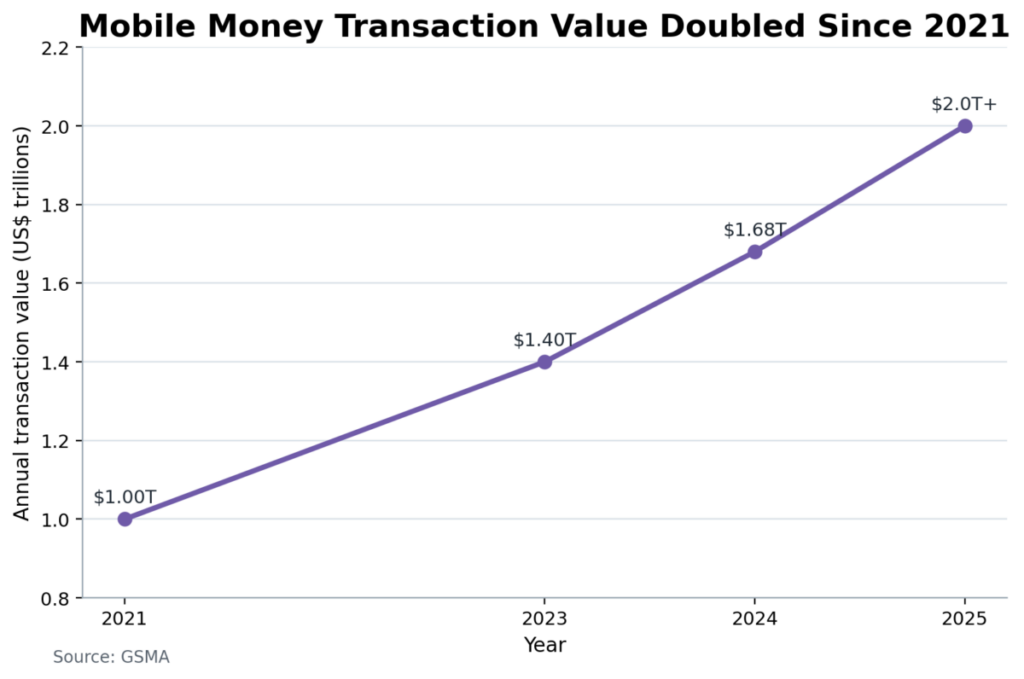
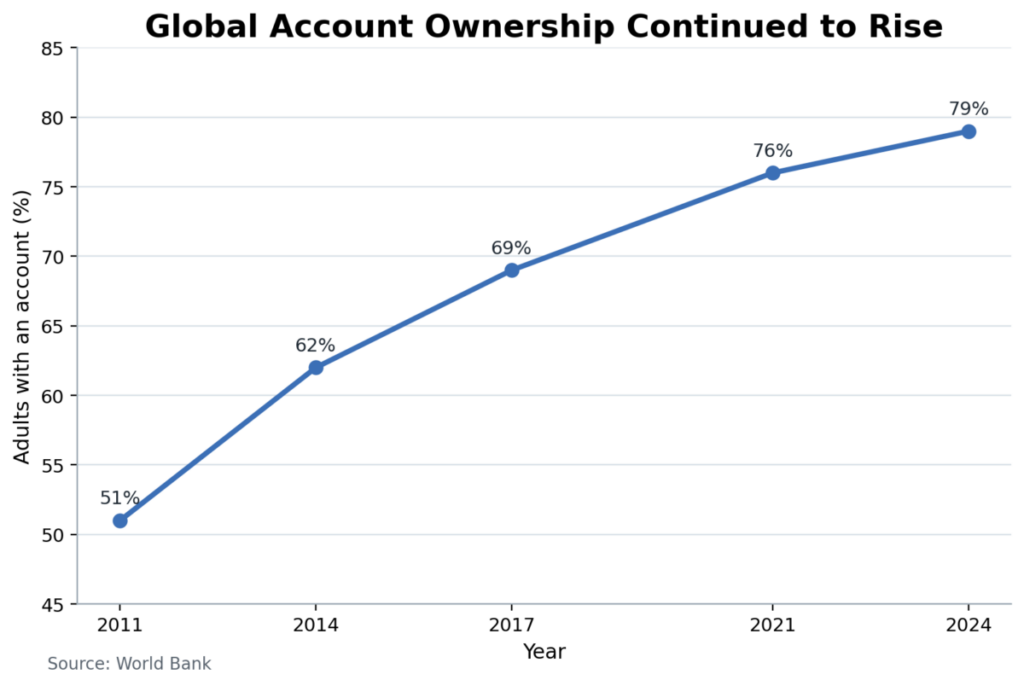
Global account ownership reached 79 percent in 2024, yet 1.3 billion adults remained outside the formal system, including nearly 900 million who already owned a mobile phone. Mobile-money systems processed more than $2 trillion in 2025 after growing 23 percent in one year, showing that access to money is increasingly being reorganized around connectivity rather than branch-based relationships.
That change began with the way people work and trade. Platform labor, online sales, and digitally mediated services produce income in smaller and less predictable intervals, often at the moment a task or transaction is completed. Mobile technology made immediate access practical by connecting work, payment, and spending within the same environment. The appeal of networked finance lies less in novelty than in its fit with modern behavior: people increasingly expect confirmation, control, and access when value is created.
Financial latency – the interval between earning value and being able to use it – has therefore become both a behavioral friction and an economic cost. A worker may need immediate payment to continue working, while a merchant may depend on the proceeds of one sale to support the next. Under those conditions, speed is not merely convenience; it determines whether economic activity can continue without borrowing or interruption.
The same transition is changing financial identity. Traditional credit systems rely on formal borrowing histories and stable documentation, while networked finance can interpret recurring transaction patterns and the continuity of economic activity. Informal behavior can become financially visible before it resembles a conventional credit file, shifting attention from an established score toward evidence of participation.
The widening schism is not simply between banks and fintech companies. It is between finance organized around future wealth and finance organized around present participation. Traditional banking assumes that money will remain within an institution long enough to be protected or expanded. Networked finance assumes that money must remain usable while it moves.
| Dimension | Traditional Banking | Networked Finance |
|---|---|---|
| Purpose | Protect and grow money | Keep money moving |
| Income model | Stable and periodic | Irregular and immediate |
| Financial identity | Credit history | Transaction patterns |
| Main value | Safekeeping | Immediate access |
| Scale | 79% global account ownership | More than $2 trillion processed |
| Sources: World Bank; GSMA; Bank for International Settlements | ||
The Infrastructure of Fast Money
Behind the apparent simplicity of a wallet payment is a system in which companies can guarantee spending power without waiting for money to complete the slower process of conventional bank settlement. The difference between an established balance and an amount “available to spend” is consequential: one reflects settled funds, while the other can function as a digital credit extension supported by fintech algorithms, internal ledgers, and platform liquidity. By absorbing the delay beneath the transaction, the platform allows a person to be paid in one instant and, in the next, transfer that value or use it to purchase goods and services.
Immediacy is central to adoption rather than merely a technical advantage. Removing continuous access to instant transfers was estimated to reduce digital-wallet use by 15.75 percentage points, indicating how strongly users value the ability to act when income or obligation appears. Work can be found through a phone, a sale completed through the same device, and the resulting income made usable without a separate visit to a bank or payment counter. Finance moves inside the activity that created the money.
SuperApps carry this logic further by creating a continuous economic environment around one digital identity. A worker can receive earnings where the work was assigned, while a merchant can accept payment and direct the balance back into the business. Users avoid repeatedly establishing identity or moving value between unrelated services. Their appeal lies less in the number of functions they contain than in the continuity they create between intention, transaction, and payment.
Familiarity then begins to shape behavior. Immediate confirmation reduces uncertainty about whether money has arrived, while a known interface lowers the cognitive effort required for each transaction. Repeated success builds trust through use rather than through the reputation of a distant institution. As employers and merchants recognize the same payment identity, the wallet becomes more valuable and daily financial behavior begins to form around the network.
The scale of activity shows how firmly this model has entered routine commerce. Mobile-money users completed approximately 108 billion transactions in 2024, nearly 300 million each day, with transaction volume rising 20 percent in one year. Digital money is no longer used principally to transfer funds between individuals; it increasingly supports purchasing, merchant activity, and the continuous circulation of income.
Beneath the interface, transfers within one provider can often be completed by changing entries on its internal ledger. Movement into another bank or payment network requires settlement through shared infrastructure, while cash-heavy economies depend on local agents to convert physical money into electronic balances and maintain enough liquidity to support withdrawals. The apparent speed at the surface therefore rests on deeper coordination between ledgers, liquidity, and regulated institutions.
Mobile access gives this architecture unusual reach. In 2024, 84 percent of adults in low- and middle-income economies owned a mobile phone, representing roughly 4 billion people, while 64 percent owned a smartphone. Basic handsets and agent-assisted transactions remain central to inclusion even as SuperApps expand among users with stronger devices and more reliable data access. Yet only about half of phone owners in these economies protected their devices with a password, transferring new security responsibilities to the individual.
Scale alone does not guarantee meaningful use. More than 2 billion mobile-money accounts existed in 2024, but only slightly more than half a billion were active each month. Continued participation depends on whether the platform solves recurring financial problems and whether enough employers, merchants, and households accept its balance to keep money useful after it enters the system.
Interoperability determines whether that usefulness develops into freedom or dependence. Closed-loop systems keep value and transaction history within one provider’s network, while interoperable systems allow funds to move into bank accounts or competing services. The distinction becomes behavioral and economic when leaving a platform means abandoning not only a payment method, but also the identity, financial history, and commercial relationships built around it.
| System Layer | Platform Function | User Effect | Evidence |
|---|---|---|---|
| Available to spend | Makes value usable early | Immediate payment access | 15.75-point usage effect |
| SuperApp | Combines work and payment | Fewer steps | One digital identity |
| Transaction network | Links users and merchants | Wider acceptance | 108 billion transactions |
| Settlement | Moves value across networks | Fast transfers | Shared payment rails |
| Agent network | Connects cash and digital value | Deposits and withdrawals | 84% phone ownership |
| Active use | Supports recurring needs | Keeps balances useful | Over 500 million active users |
| Sources: Bank for International Settlements; GSMA; World Bank; Federal Reserve Financial Services | |||
Three Financial Conditions
Networked finance does not enter every economy through the same door. In advanced systems, it reduces friction within mature banking infrastructure. In middle-income economies, it connects formal institutions with commerce that still operates partly outside them. In developing markets, it can establish foundational access before branch and card networks reach full scale. The technology may appear similar across countries, but the human need it serves – convenience, connection, or first-time participation – depends on the structure of the economy.
Within advanced economies, digital finance shortens the distance between regulated money and the moment it is needed. Bank-linked wallets and instant-payment rails allow deposits to move more quickly, while fintech platforms compete to control the interface through which consumers experience that movement. The underlying system is not being replaced so much as reorganized around lower effort, faster confirmation, and immediate availability.
Broad account ownership does not eliminate financial mismatch. Ninety-six percent of U.S. households were banked in 2023, yet 14.2 percent remained underbanked and continued to rely substantially on nonbank services. For households with unstable income or limited reserves, the problem is often not the absence of an account but the delay, cost, and complexity surrounding its use. Public instant-payment systems can reduce that financial latency without displacing regulated deposits, preserving the institutional role of banks while allowing fintech providers to compete through speed and service quality.
Cash remains part of this architecture rather than simply resisting it. Although 55 percent of euro-area consumers preferred cashless payment in stores in 2024, 62 percent still considered access to cash important. Modernization is therefore producing a hybrid system in which digital speed coexists with the resilience, privacy, and personal control associated with physical money. Regulation in advanced systems must govern platform behavior and data portability without weakening access to regulated deposits or cash.
Across middle-income economies, the central need is connection. Formal banking may already serve salaries, established businesses, and major obligations, while much of daily commerce still moves through informal or cash-intensive channels. Consumers can use a bank for one part of their financial lives and a wallet for another, creating a layered system rather than a clean transition from traditional banking to digital finance.
Interoperable payment networks bridge that divide by allowing value to move affordably between merchants, consumers, and regulated accounts. India’s Unified Payments Interface demonstrates how shared infrastructure can carry digital payments beyond proprietary wallets and into routine commerce. Users do not need to commit to one closed platform before participating, and merchants can accept digital payments without rebuilding their businesses around a single provider. The strategic issue is not whether cash disappears, but whether money can move across systems without trapping users inside one commercial network.
Within developing economies, mobile finance can provide foundational access before conventional infrastructure reaches full scale. Stored-value systems supported by distributed agents extend transaction networks beyond branch and card coverage, allowing a phone number or digital identity to perform functions once dependent on a nearby bank. Financial development can begin with the ability to receive, transfer, and store value rather than with the construction of a complete branch network.
Sub-Saharan Africa reached 58 percent account ownership in 2024, with mobile money driving much of the expansion. In Kenya, broader access to M-Pesa was associated with about 194,000 households moving out of extreme poverty. The effect extended beyond payment speed because stronger remittance connections and more reliable access to money improved households’ ability to absorb shocks and continue economic activity.
The impact of networked finance consequently changes with economic context. Advanced systems must control behavioral manipulation and protect data portability within increasingly platform-driven interfaces. Middle-income systems depend on affordable interoperability between formal and informal commerce. Developing systems require safeguarded funds, reliable agent liquidity, and practical access for users whose first financial institution may be a mobile network rather than a bank.
| Condition | Primary Need | Digital Role | Evidence | Priority |
|---|---|---|---|---|
| Advanced | Lower friction | Faster regulated payments | 96% banked; 14.2% underbanked | Data and interface rules |
| Middle-income | Formal–informal connection | Interoperable payments | India’s UPI | Low-cost interoperability |
| Developing | First-time access | Mobile and agent networks | 58% account ownership | Fund and agent safeguards |
| Hybrid outcome | Choice and resilience | Cash and digital coexistence | 55% preferred cashless; 62% valued cash access | Maintain both channels |
| Sources: Federal Deposit Insurance Corporation; European Central Bank; National Payments Corporation of India; World Bank; Innovations for Poverty Action | ||||
Business Power, Regulation, and Human Consequence
As payment becomes part of the activity that creates it, commercial power shifts from the institution holding the account toward the platform controlling the transaction. A SuperApp can become the place where a user finds work, receives income, purchases goods, applies for credit, and establishes a financial record, even when a bank continues to safeguard or settle the underlying funds. The bank remains structurally important, but the platform becomes the institution the customer sees and experiences.
Control of that interface carries strategic value because it determines which financial option appears at the moment of need. An embedded platform can direct the user toward a preferred payment method or credit product without requiring them to leave the application. Every completed task and commercial exchange also adds to a continuous record of economic behavior. Banks may retain custody and settlement, while platforms increasingly own the relationship, the data, and the context in which financial decisions occur.
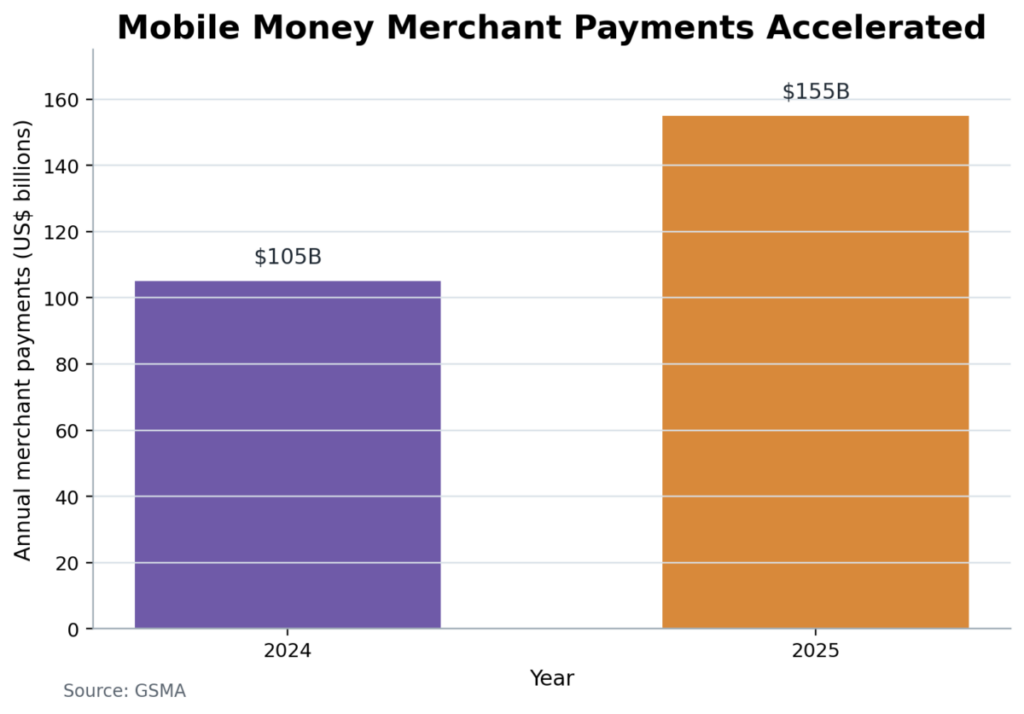
For merchants, this architecture changes the operating cycle rather than merely the payment method. Faster settlement reduces the period during which revenue remains unavailable after a sale, allowing funds to move directly into supplier payments or replacement inventory. Mobile-money merchant payments reached $155 billion in 2025 after rising by almost half in one year, showing that digital payment is becoming part of commerce itself rather than a separate institutional step.
The same transaction record can provide financial visibility to businesses and workers who lack conventional documentation. Smaller firms in emerging markets face a financing gap of roughly $5.2 trillion, creating demand for lending models that evaluate observable commercial activity. Pattern-based underwriting can interpret the continuity of cash flow and prior repayment behavior rather than relying exclusively on formal statements or a standardized credit score.
Combining transaction data with traditional credit information has increased predictive performance from 68.3 percent to 73.6 percent, but stronger prediction does not guarantee fair judgment. Irregular earnings may reflect the structure of platform labor rather than personal unreliability. When an algorithm interprets volatility without sufficient context, an expanded financial record can become another mechanism of exclusion.
Regulation must therefore follow money into the platform rather than stopping at the bank beneath it. Customer funds require protection from operating losses, while users need clear rights when balances are frozen or transactions reversed. Providers that rely on external credit models must remain accountable for the result, and borrowers need practical ways to correct inaccurate information and challenge adverse decisions.
The unequal cost of delay explains the human value of faster finance. A household with reserves can absorb a late payment, while someone living close to the next obligation may be forced to borrow or lose the ability to continue working. With online gig work involving between 154 million and 435 million people, immediate payment increasingly reflects the structure of employment rather than a preference for convenience.
Access can also change longer-term economic participation. In Kenya, broader mobile-money availability was associated with about 185,000 women moving from subsistence agriculture into business or retail activity. The effect came not only from faster transfers, but from the ability to receive money reliably and redirect it quickly into productive activity.
Opportunity, however, can become dependence when one platform connects work with payment and credit. An account suspension can interrupt both earning and spending, while a mistaken identity decision or automated risk flag can remove access to an entire economic environment. SuperApps reduce friction by integrating financial services, but that same integration concentrates control over the user’s identity and daily participation.
These systems will exert particular influence in emerging economies because they can expand more quickly than branch infrastructure and align more closely with how people already work and trade. Their growth will reinforce a clearer division of financial roles: fintech will increasingly organize fast money around movement and immediate participation, while traditional banking will continue to organize money around safekeeping, investment, and long-duration credit.
Neither system needs to eliminate the other. Networked finance will continue to grow where society values immediate access, while banks will remain essential where money must be protected and transformed into durable wealth. The central regulatory challenge is to ensure that fast money remains safeguarded and portable, and that circulation becomes a path toward financial advancement rather than a permanent lower tier of finance.
| Area | Platform Role | Effect | Evidence | Risk |
|---|---|---|---|---|
| Interface | Controls payment choices | Owns the customer relationship | SuperApp model | Biased product placement |
| Merchant payments | Speeds settlement | Improves cash flow | $155 billion in 2025 | Platform dependence |
| Transaction data | Tracks commercial activity | Expands financial visibility | $5.2 trillion funding gap | Data lock-in |
| Pattern credit | Uses cash-flow patterns | Improves risk prediction | 68.3% to 73.6% | Income misclassification |
| Economic identity | Links work and payment | Supports formal access | 154–435 million gig workers | Account suspension |
| Sources: Bank for International Settlements; GSMA; International Finance Corporation; Federal Deposit Insurance Corporation; World Bank | ||||
TL;DR Summary
- Traditional banking organizes money around safekeeping, stable income, credit history, and long-term wealth formation.
- Networked finance organizes money around immediate access, continuous movement, and participation in digital commerce.
- Mobile technology allows work, payment, spending, and financial identity to operate through one connected interface.
- Fintech platforms can make spending power available before conventional settlement is complete, reducing financial latency.
- SuperApps connect employment, commerce, payment, and credit around one persistent digital identity.
- Mobile-money users completed approximately 108 billion transactions in 2024, while annual transaction value exceeded $2 trillion in 2025.
- Digital finance serves different needs across economies: optimization in advanced markets, connection in middle-income systems, and foundational access in developing countries.
- Platforms increasingly control the customer interface even when banks retain custody and settlement.
- Transaction histories can expand access to credit, but algorithmic underwriting can misinterpret irregular income and reproduce exclusion.
- Fast payments can strengthen household resilience and merchant cash flow where income is irregular and reserves are limited.
- Regulation must protect customer funds, data portability, account recovery, and the right to challenge automated decisions.
- The emerging system will divide responsibility between fast-moving fintech platforms and banks focused on safekeeping, investment, and durable wealth.
Sources
- The Financial Latency Problem
- World Bank; The Global Findex Database 2025; – Link
- World Bank; Mobile Phone Technology Powers Saving Surge in Developing Economies; – Link
- Bank for International Settlements; Adoption and Welfare Effects of Payment Innovations; – Link
The Infrastructure of Fast Money
- GSMA; The State of the Industry Report on Mobile Money 2026; – Link
- GSMA; Mobile Money Surpasses Two Billion Registered Accounts and Half a Billion Monthly Active Users; – Link
- GSMA; Mobile Money Metrics; – Link
Three Financial Conditions
- Federal Deposit Insurance Corporation; 2023 National Survey of Unbanked and Underbanked Households; – Link
- European Central Bank; Study on the Payment Attitudes of Consumers in the Euro Area 2024; – Link
- National Payments Corporation of India; Unified Payments Interface; – Link
- Federal Reserve Financial Services; About the FedNow Service; – Link
- World Bank; Global Findex 2025 Regional Financial Inclusion Findings; – Link
Business Power, Regulation, and Human Consequence
- GSMA; Mobile Money Accounted for Two Trillion Dollars in Transactions in 2025; – Link
- International Finance Corporation; MSME Finance Gap; – Link
- Federal Deposit Insurance Corporation; On the Rise of FinTechs: Credit Scoring Using Digital Footprints; – Link
- World Bank; Working Without Borders: The Promise and Peril of Online Gig Work; – Link
- Innovations for Poverty Action; The Long-Term Effects of Access to Mobile Money in Kenya; – Link