
Internet connectivity is changing how businesses operate while expanding the number and diversity of buyers and sellers. Individuals and small businesses can reach customers through their own websites or marketplaces such as Etsy and eBay. Others supply merchandise through brokers and resellers. For rural, remote and underserved communities, these connections are especially significant. A small producer can reach distant customers without operating an online storefront.
The distinction between consumer and merchant is less pronounced. Among secondhand shoppers surveyed across ten countries in 2026, 38% had sold used merchandise online during the preceding year, and 48% of those sellers primarily did so for supplemental income. Someone purchasing clothing may later resell it, recovering part of the original expense.
Small enterprises have found opportunities in these arrangements. Among Etsy sellers surveyed in its 2024 census, 59% had first begun selling on the platform, while 29% identified their creative business as their sole occupation. Digital storefronts and outsourced production allow individuals to conduct business without establishing conventional retail infrastructure.
As producers and intermediaries connect to wider markets, consumers gain access to merchandise that might never reach local stores. Those connections are changing product discovery, merchant operations and the economics of participation.
| Population | Internet Use, 2025 |
|---|---|
| Global urban | 85% |
| Global rural | 58% |
| High-income countries | 94% |
| Low-income countries, rural | 14% |
Sources: International Telecommunication Union
The Changing Buying Experience
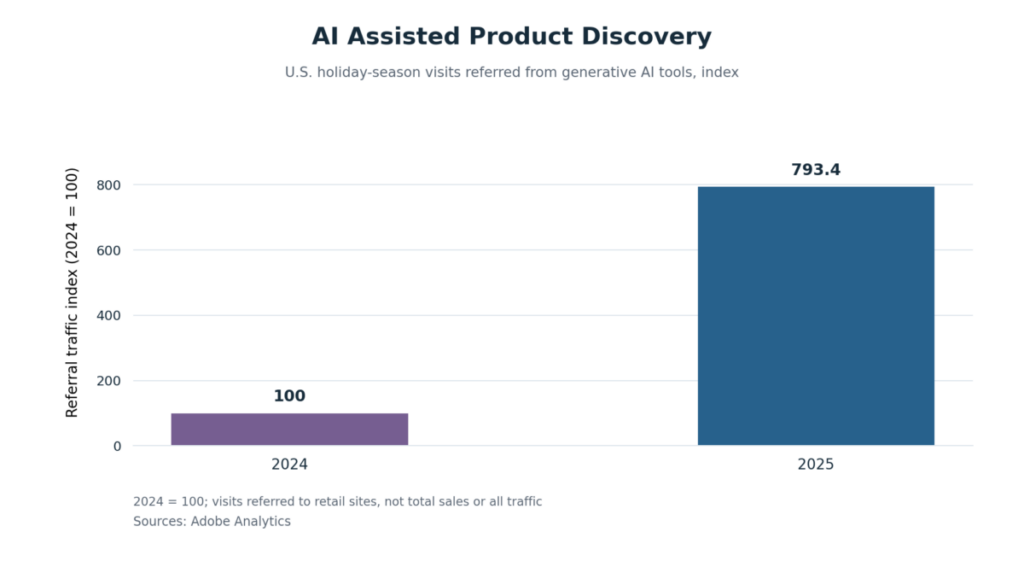
For much of the Internet’s commercial history, finding a product required knowing what to search for. A consumer seeking a waterproof cycling jacket can now describe the intended use and budget to an AI shopping assistant. The search begins with a requirement rather than a product name. During the 2025 American holiday shopping season, traffic reaching retail websites from generative AI services increased 693% over the previous year, although from a small starting point.
Better discovery can reveal specialized suppliers previously difficult to find, particularly for customers far from major retail centers. In a 2026 survey covering 29 countries, 38% of online shoppers had used AI-powered assistants to browse or buy merchandise. Augmented reality also allows customers to assess how furniture might appear inside their homes. Consumers can increasingly express what they need without knowing where to look.
Shopping has become more conversational. In Brazil, participating businesses accept purchases and payments through WhatsApp. Livestream selling allows customers to examine merchandise and question sellers. These interactions offer smaller merchants ways to develop relationships beyond conventional storefronts.
The final transaction is less forgiving than discovery. In the same 2026 survey, 67% of online shoppers had abandoned purchases because of delivery arrangements. For remote communities, transportation costs and limited delivery options can offset wider product choice. Finding a distant supplier is useful only when merchandise can be received at an acceptable cost.
| Purchasing Behavior | Shoppers | Survey |
|---|---|---|
| Abandon without preferred delivery option | 81% | 2025 |
| Abandon without preferred returns option | 79% | 2025 |
| Faster delivery would encourage purchase | 20% | 2026 |
Sources: DHL eCommerce
The Changing Selling Experience
An independent merchant can operate a storefront that once required considerable technical assistance. AI-supported software prepares product images, while automated translation facilitates international communication. Among small and medium-sized businesses participating in an OECD survey, AI adoption rose from 26% in 2024 to 39% in 2025. Although not representative of all small businesses, the findings illustrate growing adoption of digital tools.
Not every producer needs these tools directly. A rural craftsperson may sell through a marketplace, while an agricultural producer supplies a reseller handling online orders and distribution. Intermediaries connect producers to customers without requiring them to operate online stores.
For merchants managing their own sales, improvements often occur behind the storefront. An online purchase can update inventory and initiate fulfillment without repeated manual entry, reducing administrative work.
Customers, however, still have to find the business.
As discovery moves into conversations and recommendation systems, visibility demands more than an attractive storefront. In the OECD’s 2025 survey, 51% of participating retail businesses prioritized digital marketing and search optimization skills. Accurate product information also helps purchasing software identify relevant merchandise.
A six-year ethnographic study published in November 2026 found that digital platforms were reshaping small-business work through content production and online relationship management. A merchant may spend less time processing orders but more time attracting customers. Intermediaries offer another route to market, exchanging some control and revenue for established customer access.
| Learning Method | Surveyed SMEs |
|---|---|
| Internet research | 35% |
| Learning from colleagues | 23% |
| Formal training | 13% |
| Expert-led training | 6% |
Sources: OECD
New Forms of Commerce
An individual producing woodworking videos can sell downloadable designs to an established audience. Someone designing household accessories can offer personalized products manufactured after an order arrives. These practices are not new, but connecting customers, payments and production has become easier. A designer in a small town can serve international customers while manufacturing takes place elsewhere.
Resale offers a clear example of consumers becoming commercial participants. In a 2026 international survey, 47% of respondents purchased secondhand merchandise at least monthly, compared with 35% the previous year. Improved listing tools and integrated shipping make household sales more practical. Saving money ranked among the three leading motivations for 84% of surveyed secondhand buyers.
Resale marketplaces connect buyers who might never encounter one another locally. Collectors find specialized merchandise while households recover money from possessions they no longer need. Demand is aggregated across locations rather than restricted to nearby customers.
Customized production follows a related principle. Print-on-demand services allow merchants to sell designs without inventories of finished products. Additive manufacturing extends small-scale production to specialized components. Remote producers can sell directly or through established resellers, manufacturing against actual orders rather than estimates of future demand.
These arrangements accommodate small enterprises. Etsy’s 2024 census found that 89% of sellers operated one-person businesses and 97% worked from home. Agricultural producers can similarly coordinate digital orders through regional distributors, while recurring subscriptions help anticipate demand. Connected services reduce the expense of coordinating commerce, although profitability still depends on completing transactions economically.
| Seller Characteristic | Surveyed eBay Sellers |
|---|---|
| Source inventory from personal belongings | 85% |
| Source inventory from family and friends | 28% |
| Selling secondhand for over five years | 58% |
| Selling secondhand for over twenty years | 12% |
Sources: eBay
The Economics of Independent Commerce
A merchant can test demand before investing in inventory or offer merchandise manufactured only after purchase. For rural producers, access to distant customers can overcome limited local demand. Profitability, however, remains a separate consideration.
Consider a merchant selling a $60 product costing $20 to manufacture. The remaining $40 must cover customer acquisition, payment processing, shipping and returns. A low-cost storefront offers little advantage if fulfillment absorbs the margin. Brokers may eliminate some marketing expenses but retain a share of revenue. The better arrangement depends on costs and services.
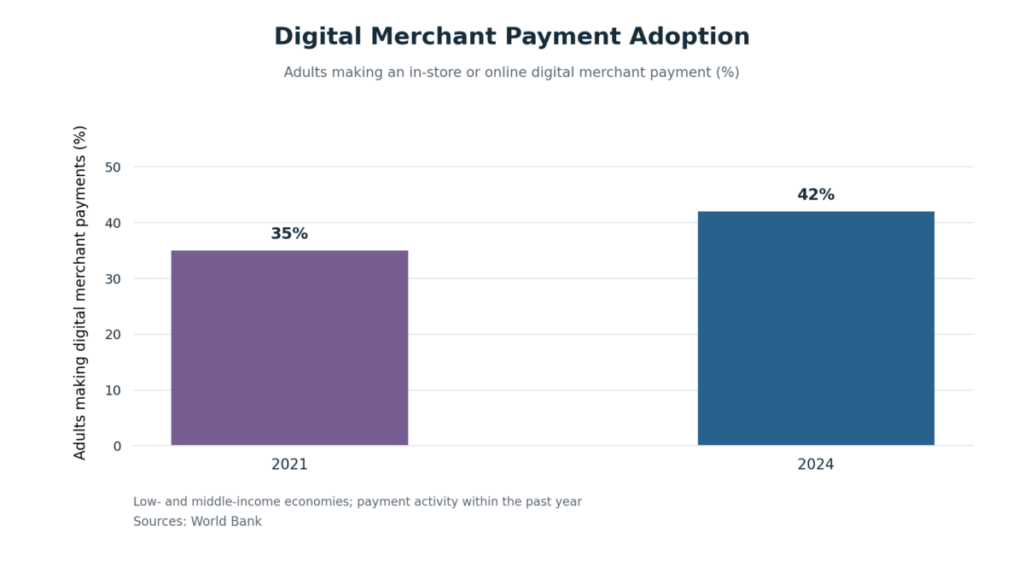
Payment preferences complicate international sales. In low- and middle-income economies, 42% of adults made digital merchant payments in 2024, compared with 35% in 2021. East Asia and the Pacific reached 67%, while usage remained considerably lower in South Asia and Sub-Saharan Africa. Merchants entering unfamiliar markets may need intermediaries equipped for local purchasing practices.
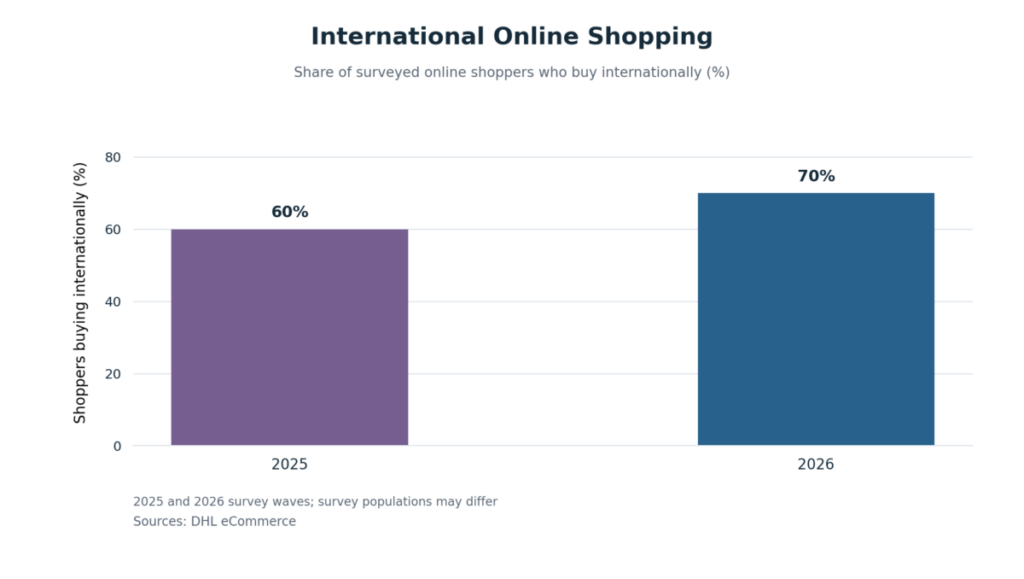
Distribution remains another constraint. Among sellers participating in eBay’s 2026 international survey, 53% identified logistics and delivery as barriers. Although 70% of shoppers surveyed across 29 countries reported purchasing from foreign retailers, shipping and import expenses can make international sales uncompetitive.
Internet connectivity cannot eliminate inadequate transportation infrastructure. Regional distributors may consolidate shipments more economically than individual remote producers. Their fees must be weighed against the services and customer access they provide.
Specialized knowledge and production flexibility allow independent merchants to compete beyond price. Loyal customers reduce repeated acquisition expenses, while dependable distributors provide similar stability for indirect sellers. The opportunity lies in serving enough customers profitably, wherever they live.
| Payment Experience | Share |
|---|---|
| Shoppers abandoning without preferred payment method | 62% |
| Businesses recognizing payment choice as an abandonment driver | 45% |
Sources: DHL eCommerce
The Next Five Years
The next stage of e-commerce may involve more purchasing through connected services and less movement between individual websites. In a 2026 international survey, 29% of shoppers expressed willingness to let AI make purchasing decisions within five years. A customer could describe a specialized product, identify a manufacturer and authorize payment through one assistant.
In a 2025 survey, 70% of shoppers expected social media to become their primary shopping channel by 2030. Expectations do not establish adoption, but suggest conventional storefronts may become less central to discovery, potentially exposing customers to previously overlooked producers.
Merchants anticipate similar changes. In 2026, 73% of surveyed e-commerce businesses expected to increase generative AI use over five years, while 59% anticipated consumers purchasing through virtual assistants. Accurate product information and dependable fulfillment could acquire greater importance when software evaluates offers. Producers working through resellers may benefit without operating these systems themselves.
Commercial infrastructure will determine how widely these benefits extend. Translation may connect buyers and sellers across languages, but delivery must remain economical. Purchasing agents require clear spending permissions and trustworthy merchant information. For underserved communities, connectivity, payment services and transportation determine actual market access.
By 2031, purchasing locally, shopping online and commissioning products directly could become more closely integrated. Specialized demand scattered across communities may sustain enterprises unable to survive on local customers alone. The economic change is the ability to connect buyers, sellers and producers beyond their immediate markets. For many remote communities, participation will depend less on owning an online storefront than on having dependable access to the commercial networks that serve them.
| Dimension | Measurement | Breakdown |
|---|---|---|
| Connectivity | Internet use rate | Urban / rural |
| Purchasing access | Online buyer participation | Region / income |
| Merchant adoption | Online sales participation | Firm size / region |
| Financial access | Digital merchant payments | Rural / urban |
| Market reach | Cross-border sales participation | Direct / intermediary |
| Commercial viability | Net transaction margin | Channel / location |
Sources: International Telecommunication Union, World Bank, OECD, DHL eCommerce
TL;DR
-
Internet connectivity is expanding commerce for individuals and businesses, including rural and underserved communities.
-
Buyers and sellers participate directly through marketplaces or indirectly through brokers and distributors.
-
Conversational shopping allows consumers to discover merchandise through personal requirements.
-
Product visualization and merchant interaction improve purchasing information.
-
Digital markets expand access to specialized merchandise beyond local communities.
-
Integrated software reduces administration but increases the importance of customer acquisition and visibility.
-
Producers without storefronts can reach distant customers through commercial intermediaries.
-
Resale and on-demand manufacturing reduce some inventory and market-entry barriers.
-
Digital ordering and subscriptions improve demand coordination for local producers.
-
Lower entry costs do not eliminate transaction fees, intermediary margins or delivery expenses.
-
Payment preferences and transportation infrastructure continue to affect international participation.
- Through 2031, connected services could make dispersed specialized demand economically viable for more independent producers.
Sources
- International Telecommunication Union; Facts and Figures 2025; – Link
- UN Trade and Development (UNCTAD); Fast-tracking Implementation of Reforms Enabling E-Commerce and Digital Trade; – Link
The Changing Buying Experience
- Adobe Analytics; 2025 Holiday Shopping Season Results; – Link
- DHL eCommerce; E-Commerce Trends Report 2026; – Link
- Meta; Pay Small Businesses in Brazil on WhatsApp; – Link
The Changing Selling Experience
- Organisation for Economic Co-operation and Development (OECD); SME Digitalisation for Competitiveness: The 2025 OECD D4SME Survey; – Link
- Swartz, Brichta and Hudome; Platformization and the Changing Work of Running a Small Business; – Link
New Forms of Commerce
- eBay; 2026 Recommerce Report; – Link
- Etsy; 2025 Annual Report and 2024 Global Seller Census Findings; – Link
The Economics of Independent Commerce
- World Bank; Global Findex Database 2025; – Link
- World Trade Organization; The Long-Run Impact of Digitalization on Trade Patterns; – Link
- World Trade Organization; Trade Cost Index; – Link
The Next Five Years