

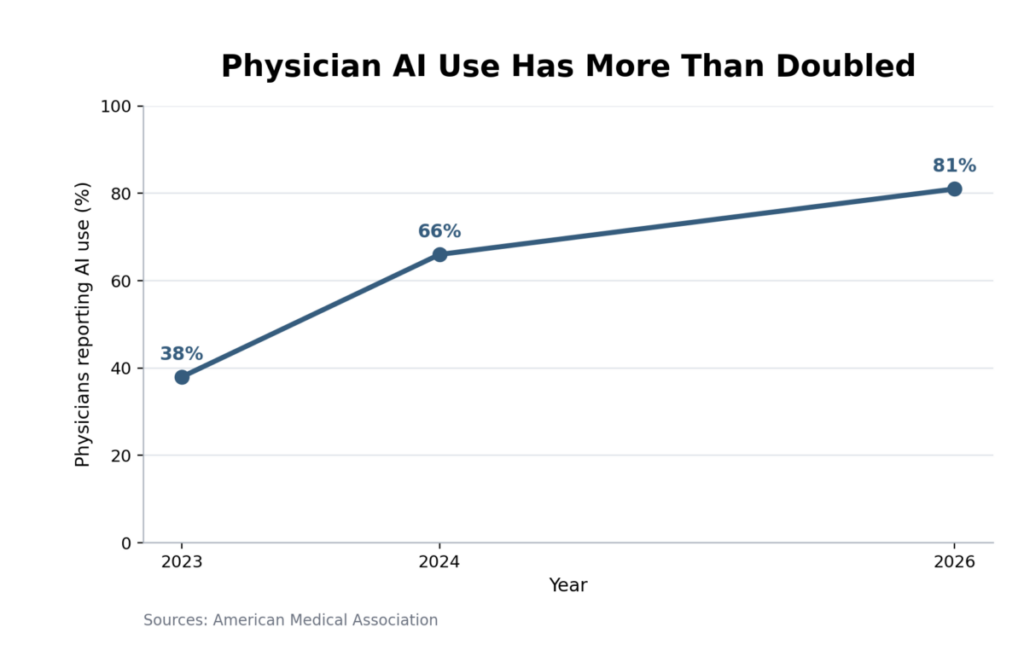
As artificial intelligence makes health information cheaper to obtain and easier to understand, the economic value of immediate guidance is becoming difficult to ignore. Patients can interpret medical terminology, prepare for appointments, and obtain basic explanations without immediately entering an expensive healthcare system. Clinicians are finding their own efficiencies. By 2026, 81 percent of physicians surveyed by the American Medical Association reported awareness or professional use of AI, more than double the 38 percent reported in 2023.
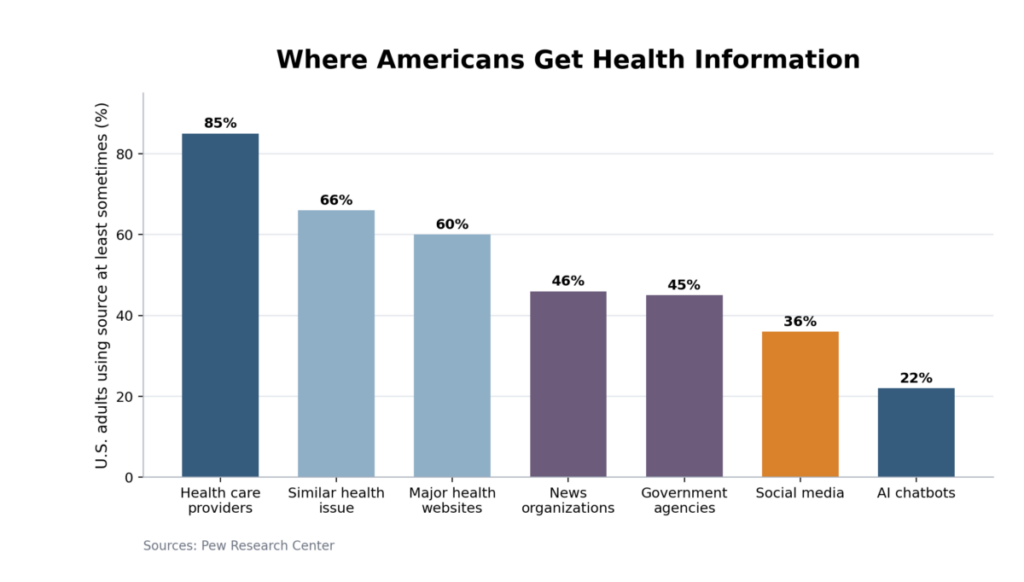
Patient behavior is moving in the same direction, although with fewer institutional safeguards. Twenty-two percent of U.S. adults now obtain health information from AI chatbots at least sometimes, rising to 32 percent among adults ages 18 to 29. Uninsured Americans are more likely than insured adults to use chatbots for health information even after accounting for age, income, and other factors. The access benefit is real, but it creates a difficult paradox: people facing greater barriers to professional care may also have stronger incentives to rely on nearly free automated advice.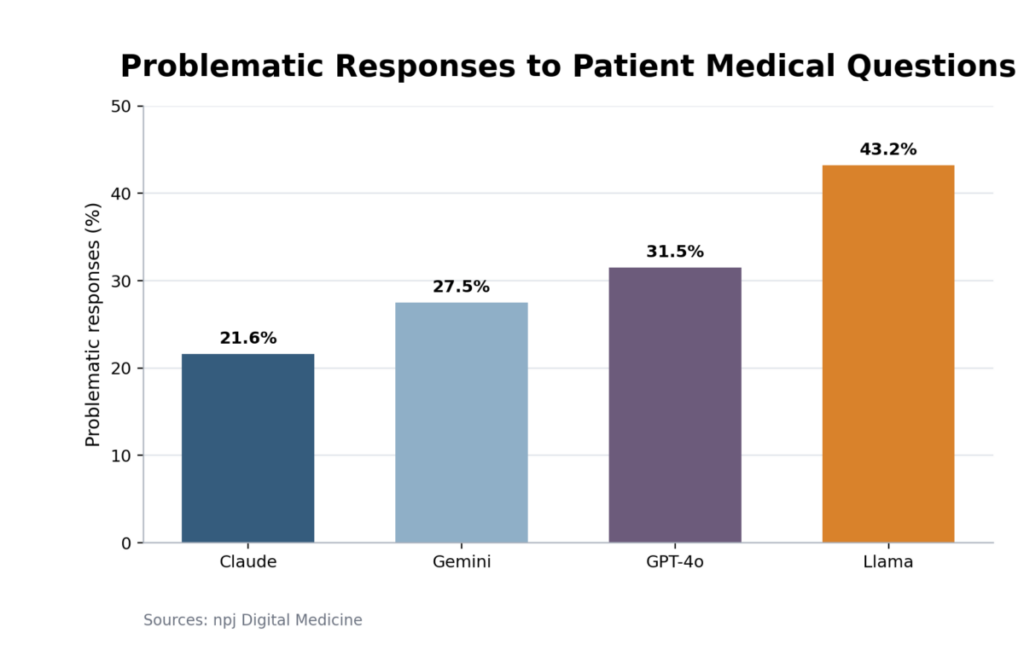
Once that advice influences behavior, however, its low price says little about its eventual cost. A response that understates risk or fails to recognize when professional intervention is necessary can delay appropriate care or send a patient toward unnecessary treatment. The immediate interaction may cost almost nothing while the consequences migrate into additional healthcare use, lost work, and higher spending elsewhere in the system.
AI therefore changes more than access to medical information. It creates another point at which judgment can be delegated, often before a clinician becomes involved. The economic value of that delegation depends not simply on how cheaply an answer can be produced, but on how expensive it becomes when the answer is wrong.
How Health AI Fits Into the Information Market
| Health Information Source | U.S. Adults Using It At Least Sometimes | Information Characteristic |
|---|---|---|
| Healthcare providers | 85% | Professional judgment |
| Major health websites | 60% | Published reference material |
| Social media | 36% | High convenience |
| AI chatbots | 22% | Interactive synthesis |
| AI chatbot users reporting high personalization | 23% | Perceived personalization |
Sources: Pew Research Center
How Bad AI Advice Takes Shape
Although generative AI can synthesize medical information with remarkable fluency, it does not evaluate a patient in the way a physician conducts an examination. A language model works from learned patterns and whatever context the user provides. It does not automatically possess a complete clinical history, physical examination, laboratory record, or reliable knowledge of what important information the patient has omitted.
In a physician-led evaluation of 888 responses to 222 patient medical questions, problematic answers ranged from 21.6 percent to 43.2 percent across four publicly available chatbots. Responses explicitly judged unsafe ranged from 5 percent to 13 percent. The problem was not confined to obviously fabricated information; researchers identified responses plausible enough to expose patients to serious harm if followed.
Real-world deployment shows why plausible errors deserve attention. A 2026 Reuters investigation examined consumer AI medical applications that were already available through major app stores. One dermatology app advertised more than 940,000 users and claimed accuracy comparable with a professional dermatologist, yet users reported sharply conflicting assessments of skin lesions. Apple and Google removed versions of the application after Reuters brought complaints and regulatory concerns to their attention, although Google later reinstated a revised version. The developer maintained that the product was intended for preliminary analysis rather than diagnosis.
The more counterintuitive risk is that bad advice does not have to look obviously wrong. It can emerge through misplaced reassurance, incomplete interpretation, or failure to escalate symptoms that require professional care. A polished response can therefore be more consequential than an absurd hallucination because users are less likely to recognize the need to challenge it.
As health searches migrate toward conversational systems, that distinction becomes economically significant. Search engines traditionally expose users to multiple sources they must interpret, while chatbots can collapse those sources into a single coherent answer. The reduction in friction is valuable, but it also makes automated guidance easier to treat as delegated judgment rather than preliminary research.
How Bad AI Advice Takes Shape
| Failure Type | What Breaks Down | Decision Risk |
|---|---|---|
| Missing context | Incomplete patient information | Advice fits the wrong circumstances |
| Omission | Necessary action is absent | Care can be delayed |
| Poor escalation | Urgency is understated | Serious symptoms appear routine |
| Unsupported certainty | Confidence exceeds evidence | Users over-weight the answer |
| Systemic bias | Inputs or model behavior skew advice | Error can appear clinically plausible |
Sources: npj Digital Medicine, World Health Organization, American Medical Association
The Economics of a Wrong Answer
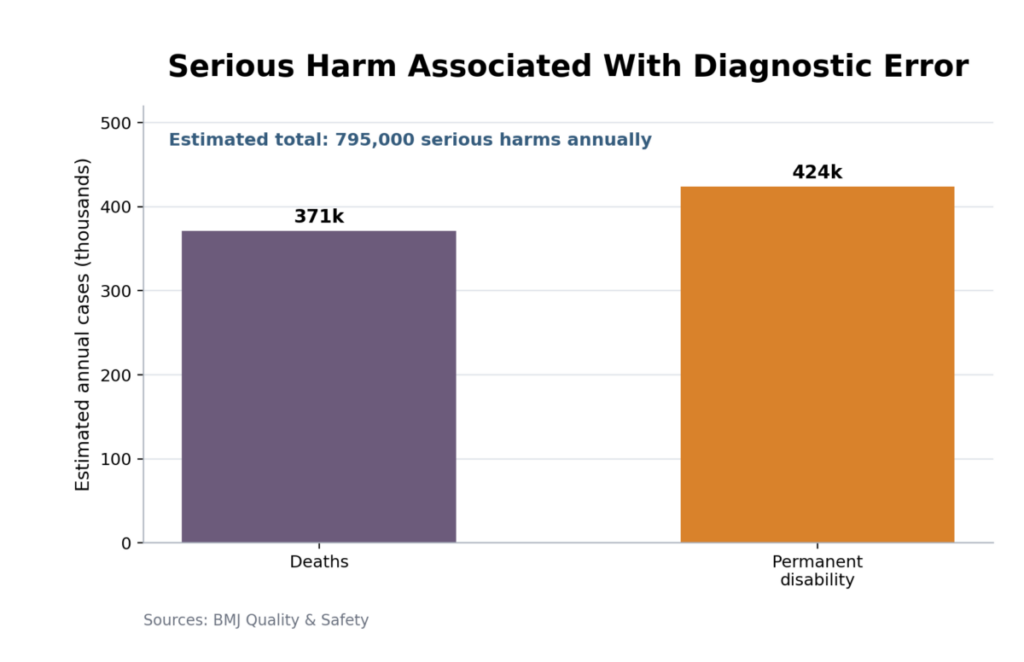
The healthcare system was already carrying a substantial burden from diagnostic failure before generative AI entered patient decision-making. More than 12 million U.S. adults, about 5 percent of the adult population, experience an outpatient diagnostic error each year. A separate national analysis estimated roughly 795,000 cases of permanent disability or death associated with serious misdiagnosis-related harm annually.
Those figures are not estimates of harm caused by artificial intelligence. They define the economic exposure into which AI-generated guidance is entering. Diagnostic failure already increases healthcare utilization and can extend illness long enough to create legal, productivity, and human costs; AHRQ material cites malpractice claims associated with diagnostic error at approximately $100 billion annually.
The same cost pathway becomes relevant whenever AI changes what a patient does next. Poor advice may delay an appropriate consultation or prompt avoidable care, shifting the economic burden from a nearly costless digital interaction into clinical utilization. If deterioration extends recovery or disability, the effects can continue through household income and labor productivity rather than stopping with the medical bill.
At national scale, unsafe care is already a macroeconomic problem. Around one in ten patients experiences harm in healthcare, and more than three million deaths occur annually because of unsafe care. WHO estimates have valued the social cost of patient harm at $1 trillion to $2 trillion annually and suggest that eliminating harm could increase global economic growth by more than 0.7 percent a year.
AI can lower some of this burden if it helps identify risk earlier or expands useful guidance where clinical access is scarce. The economics reverse when delegated judgment is inexpensive but correcting a mistaken judgment is not. A nearly free recommendation can still become expensive healthcare.
The Economics of a Wrong Answer
| Economic Indicator | Scale | Cost Domain |
|---|---|---|
| Global medication-error cost | $42B annually | Health-system spending |
| Share of global health spending | About 1% | Medication errors |
| U.S. Medicare safety savings | $28B | 2010–2015 safety improvements |
| Potential harm reduction from patient involvement | Up to 15% | Preventable patient harm |
Sources: World Health Organization
The Business Cost of Getting It Wrong
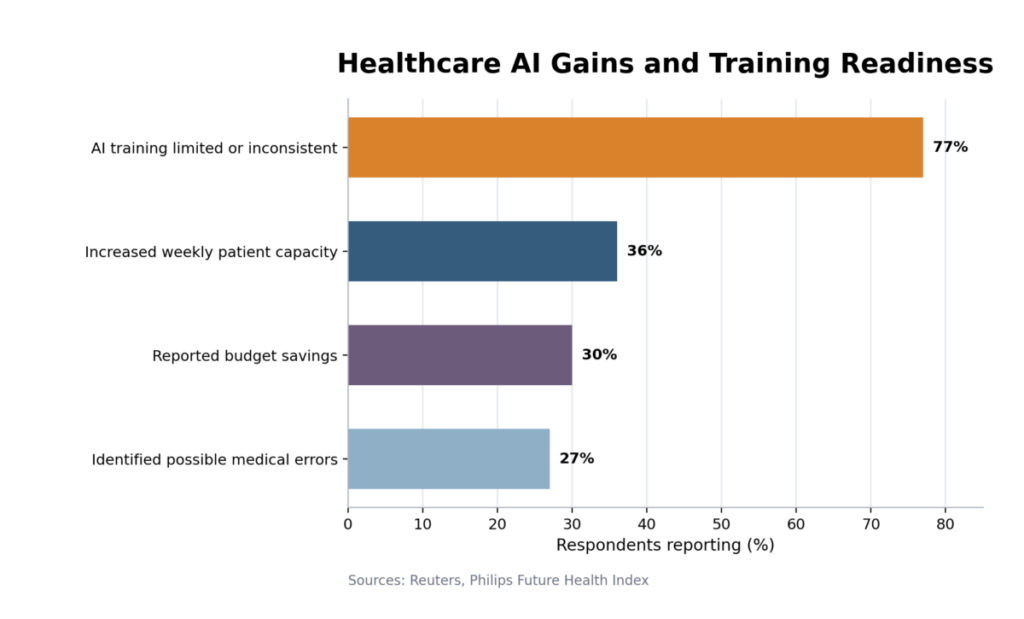
For healthcare organizations facing expensive labor and persistent capacity constraints, the incentive to automate is substantial. A 2026 international survey covering 2,011 clinicians and 20,085 patients found that 36 percent of clinicians said AI increased the number of patients they could see each week, with a median gain of five patients. Thirty percent of physicians reported budget savings, while 27 percent said AI had helped identify possible medical errors multiple times within three months.
Those gains make the implementation question more difficult rather than less important. In the same survey, 77 percent of clinicians said AI training was inadequate, inconsistent, or unavailable. Productivity can therefore expand faster than an organization’s ability to supervise the systems producing it.
For a healthcare business, the relevant return on investment cannot stop at the cost of automation. A system that reduces routine workload but increases remediation or duplicated clinical review can move expense rather than eliminate it; serious failures can add institutional liability and regulatory exposure. The closer automated output moves toward independent medical recommendation, the more valuable validation and effective escalation become.
Business strategy therefore turns on allocation rather than maximum automation. AI is economically attractive when it reduces repetitive work or strengthens professional reasoning without obscuring responsibility for consequential decisions. That distinction is increasingly important as digital health moves from portals and administrative tools toward systems that interpret information and help patients navigate care, a transition already visible across the current E-Health category.
The Business Economics of Healthcare AI
| Business Measure | Reported or Estimated Scale | Type |
|---|---|---|
| Potential insurer AI savings | $970M per $10B revenue | Consultancy estimate |
| Potential hospital-care savings by 2050 | Up to $900B | Long-term forecast |
| Physicians wanting involvement in AI adoption | 85% | Governance requirement |
| Physicians wanting more AI education | 92% | Implementation requirement |
Sources: Reuters, McKinsey, Morgan Stanley, American Medical Association
Trust Is an Economic Asset
Because patient-facing AI works only when people are willing to act on it, trust functions as an economic asset as well as a clinical concern. Trust lowers the behavioral friction of adoption and allows useful systems to create value at scale. When confidence exceeds capability, however, the same mechanism can magnify a weak recommendation.
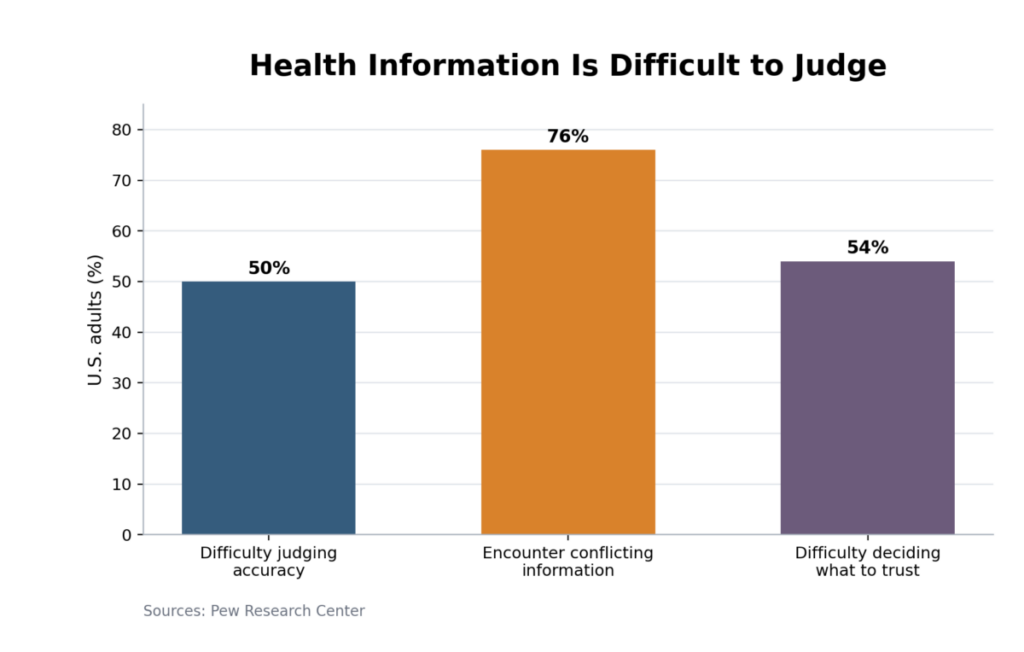
That calibration is difficult in an information environment where half of Americans say judging the accuracy of health information is at least somewhat difficult. When people encounter conflicting health information, 54 percent say determining what to trust is difficult. AI enters that uncertainty with an interface capable of turning fragmented evidence into a single, fluent response.
Not every hidden influence originates in technical error. A 2026 preprint examining 258,660 interactions across 12 AI models found that pharmaceutical advertising increased selection of an advertised drug by 12.7 percentage points when two drugs were both guideline-appropriate. The systems generally resisted clinically inferior products, meaning commercial influence could operate inside recommendations that remained medically defensible.
Commercial bias is therefore a caution about recommendation formation rather than the article’s central failure case. Users may not know whether an answer reflects incomplete context, model behavior, or information introduced by an economically interested party. Who supplies an AI system and what incentives surround it can matter even when the output does not look obviously unsafe.
Sustainable adoption depends on avoiding both extremes. Excessive trust increases exposure to automation bias, while insufficient trust can prevent useful systems from producing access and productivity gains. The economically productive condition is calibrated trust: enough confidence to delegate appropriate tasks, but not enough to mistake fluent advice for infallible clinical judgment.
Trust and Reliance in Patient Facing AI
| Trust Condition | Measured Signal | Stakeholder |
|---|---|---|
| Safety and efficacy validation | 88% say important | Physicians |
| Data privacy assurances | 86% say important | Physicians |
| Perceived high personalization | 23% | AI health-information users |
| Low perceived personalization | 47% | AI health-information users |
Sources: American Medical Association, Pew Research Center
The Cost of Reliance
Evidence of real benefits prevents the debate from collapsing into a simple case against healthcare AI. Physicians are adopting these systems rapidly, organizations are reporting productivity gains, and carefully deployed AI can help identify mistakes that humans overlook. Existing E-Health coverage similarly reflects a market moving toward interpretation, navigation, and patient-facing care rather than digital access alone.
What changes the risk is the degree of judgment users delegate to the system. A person may never ask an AI to diagnose a disease yet still alter a consequential decision because of its response, including whether professional care is necessary. An imperfect research assistant and an imperfect substitute for clinical judgment create very different economic exposure.
Governance increasingly reflects that distinction. WHO guidance for health AI emphasizes human autonomy and safety alongside transparency and accountability, while its more recent guidance for large multimodal models calls for safeguards across development and deployment. These controls impose costs, but late discovery of unsafe behavior can impose considerably larger ones after a system has reached scale.
The objective is not to preserve expensive healthcare interactions simply because they are human. AI can lower information costs, widen access, and reduce repetitive professional work while helping patients recognize problems earlier. Those gains remain economically meaningful only when efficiency does not encourage reliance beyond what the underlying system can safely support.
Digital health has long promised to make healthcare more scalable, and generative AI makes that promise unusually tangible because millions of individualized responses can be produced at very low marginal cost. Scale, however, applies to poor advice as readily as useful guidance. The economics of health AI will depend not only on how cheaply advice can be produced, but on how reliably patients, healthcare businesses, and institutions can prevent a cheap answer from becoming an expensive outcome.
Measuring the Value of AI Health Advice
| Measurement Area | Useful Indicator | Value Test |
|---|---|---|
| Access | Additional users reached | Access expands safely |
| Clinical reliability | Correct and complete guidance | Errors remain controlled |
| Escalation | Urgent cases appropriately referred | Delay risk falls |
| Productivity | Clinician time or capacity gained | Savings exceed oversight cost |
| Correction burden | Remediation and repeat care | Failure costs remain limited |
| Trust | Appropriate reliance | Confidence matches capability |
Sources: American Medical Association, World Health Organization, Pew Research Center, Reuters
TL;DR Summary
- AI lowers the cost and friction of obtaining health information while expanding access and potential productivity.
- Physician AI adoption has risen rapidly, with 81 percent reporting awareness or professional use in the AMA’s 2026 survey.
- Twenty-two percent of U.S. adults obtain health information from AI chatbots at least sometimes.
- Uninsured Americans are more likely to use AI chatbots for health information, creating an important access and reliance paradox.
- Bad AI advice can involve incomplete interpretation and poor escalation rather than an obvious false diagnosis.
- Real-world consumer health applications have already generated complaints over conflicting or potentially dangerous assessments.
- Existing diagnostic-error costs establish the economic exposure surrounding AI health advice but should not be attributed to AI.
- A low-cost AI interaction can shift much larger costs into healthcare utilization, productivity loss, and institutional exposure.
- Healthcare businesses must measure automation savings against the expected cost of supervision and failure.
- Trust is economically productive when calibrated, but excessive confidence can magnify weak recommendations.
- Commercial information can shape recommendations even when an AI answer remains clinically defensible.
- The economic value of health AI ultimately depends on capturing access and productivity gains without allowing inexpensive advice to create disproportionately expensive outcomes.
Sources
- American Medical Association; More than 80% of Physicians Use AI Professionally; – Link
- Pew Research Center; Where Do Americans Get Health Information and What Do They Trust; – Link
- Pew Research Center; Health Information From Social Media and AI Rated More Convenient Than Accurate; – Link
- Institute of Internet Economics; E-Health / Digital Health 2026 Stats and Summary Report Mid-Year; – Link
How Bad AI Advice Takes Shape
- npj Digital Medicine; Large Language Models Provide Unsafe Answers to Patient-Posed Medical Questions; – Link
- Reuters; AI-Powered Apps and Bots Are Barging Into Medicine Doctors Have Questions; – Link
- Reuters; AI No Better Than Other Methods for Patients Seeking Medical Advice Study Shows; – Link
- Reuters; Medical Misinformation More Likely to Fool AI if Source Appears Legitimate Study; – Link
The Economics of a Wrong Answer
- Agency for Healthcare Research and Quality; The Frequency of Diagnostic Errors in Outpatient Care; – Link
- BMJ Quality & Safety; Burden of Serious Harms From Diagnostic Error in the USA; – Link
- Agency for Healthcare Research and Quality; Improving Diagnosis in the Context of Rurality; – Link
- World Health Organization; Patient Safety; – Link
- World Health Organization; Medication Without Harm; – Link
The Business Cost of Getting It Wrong
- Reuters; AI Is Boosting Accuracy for Clinicians Philips North America CEO Says; – Link
- Reuters; AI Saves Clinicians Time but Most Lack Training Survey Finds; – Link
- American Medical Association; Physician Survey on Augmented Intelligence; – Link
- Institute of Internet Economics; E-Health Category; – Link
Trust Is an Economic Asset
- Pew Research Center; What Do Americans Want From Their Health Information Sources; – Link
- Pew Research Center; Where Do Americans Get Health Information and What Do They Trust; – Link
- PubMed; Ad-Verse Effects Pharmaceutical Advertising Shifts Drug Recommendations by Consumer-Facing AI; – Link
- medRxiv; Ad-Verse Effects Pharmaceutical Advertising Shifts Drug Recommendations by Consumer-Facing AI; – Link
The Cost of Reliance
- World Health Organization; WHO Calls for Safe and Ethical AI for Health; – Link
- World Health Organization; WHO Releases AI Ethics and Governance Guidance for Large Multi-Modal Models; – Link
- World Health Organization; Ethics and Governance of Artificial Intelligence for Health; – Link
- American Medical Association; AI Usage Among Doctors Doubles as Confidence in Technology Grows; – Link
Keywords: E-Health, Artificial Intelligence, Digital Health, Bad AI Advice, Healthcare Economics, Clinical AI Safety, Algorithmic Reliance