

Built to move power across distance, electricity grids are increasingly being asked to manage a second flow that is nearly as consequential: information. Utilities must accommodate distributed generation and storage alongside rising demand from electric vehicles and data centers without assuming that every constraint can be solved by constructing another line or substation. More than 2,500 gigawatts of renewable generation, storage, and large-load projects are stalled in grid connection queues worldwide. Annual grid investment is about $400 billion and needs to rise roughly 50 percent by 2030, while major projects can take five to 15 years to plan and complete.
Against that physical constraint, the Internet of Things is changing grid operation across the network. Utilities can monitor infrastructure that was previously difficult to observe continuously and automate some responses to changing conditions. Smart grids use those signals to coordinate generation with demand, while connected devices at the network edge allow businesses and households to influence when electricity is consumed. EV chargers and smart thermostats are among the most familiar examples.
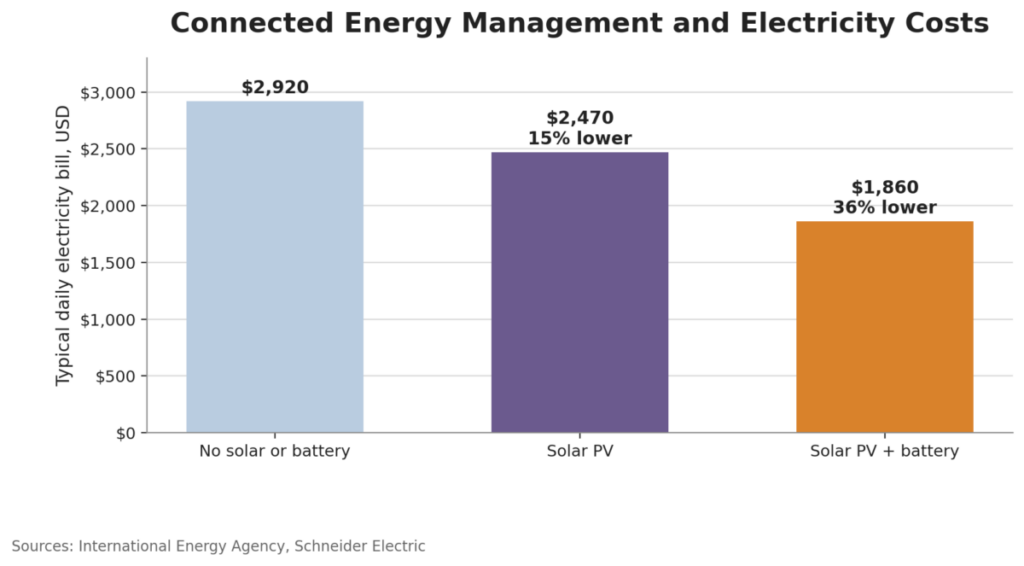
Economic gains emerge when better information changes the use of physical capital. Greater visibility can reduce maintenance costs and outage duration, while improved coordination allows an existing network to accommodate more generation or demand. Connected devices can also shift consumption away from stressed periods and provide flexibility that might otherwise require additional utility-owned capacity. The International Energy Agency estimates that improved grid digitalization could defer roughly $1.8 trillion of global investment through 2050 by extending asset life and improving utilization.
As those capabilities mature, their influence moves beyond the markets where they were first deployed. Advanced economies absorb much of the early cost of establishing standards and workable operating models, creating knowledge that can later be applied elsewhere. Developing economies can adopt similar technologies at greater scale while adapting them to electricity systems that are still expanding rapidly. In lower-income markets, distributed generation and digitally managed networks may allow parts of the legacy development path to be avoided altogether.
IoT is consequently changing more than grid operation. It is influencing how electricity technology is financed and scaled, as well as how it moves between economies at different stages of development.
How Grid Digitalization Changes Infrastructure Economics
| Capital Measure | Benchmark | Grid Context |
|---|---|---|
| Generation investment | About $1 trillion/year | New supply capacity |
| Required grid investment | More than $600 billion/year by 2030 | Transmission and distribution |
| EMDE grid investment excluding China | Recent decline | Demand and access still rising |
Sources: International Energy Agency
IoT Gives Utilities New Ways to See and Control the Grid
IoT Gives Utilities New Ways to See and Control the Grid
| U.S. Customer Class | AMI Meters 2024 | Share of Sector Meters |
|---|---|---|
| Residential | 123.0 million | 84% |
| Commercial | 16.5 million | 81% |
| Industrial | 0.94 million | 80% |
Sources: U.S. Energy Information Administration
Smart Grids Turn Information Into Coordination
Once individual assets become observable, a smart grid can use their information to coordinate the electricity system as conditions change. A network may contain millions of connected devices without becoming materially smarter if those signals remain isolated. The economic distinction lies in whether information changes how the system operates.
Across advanced grids, coordination increasingly means extracting more flexibility from infrastructure already in place. Storage can absorb electricity when supply is abundant and return it during periods of stress. Demand-response programs can reduce consumption when capacity becomes constrained, while time-sensitive pricing can encourage flexible demand to move toward less expensive hours. Distributed solar can also respond more intelligently to local network conditions rather than operating independently of them.
That flexibility matters because physical expansion is slow and increasingly expensive. Prices for major grid components have risen sharply in recent years, while some digital and grid-enhancing technologies can be installed much faster than large transmission projects. The IEA estimates that selected upgrades could unlock enough existing capacity to connect roughly 450 to 700 gigawatts of advanced projects currently waiting in queues. Better coordination can therefore increase productive capacity before new physical infrastructure is completed.
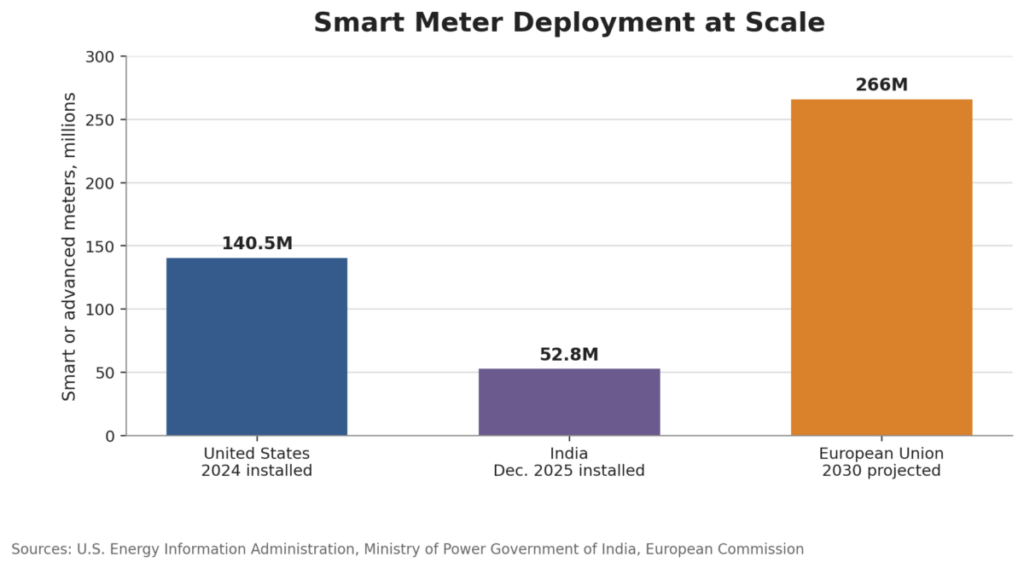
Experience at scale creates a second economic effect. Utilities and regulators gain practical evidence about which systems improve reliability and how distributed resources can be integrated into everyday operations. Suppliers also develop experience that can be carried into new markets. Over time, those lessons spread through the wider electricity sector and influence financing, technical practice, and standards.
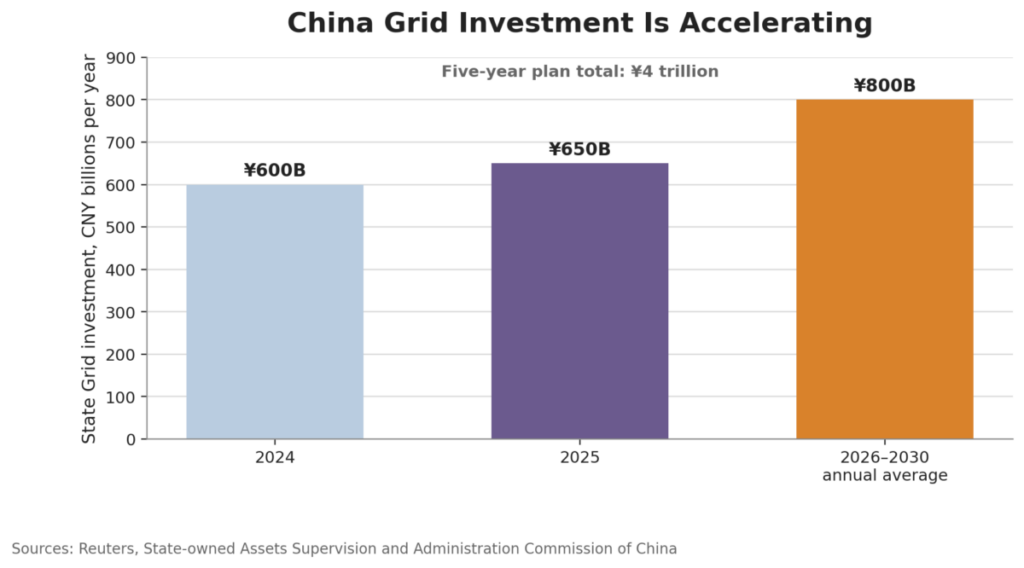
China represents a different stage because digitalization is occurring alongside enormous physical investment. State Grid plans to invest about 4 trillion yuan, or $574 billion, between 2026 and 2030, roughly 40 percent more than during the previous five-year period. The program will expand network capacity while supporting a more flexible electricity system.
At that scale, IoT serves a different economic purpose. China is not merely applying mature-market technology to an existing network. Digital coordination is being introduced as the electricity system continues to expand. Technologies proven elsewhere can therefore be adapted while new electricity capital is still being formed.
Similar conditions exist across several rapidly expanding electricity markets. Their networks can incorporate digital monitoring and automated control as infrastructure is built, avoiding some of the informational blind spots that mature grids must now address through costly retrofits.
Technology diffusion follows naturally from this pattern. As early deployments establish viability and larger markets turn capability into routine infrastructure practice, later adopters gain access to more mature equipment and operating knowledge.
Smart Grids Turn Information Into Coordination
| China Grid Measure | Scale | Coordination Pressure |
|---|---|---|
| Solar PV additions in 2024 | More than 340 GW | Rapid network integration |
| Renewable additions forecast 2024–2030 | 3,207 GW | Growing balancing needs |
| Provinces reporting DPV congestion or restrictions in 2024 | 11 | Local hosting constraints |
Sources: International Energy Agency
Connected Devices Change How Electricity Is Used
Beyond the utility boundary, connected devices are changing a relationship that remained largely one-directional for most of the grid’s history. Electricity consumption was something the system served. Increasingly, consumption itself can respond to grid conditions.
A smart thermostat can reduce heating or cooling demand during a stressed period, while an electric vehicle charger can delay charging until lower-demand hours. At commercial scale, building controls can adjust energy use according to changing conditions. Batteries perform a related function by storing power when supply is abundant and releasing it when demand rises. The shared mechanism is responsiveness rather than the device itself.
That responsiveness matters because power systems are built partly around peak demand. Infrastructure must remain available for a limited number of high-consumption hours even when much of that capacity sits underused during the rest of the year. Moving flexible demand away from those periods improves the utilization of existing assets. Where renewable output is abundant, shifting consumption toward high-generation periods can also reduce curtailment and improve the productivity of installed capacity.
Advanced economies are beginning to show how consumer equipment can participate in this operating model. Connected vehicles and household energy systems can function as flexible loads or distributed resources, allowing equipment owned by consumers to provide services that once depended on utility-controlled assets. For households and businesses, greater flexibility can reduce exposure to expensive peak periods while improving resilience when network conditions deteriorate.
Rapidly developing markets face a similar opportunity under different conditions. Urbanization and rising electricity demand make the timing of consumption increasingly consequential. Smart charging and connected building controls can prevent part of that growth from producing an equivalent increase in peak-capacity requirements. China has already begun testing vehicle-to-grid models that allow electric vehicles to interact more actively with the electricity system as its EV fleet expands.
In developing markets, the opportunity can extend beyond efficiency toward leapfrogging. Countries with limited conventional distribution infrastructure do not necessarily need to reproduce the historical sequence of centralized generation followed by later digital retrofits. Distributed generation can instead be built with digital monitoring from the outset, allowing operators to manage service more efficiently as networks expand.
Mini-grids show how that model can work. The World Bank has estimated that they could eventually serve hundreds of millions of people where conventional grid extension remains uneconomic. Their viability depends partly on operators being able to monitor service, identify problems quickly, and collect payment efficiently. Digital systems therefore support commercial sustainability as well as technical performance.
Development finance is beginning to move in the same direction. A World Bank program approved in June 2026 includes a $200 million first phase within an $853 million regional initiative supporting distributed renewable electricity in four West and Central African countries. Mission 300, backed by the World Bank and African Development Bank, had connected more than 50 million people across 40 African countries by June 2026 toward a target of 300 million by 2030.
The spread of this technology therefore does not follow a simple rich-country-first sequence. What begins as an operating model in advanced markets can be adapted at scale elsewhere and then applied selectively in developing economies without requiring them to reproduce every legacy architecture that came before.
Connected Devices Change How Electricity Is Used
| Connected Resource | Supplemental Evidence | Grid Function |
|---|---|---|
| Household IoT resources | Modeled under 5%–40% power-loss scenarios | Local balancing and resilience |
| China V2G pilots | 30 projects in 9 cities | Peak shifting and power return |
| China public charging network | More than 4.7 million points | Large controllable load base |
| China share of global public chargers | More than 65% | Grid-scale demand coordination |
Sources: MIT, Reuters, International Energy Agency
Cybersecurity and Governance Set the Limits of Integration
Greater visibility and control also create greater dependence on connected equipment behaving correctly. A malfunctioning conventional appliance generally creates a local problem, while a compromised connected device can become part of a coordinated event. Making electricity infrastructure more programmable therefore increases both its economic usefulness and the cost of maintaining trust.
As connected equipment gains influence over the electricity system, cybersecurity moves from a supporting technology concern into infrastructure economics. Grid operators must be able to trust the devices and communications on which increasingly automated systems depend. Security therefore becomes a continuing cost of connectivity rather than a protection added after installation.
Interoperability creates a related tension. Economic value rises when equipment from different manufacturers can exchange useful information, but shared connectivity also creates dependencies across technologies and suppliers. Utilities must therefore consider whether equipment can remain secure and supportable throughout its operating life without creating new operational risks when systems are upgraded or replaced.
Those governance lessons also diffuse between development tiers. Advanced countries often encounter them first because their installed device populations are larger and their legacy systems more complex. Emerging economies can incorporate that experience into modernization programs before reaching the same level of complexity. Developing economies can draw on established standards while adapting security requirements to local costs and technical capacity.
Financing depends on the same institutional credibility. The IEA notes that emerging-market smart-grid investment requires projects that lenders and governments can evaluate with confidence. Standardization can strengthen that confidence by reducing uncertainty around equipment performance and project design.
Digitalization can also strengthen the financial position of utilities themselves. Better metering and operating data can reduce losses, support revenue collection, and make utility performance more visible to regulators and investors. In markets where weak utility finances constrain infrastructure investment, improved information can affect not only how assets operate but also how confidently future projects can be financed.
IoT investment can therefore improve the productive use of electricity infrastructure while strengthening the financial conditions for further investment.
Cybersecurity and Governance Set the Limits of Integration
| Governance Layer | Core Requirement | Operational Scope |
|---|---|---|
| Device identity | Authenticate before connection | Network access |
| Interoperability | Common interfaces and standards | Multi-vendor systems |
| Testing | Ongoing certification | Devices and integrated systems |
| Compliance exposure | Reliability-standard enforcement | Up to $1 million per violation per day |
Sources: National Institute of Standards and Technology, North American Electric Reliability Corporation
The Next Grid Will Be More Connected but Not the Same Everywhere
Although electricity systems are moving toward greater sensing, coordination, and device participation, their starting points remain too different for one universal smart-grid model.
The United States and Western Europe show how connected technologies can increase the productivity of mature, capital-intensive networks. Digital monitoring improves asset management, while flexible demand and distributed resources offer new ways to manage system constraints. Those deployments also generate standards and operating evidence that later adopters can evaluate.
China, India, and other rapidly developing markets represent a different stage. Digital technologies can be deployed while electricity infrastructure is still expanding, allowing lessons from earlier markets to become part of large-scale implementation rather than later retrofits. The scale of those investments can deepen supplier ecosystems and operating expertise.
Developing economies have an opportunity to follow a less sequential path. They still require substantial physical investment, but they do not need to reproduce every stage through which today’s advanced grids evolved. Digitally managed mini-grids and distributed renewable systems can allow some regions to build around technologies that mature economies adopted only after decades of centralized development.
The financing architecture is beginning to reflect that possibility. World Bank and African Development Bank programs increasingly combine infrastructure capital with reforms intended to strengthen utilities and attract private investment. Mission 300’s participating countries are developing national energy compacts intended to guide spending and improve operating performance while mobilizing additional capital.
None of these pathways makes physical grid investment unnecessary. Digitalization determines how productively that capital can be used. IoT gives utilities a more precise understanding of their assets, while smart-grid coordination and connected devices make the wider system more responsive to changing conditions.
Across development tiers, the larger economic movement remains consistent. Capabilities proven in advanced markets can be adapted and scaled elsewhere, allowing developing economies to bypass parts of the legacy path as technology and operating knowledge become more accessible.
The technology may be shared globally, but its greatest economic value appears where better information removes the constraint that matters most locally.
The Next Grid Will Be More Connected but Not the Same Everywhere
| Measurement Area | Suggested Indicator | Development Signal |
|---|---|---|
| Asset productivity | Capacity served per unit of grid capital | Optimization |
| Distribution performance | Technical and commercial loss rate | Utility modernization |
| Demand flexibility | Shiftable peak load | Coordination maturity |
| Utility finance | Collection and metering performance | Investment readiness |
| Distributed access | Commercially viable mini-grid connections | Leapfrog potential |
| Capital mobilization | Private capital per public dollar | Scaling capacity |
Sources: International Energy Agency, World Bank
TL;DR Summary
- IoT is changing electricity systems through utility monitoring, smart-grid coordination, and connected-device participation.
- More than 2,500 GW of generation, storage, and large loads are stalled in global grid connection queues.
- Annual grid investment of roughly $400 billion needs to rise about 50 percent by 2030.
- Grid digitalization could defer approximately $1.8 trillion of global grid investment through 2050.
- Advanced economies establish operating models, standards, and supplier experience that can reduce deployment risk elsewhere.
- Large emerging markets can scale and adapt those technologies while expanding physical electricity infrastructure.
- China’s State Grid plans roughly $574 billion of investment between 2026 and 2030.
- Connected devices can shift demand and improve the utilization of generation and grid capacity.
- Developing economies may be able to leapfrog parts of legacy grid development through digitally managed distributed systems.
- Development finance increasingly connects infrastructure investment with utility reform and private-capital mobilization.
- Better metering and operating data can strengthen utility finances through improved loss identification and revenue collection.
- Cybersecurity, interoperability, governance, and technical capacity will shape how much economic value connected grids ultimately create.
Sources
- International Energy Agency; Electricity 2026 – Grids; – Link
- International Energy Agency; Unlocking Smart Grid Opportunities in Emerging Markets and Developing Economies – Executive Summary; – Link
- International Energy Agency; Digitalization and Energy; – Link
IoT Gives Utilities New Ways to See and Control the Grid
- U.S. Energy Information Administration; Advanced Metering Infrastructure 2015 through 2024; – Link
- European Commission; Smart Grids and Meters; – Link
- Ministry of Power Government of India; Annual Report 2025–26; – Link
- World Bank; Can Utilities Realize the Benefits of Advanced Metering Infrastructure; – Link
Smart Grids Turn Information Into Coordination
- International Energy Agency; Integrating Distributed Energy Resources in China – Executive Summary; – Link
- International Energy Agency; Grid Investments; – Link
- Reuters; China’s Power Grid Investments to Surge to Record $574 Billion in 2026–2030; – Link
- International Energy Agency; Electricity – Renewables 2024; – Link
Connected Devices Change How Electricity Is Used
- Massachusetts Institute of Technology; Rooftop Panels EV Chargers and Smart Thermostats Could Chip In to Boost Power Grid Resilience; – Link
- International Energy Agency; Vehicle-to-Grid Technology; – Link
- Reuters; China to Launch Grid-Connected Car Projects to Balance Power Supply; – Link
- International Energy Agency; How Are Consumers Benefiting From System Efficiency; – Link
- World Bank; Mini Grids for Half a Billion People; – Link
Cybersecurity and Governance Set the Limits of Integration
- National Institute of Standards and Technology; Cybersecurity for Smart Grid Systems; – Link
- National Institute of Standards and Technology; Cybersecurity Framework Smart Grid Profile; – Link
- National Institute of Standards and Technology; Framework and Roadmap for Smart Grid Interoperability Standards Release 4.0; – Link
- World Bank; Data Analytics for Advanced Metering Infrastructure; – Link
The Next Grid Will Be More Connected but Not the Same Everywhere
- International Energy Agency; Financing Electricity Access in Africa – Executive Summary; – Link
- International Energy Agency; Africa – World Energy Investment 2025; – Link
- World Bank; Mission 300 Connects Over 50 Million People to Electricity Across Africa; – Link
- World Bank; National Energy Compacts in Africa – Mission 300; – Link
- World Bank; Regional Program for Distributed Access Through Renewable Energy Solutions; – Link
Keywords: Internet of Things, Electricity Grids, Smart Grids, Energy Economics, Infrastructure Investment, Technology Diffusion, Grid Digitalization