
The paths of Bitcoin and blockchain have separated. Bitcoin and related cryptoassets have moved beyond the early enthusiasm of technologists and the theoretical debates of academics into the formal investment system. Bitcoin remains the benchmark asset for the category, with a live market capitalization near $1.28 trillion and about 20.05 million BTC in circulation against a fixed maximum supply of 21 million. It now operates increasingly like a quasi-commodity, supported by regulation, oversight, exchange-traded products, institutional custody, and formal market infrastructure.
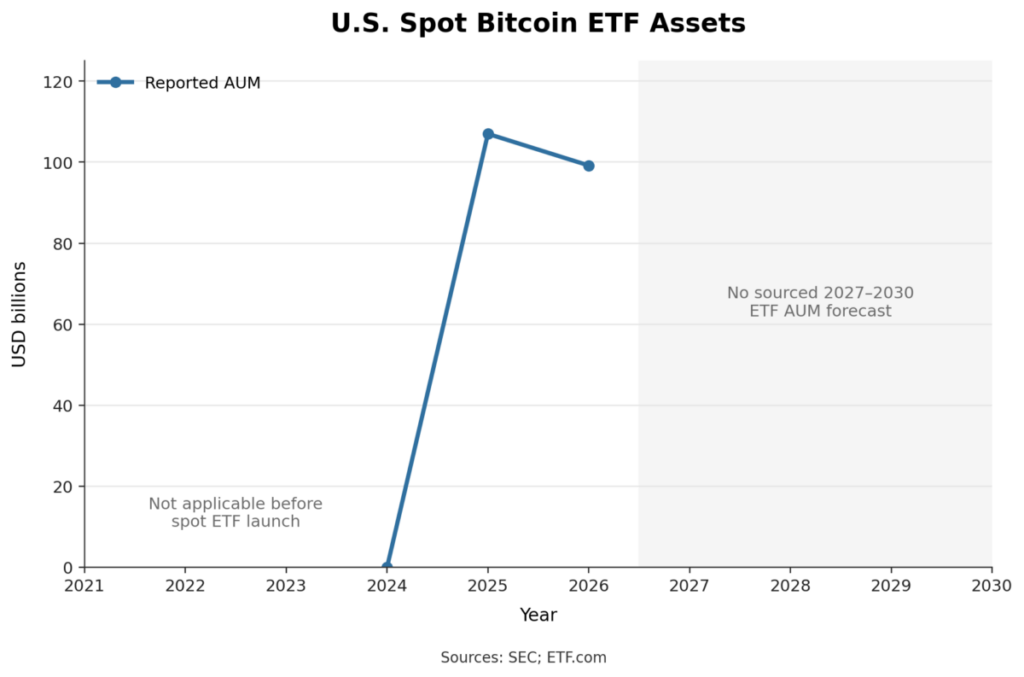
The institutional structure of Bitcoin changed materially after U.S. spot bitcoin exchange-traded products were approved for listing and trading in January 2024. Spot bitcoin ETFs now hold more than $86 billion in U.S. assets under management, and BlackRock’s iShares Bitcoin Trust charges a 0.25% sponsor fee for exchange-traded bitcoin exposure. These figures show how Bitcoin has moved from direct self-custody and exchange-based access into conventional brokerage-market packaging. Major financial institutions now treat Bitcoin as part of the investment landscape, even as its volatility remains distinct. The category has become less defined by novelty and more defined by financial assimilation.
Blockchain, as a security and algorithmic method, has followed a different path. Its role is becoming less speculative and more infrastructural. Public blockchain activity has broadened beyond Bitcoin price exposure into stablecoin settlement, exchange services, tokenized assets, compliance systems, and secure transaction architecture. In banking, settlement, corporate recordkeeping, and systems that require verifiable security, blockchain methods are increasingly used to establish transaction integrity and assign ownership to a specific person, asset, product, or process.
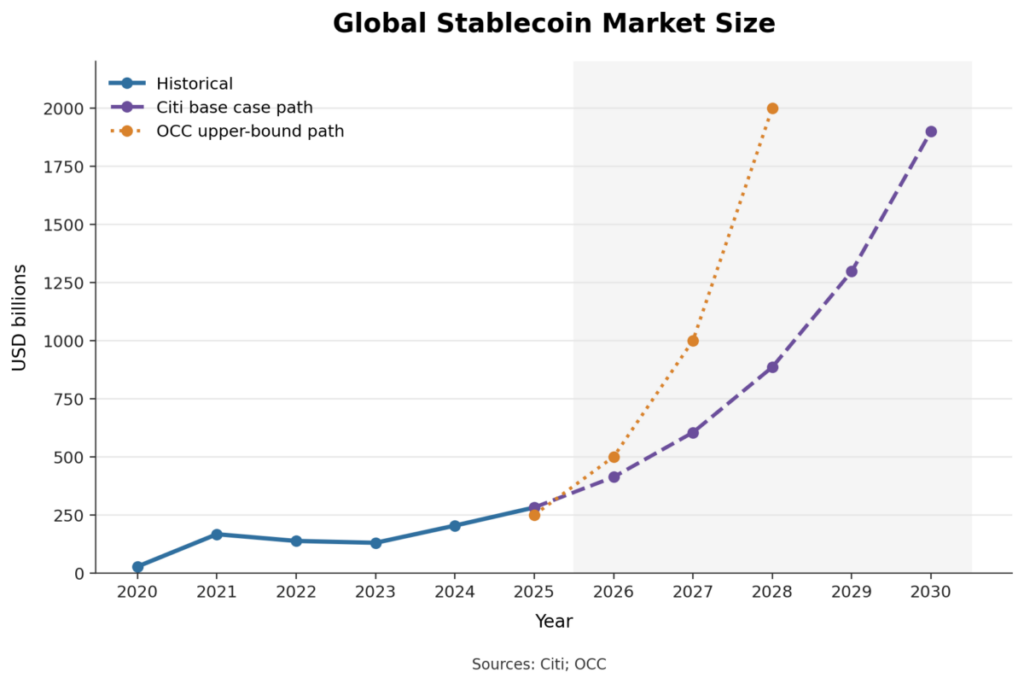
Outside Bitcoin, blockchain functions as a secure transaction standard rather than a tradable asset. Stablecoins form the most visible payments and settlement layer in the blockchain category. USDT has a live market capitalization of about $186.2 billion, while USDC has been used for more than $25 trillion in on-chain transactions through March 31, 2025. Stablecoin market capitalization grew by about 50% during 2025, with transaction volume and DeFi usage also rising. The use of blockchain in financial instruments, medical records, corporate systems, and digital ownership reflects a broader movement from ordinary encryption toward verifiable, auditable, and localized control of data and transactions.
Coinbase’s 2026 revenue trend shows the other side of that maturation. Total revenue and transaction revenue declined on an annualized Q1 basis, even as stablecoin scale continued to rise. The pattern points to a category moving beyond speculative trading volume toward a more mixed financial infrastructure model, where exchange activity remains cyclical but stablecoin settlement, custody, compliance, and regulated products carry more of the long-term structure.
Key takeaway: Bitcoin remains the category’s largest asset, but stablecoins and ETFs now explain much of the sector’s institutional and transactional growth.
| Category Summary Support Table | ||||
|---|---|---|---|---|
| Name | 2025 | 2026 (est)* | % Growth | Source |
| Bitcoin market capitalization | $2.054T | $1.278T | -37.79% | YCharts |
| Bitcoin circulating supply | ~20.0M BTC | 20.05M BTC | ~0.3% | CoinMarketCap |
| U.S. spot bitcoin ETF assets | $107B | $99.19B | -7.3% | ETF.com |
| Payment stablecoin issuance | $250B | $500B | 100% | OCC |
| * Estimate | ||||
New Trends
The new trend for 2026 is not the arrival of blockchain itself, but the maturation of the rails around it. Stablecoins are being treated as regulated payment instruments, exchange-traded bitcoin products are being treated as ordinary investment wrappers, and compliance has become a core operating layer for crypto firms. The U.S. GENIUS Act, signed into law on July 18, 2025, created a federal regulatory system for stablecoins with reserve, disclosure, marketing, insolvency, anti-money-laundering, and sanctions-compliance requirements.
Exchange economics are also becoming more cyclical and more segmented. Coinbase’s 2026 annualized run rate shows weaker transaction revenue than full-year 2025, while stablecoin market capitalization continued to grow. The divergence marks a new operating pattern for the category: trading revenue can contract while settlement infrastructure expands.
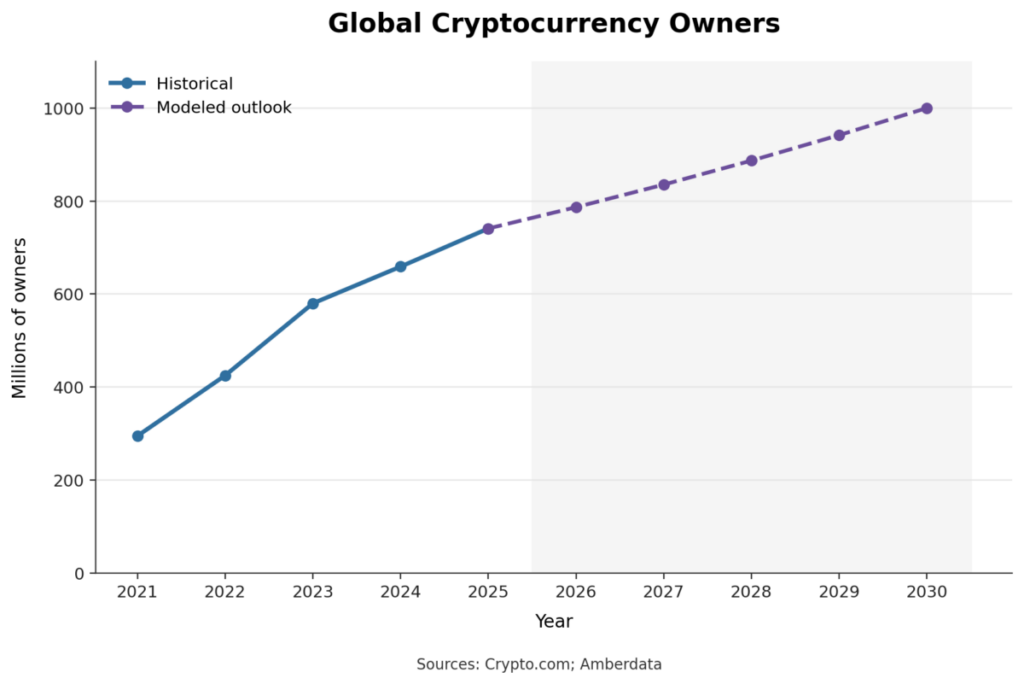
Blockchain adoption is also becoming more geographically distributed. Chainalysis ranked India first and the United States second in its 2025 Global Crypto Adoption Index, followed by Pakistan, Vietnam, and Brazil. The ranking shows a category that is no longer concentrated only in offshore trading venues or early-adopter developer communities.
Key takeaway: The leading 2026 trend is regulated integration, with stablecoin law, ETF access, and country-level adoption replacing early-cycle crypto experimentation.
| New Trends Support Table | ||||
|---|---|---|---|---|
| Name | 2025 | 2026 (est)* | % Growth | Source |
| Payment stablecoin issuance | $250B | $500B | 100% | OCC |
| Aggregate stablecoin market capitalization | ~$211B | $317B | ~50% | Federal Reserve |
| U.S. stablecoin framework | GENIUS Act enacted | Implementation phase | N/A | White House |
| Coinbase prediction markets annualized revenue | N/A | $100M+ | N/A | Coinbase |
| * Estimate | ||||
Major Milestones
The approval of U.S. spot bitcoin exchange-traded products in January 2024 remains the key market-structure milestone for Bitcoin. It gave investors a regulated route to bitcoin exposure without requiring direct custody, crypto exchange accounts, or private-key management. The current ETF asset base above $86 billion shows that the product category moved quickly from approval to material scale.
The second major milestone is the formal regulatory treatment of stablecoins. The GENIUS Act requires 100% reserve backing with liquid assets such as U.S. dollars or short-term Treasuries and requires monthly public reserve disclosures. That structure places stablecoins closer to regulated payment infrastructure than to the loosely supervised crypto instruments that defined earlier market cycles.
The shift from uniform crypto growth to segmented financial performance is also a maturity marker. Coinbase’s annualized 2026 revenue points to weaker trading activity than 2025, while stablecoin issuance and circulation continued to expand. That split is consistent with a more mature category in which market infrastructure, regulated products, and payment rails no longer move in lockstep with exchange trading volume.
Key takeaway: The two defining milestones are ETF approval for Bitcoin exposure and federal stablecoin regulation for blockchain-based settlement.
| Major Milestones Support Table | ||||
|---|---|---|---|---|
| Name | 2025 | 2026 (est)* | % Growth | Source |
| Spot bitcoin ETF AUM | $107B | $99.19B | -7.3% | ETF.com |
| Spot bitcoin ETF count | 11 launch funds | 37 U.S. funds | 236.4% | ETF.com |
| IBIT sponsor fee | 0.25% | 0.25% | 0% | BlackRock |
| Stablecoin federal framework | GENIUS Act enacted | Implementation phase | N/A | White House |
| * Estimate | ||||
Industry Outlook
The near-term outlook is shaped by three measurable forces: bitcoin ETF asset flows, stablecoin circulation, and regulated exchange revenue. Coinbase’s 2025 Form 10-K showed $7.18 billion in total revenue, including $4.06 billion in transaction revenue and $2.83 billion in subscription and services revenue, indicating that large crypto platforms are no longer dependent only on spot-trading commissions. Stablecoin revenue at Coinbase reached $1.35 billion in 2025, up from $910.5 million in 2024.
The long-term outlook remains cautious because blockchain markets still depend on asset prices, reserve confidence, cybersecurity, and regulatory access. Stablecoins have gained scale, but their expansion links crypto activity more directly to Treasury markets and compliance systems. Bitcoin has gained mainstream packaging through ETFs, but its market value remains volatile and its mining economics remain tied to power prices, hardware efficiency, and the block reward cycle.
Key takeaway: The category’s future depends less on whether blockchain exists and more on whether regulated financial products, stablecoin settlement, and exchange economics continue to scale without major security or liquidity shocks.
| Industry Outlook Support Table | ||||
|---|---|---|---|---|
| Name | 2025 | 2026 (est)* | % Growth | Source |
| Stablecoin market capitalization | ~$211B | $317B | ~50% | Federal Reserve |
| USDC circulation | ~$60B | $77B | 28% | Circle / Reuters |
| U.S. spot bitcoin ETF assets | $107B | $99.19B | -7.3% | ETF.com |
| Coinbase total revenue | $7.18B | $5.72B annualized | -20.3% | Coinbase / Reuters |
| Coinbase transaction revenue | $4.06B | $3.02B annualized | -25.6% | Coinbase / Reuters |
| * Estimate | ||||
Supplemental Data
Ecological / Environment
Bitcoin mining remains the category’s clearest environmental and infrastructure constraint. The U.S. Energy Information Administration estimated that annual electricity use from U.S. cryptocurrency mining probably represented 0.6% to 2.3% of U.S. electricity consumption. The EIA also estimated that U.S.-based Bitcoin mining electricity use ranged from 25 TWh to 91 TWh, assuming the United States retained roughly 38% of global Bitcoin mining activity.
Mining demand is difficult to monitor because facilities can relocate quickly to lower-cost power regions, and mining activity may be hard to separate from other large industrial loads. This makes cryptocurrency mining an infrastructure planning issue as well as an environmental issue. The constraint is most acute for proof-of-work mining, while stablecoins, exchanges, and many smart-contract networks do not carry the same direct electricity profile.
Key takeaway: U.S. cryptocurrency mining is large enough to matter for grid planning, with estimated electricity use equal to 0.6% to 2.3% of national consumption.
Key Global Stats
Bitcoin Market Value
Bitcoin’s market capitalization stands near $1.28 trillion, with about 20.05 million BTC in circulation. The asset remains the primary price benchmark for the blockchain category and the largest single cryptoasset by market value. Its fixed maximum supply of 21 million BTC continues to distinguish Bitcoin from fiat-linked stablecoins and corporate platform tokens.
Key takeaway: Bitcoin’s roughly $1.28 trillion market value makes it the central asset in the blockchain economy.
Spot Bitcoin ETF Scale
U.S. spot bitcoin ETFs hold more than $86 billion in assets under management across 37 ETFs. The approval of spot bitcoin exchange-traded products in January 2024 created a regulated product bridge between Bitcoin and traditional investment accounts. BlackRock’s IBIT charges a 0.25% sponsor fee, showing that bitcoin exposure is now being priced and distributed like a mainstream asset-management product.
Key takeaway: Spot bitcoin ETFs have turned Bitcoin into a conventional brokerage-market product with more than $86 billion in U.S. ETF assets.
Stablecoin Settlement
USDC had processed more than $25 trillion in on-chain transactions through March 31, 2025, including $5.9 trillion in the first quarter of 2025 alone. USDT remains the largest stablecoin, with a live market capitalization of about $186.2 billion. Stablecoins are the clearest example of blockchain infrastructure being used as a transactional layer rather than only as an asset-trading market.
Key takeaway: Stablecoins now represent a large-scale settlement layer, with USDC alone exceeding $25 trillion in cumulative on-chain transaction volume.
Exchange and Platform Revenue
Coinbase generated $7.18 billion in total revenue in 2025, including $6.88 billion in net revenue. Transaction revenue reached $4.06 billion, while subscription and services revenue reached $2.83 billion. Stablecoin revenue rose to $1.35 billion, showing that platform economics now include reserve-linked and service-based income in addition to trading fees.
Key takeaway: Coinbase’s 2025 revenue mix shows that crypto platform economics are shifting toward services and stablecoin-linked income alongside trading.
Security and Illicit Finance
Cybersecurity remains a major constraint for the blockchain category. The FBI attributed the February 2025 Bybit theft of approximately $1.5 billion in virtual assets to North Korean actors. The incident shows that large crypto platforms are part of the same financial-security environment as banks, payment networks, and capital-market infrastructure.
Key takeaway: The $1.5 billion Bybit hack shows that crypto market scale has made blockchain infrastructure a high-value target for state-linked cyber activity.
Notable Country / Region Stats
India ranked first in the 2025 Global Crypto Adoption Index, while the United States ranked second. This country pattern shows that blockchain adoption includes both high-volume advanced markets and large emerging digital economies. The same ranking placed Pakistan, Vietnam, and Brazil behind India and the United States, indicating that user adoption is not confined to one income group or one regional model.
The United States is also central to blockchain’s regulated-market structure. It hosts the major spot bitcoin ETF market, passed the GENIUS Act for stablecoins, and accounts for a large share of Bitcoin mining activity in available EIA estimates. The EIA cited Cambridge data showing the U.S. share of global Bitcoin mining rising from 3.4% in January 2020 to 37.8% in January 2022, the last month for which those published estimates were available.
Key takeaway: India leads measured adoption, while the United States is the main jurisdiction for ETF scale, stablecoin regulation, and documented mining infrastructure.
Keywords: Bitcoin, Blockchain, Stablecoins, Spot Bitcoin ETFs, Crypto Regulation

