
For most of its commercial life, e-commerce benefited from being treated as something new. Policymakers had good reason to give digital retail room to develop. Online sellers lowered the cost of finding products and completing transactions across distance. Rules written for traditional retail often did not fit neatly, and governments were cautious about slowing a market that was still proving what it could do.
The problem is that e-commerce is no longer small enough for its weaknesses to remain peripheral.
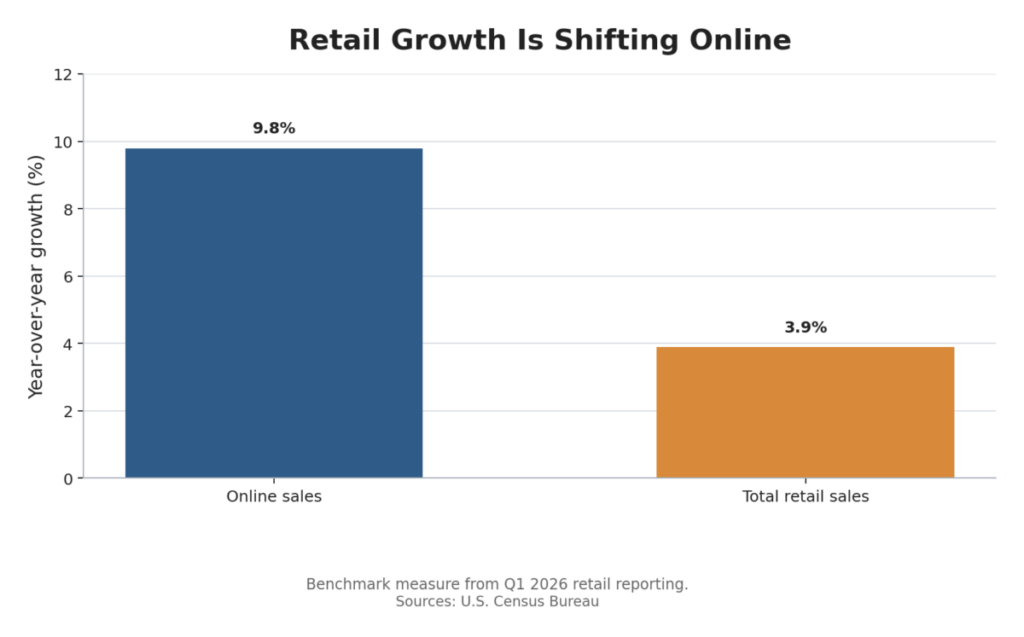
U.S. retail e-commerce sales reached $326.7 billion in the first quarter of 2026, up 9.8 percent from a year earlier while total retail grew 3.9 percent. Online sales represented 16.9 percent of U.S. retail spending. China was further along in 2025, when online sales of physical goods reached 13.1 trillion yuan and accounted for 26.1 percent of consumer-goods retail. Digital retail may still represent a minority of total spending, but its influence reaches well beyond transactions completed online.
Physical retailers now compete against expectations shaped online, from finding a product to receiving it. Merchants increasingly depend on digital channels to reach demand, while large marketplaces can sit between millions of buyers and sellers. As online purchasing becomes ordinary commerce, the familiar forces of economics become harder to separate from the technology that enabled it.
E-commerce initially grew by reducing transaction costs and expanding market access. Its scale now raises older questions about consumer welfare and competition, including what buyers can reasonably know and who pays when transactions create wider costs. The technology is modern. The economics are not.
| Market | Integration Measure | Figure |
|---|---|---|
| United States | Quarterly e-commerce growth | +2.7% |
| United States | Quarterly total retail growth | +1.5% |
| China | Total online retail sales | ¥15.97T |
| China | Annual online retail growth | +8.6% |
| European Union | Businesses using e-sales | 24% |
| European Union | Large businesses using e-sales | 48% |
Sources: U.S. Census Bureau, National Bureau of Statistics of China, Eurostat
The Old Economics Are Catching Up
The economics behind e-commerce are easier to understand than much of the technology surrounding it. Online markets reduced transaction costs by making products easier to find and purchases easier to complete across distance. Large marketplaces gained another advantage as more buyers attracted more sellers, generating enough activity to support services that smaller competitors struggled to match.
Those economies of scale and network effects can produce real consumer benefits while disrupting the rest of retail. Research on the rollout of a major e-commerce company’s fulfillment centers found that nearby physical-store sales fell about 4 percent and employment declined 2.1 percent. Retail-worker income fell 2.4 percent in affected areas, while some jobs shifted toward transportation and warehousing.
Economists would recognize that pattern as creative destruction. A more efficient business model replaces part of an older one, changing where jobs and investment go and who captures the resulting income. That process is not automatically a market failure.
The concern begins when the winner becomes so important that future competitors cannot realistically reproduce the advantages that helped it grow. A marketplace with a large pool of buyers becomes difficult for merchants to ignore. Those merchants make the marketplace more useful to consumers, reinforcing its position and raising the barrier facing new competitors. Competition can produce concentration, while concentration can eventually alter competition itself.
Other traditional economic problems follow the same path. Easy returns reduce risk for consumers but create costs elsewhere in the system. Cross-border shopping expands choice while still requiring customs and product-safety enforcement. When the people creating those costs do not fully bear them, economists describe the result as an externality.
Regulation increasingly determines who pays. Seller verification or product oversight can raise the cost of operating a marketplace, but those requirements can also keep consumers and public agencies from absorbing costs created by the transaction.
E-commerce has therefore reached a familiar stage in economic development. Efficiency remains valuable, but mature markets must also ask whether competition is functioning and whether consumers have enough information to make informed choices. They must also decide whether the price of a transaction reflects enough of what it costs to make that transaction safe and reliable.
| Economic Force | Market Effect | Supporting Evidence |
|---|---|---|
| Creative destruction | Retail activity shifts | 938 retail jobs lost per county per quarter |
| Labor reallocation | Jobs move toward fulfillment | +256 transport and warehousing jobs |
| Spillover employment | Activity shifts beyond retail | +143 food-service jobs |
| Entry pressure | Young and small stores weaken | Store exits rise; entry declines |
Sources: National Bureau of Economic Research
Consumers Made Convenience Economically Powerful
The economic rise of e-commerce ultimately depended on people deciding that these efficiencies improved daily life. Shopping takes time, and local availability has limits. A poor purchase adds another cost when correcting it requires more effort. E-commerce reduced those burdens enough to change what consumers expect from retail.
Research using U.S. transaction data from 2007 through 2017 estimated that e-commerce created consumer welfare gains equal to about a permanent 1 percent increase in consumption, worth more than $1,000 per household. Those gains were not simply about avoiding a drive. Consumers gained access to purchases that became easier or more worthwhile online.
Convenience therefore acts like part of the price even when it never appears on the receipt. A shopper weighs what an item costs against the effort required to obtain it and the difficulty of reversing the purchase if something goes wrong. Those preferences help explain why the same technology can carry different economic importance for a dense urban consumer, a rural household, or a merchant trying to reach customers beyond a local market.
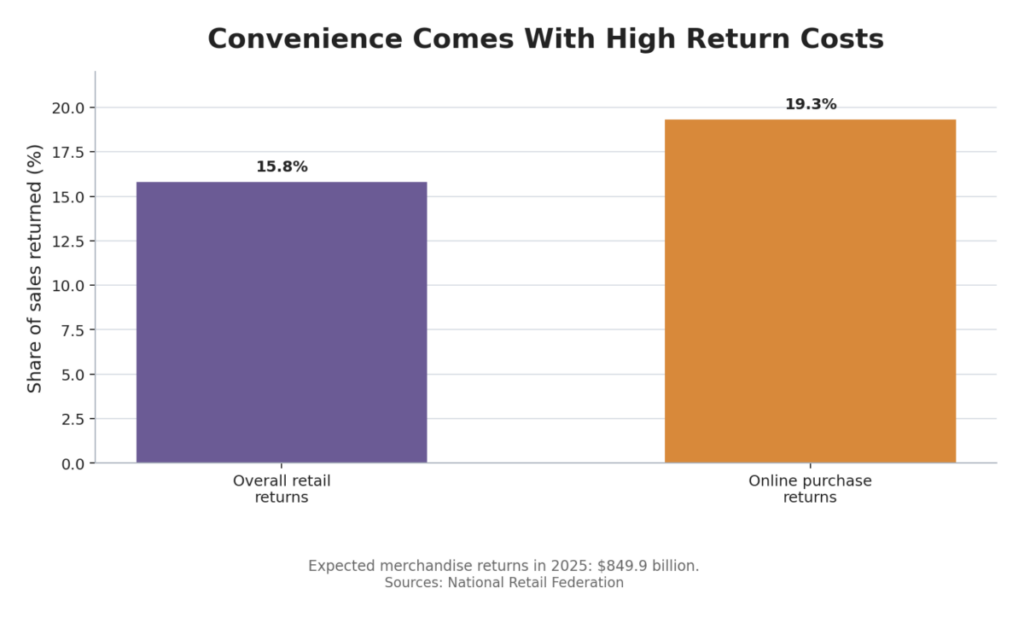
Returns show how strongly that expectation has taken hold. U.S. retailers expected $849.9 billion in merchandise returns in 2025, equal to 15.8 percent of annual sales. Online purchases carried a projected return rate of 19.3 percent, while 82 percent of consumers said free returns were important when choosing where to shop. A benefit that reduces risk for the buyer therefore becomes a major cost for the seller.
Trust works the same way. Consumers use large marketplaces partly because they do not want to investigate every unfamiliar merchant themselves. Reviews, guarantees, and reliable fulfillment reduce that burden, making distant sellers easier to use. Trust becomes part of what the platform is selling.
The depth of e-commerce integration therefore depends on more than whether the technology is available. It depends on what consumers and businesses need from it. Where online commerce solves meaningful problems of time, access, or uncertainty, it can become deeply embedded in everyday economic life.
| Consumer Measure | Figure | Economic Signal |
|---|---|---|
| U.S. online spending share in study | 8% | Meaningful consumer adoption |
| Estimated U.S. welfare gain | About 1.1% of consumption | Value beyond purchase price |
| EU online shoppers age 16–24 | 84% | High routine adoption |
| EU online shoppers age 65–74 | 55% | Adoption extends across generations |
| EU country range | 57%–95% | Demand remains uneven |
Sources: National Bureau of Economic Research, Eurostat
Regulation Returns With Scale
Once e-commerce becomes deeply integrated, consumer protection starts to resemble the same economic problem it has always been in traditional retail. Sellers often know things buyers cannot reasonably discover before purchasing. A shopper cannot test every charger for electrical safety or trace every distant merchant before clicking buy. Economists call that information asymmetry.
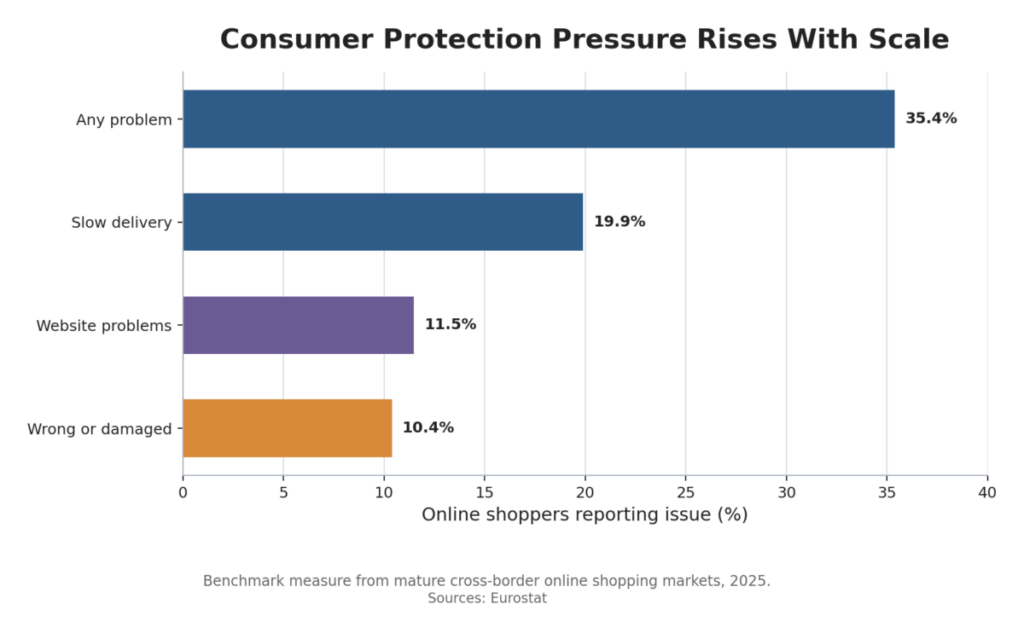
E-commerce made transactions easier, but it also made mistakes easier to multiply. In 2025, 35.4 percent of recent EU online shoppers reported a problem with an online purchase. Slow delivery affected 19.9 percent, while 10.4 percent received incorrect or damaged goods or services. Most are ordinary retail failures. Marketplace scale can expose extraordinary numbers of consumers to them.
Governments are increasingly putting more responsibility on the companies organizing those markets. The U.S. INFORM Consumers Act requires covered marketplaces to verify information from high-volume third-party sellers. The principle is straightforward: once a seller conducts substantial business through a platform, the platform is expected to know who that seller is.
Europe has moved further toward holding large platforms responsible for how their marketplaces operate. In July 2026, the European Commission fined AliExpress €550 million over Digital Services Act failures tied to risks from illegal, unsafe, and counterfeit products. Marketplace oversight had become a material business cost rather than a distant legal concern.
That changes the economics of scale. Platforms became powerful partly because they could add sellers and products without owning all of the inventory themselves. More sellers attracted more buyers, who in turn made the platform more attractive to sellers. Regulation adds a cost to that cycle because greater scale also means more activity to supervise. Product safety is increasingly part of running the marketplace itself.
Regulation is therefore emerging from traditional economic concerns rather than simply from discomfort with technology. Information asymmetry gives consumer protection an economic purpose. External costs raise the question of who should pay, while concentrated market power raises a different question about whether competition remains effective. E-commerce has become large enough for these old problems to matter at digital scale.
| Oversight Area | Verified Measure | Scale |
|---|---|---|
| U.S. seller verification | High-volume seller threshold | 200 transactions and $5,000 revenue |
| EU low-value imports | Consignments entering EU | 4.6 billion |
| EU border processing | Low-value parcels per day | About 12 million |
| EU product safety | Safety Gate alerts | 4,671 |
| EU marketplace oversight | Registered marketplaces | More than 1,200 |
| Automated surveillance | Sites scanned | More than 1.6 million |
Sources: Federal Trade Commission, European Commission
The Economics Change With the Market
Those economic principles travel well across borders. Their policy application does not.
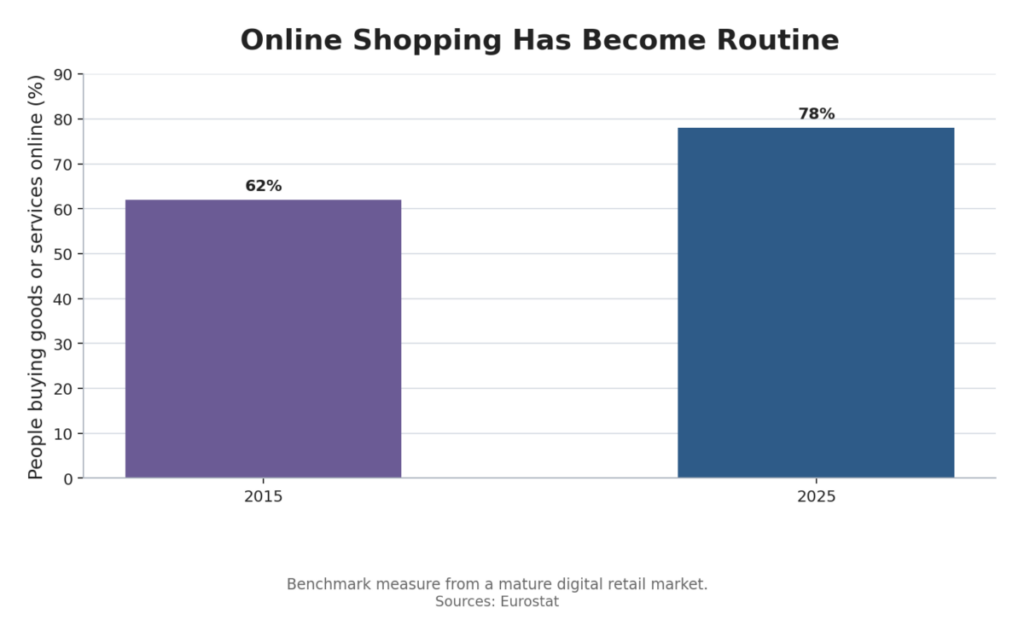
In mature digital markets, basic adoption is largely solved. Seventy-eight percent of Europeans purchased goods or services online in 2025, while e-commerce captured 16.9 percent of U.S. retail in early 2026. Policy can therefore focus more heavily on the consequences of scale because consumers and businesses already rely on the market.
Europe and the United States handle those consequences differently. Europe has been more willing to place direct obligations on large platforms. The United States relies more heavily on existing competition and consumer-protection law, supplemented by targeted rules such as seller verification. Both are responding to traditional economic problems inside highly developed digital markets, but responsibility is assigned differently.
China represents another form of maturity. Online sales of physical goods accounted for 26.1 percent of consumer-goods retail in 2025. Payments and logistics developed alongside marketplace growth, so regulation operates inside a deeply integrated digital retail system rather than a market still trying to persuade consumers to shop online.
Rapid-growth markets face a different economic balance. Across Latin America and the Caribbean, digital payments are expanding while trust and access still limit participation in some markets. Consumer protection can make people more willing to transact, but rules designed for mature economies can also raise the cost of entry for merchants whose digital participation is still developing.
The difference becomes larger where basic access remains a constraint. UN Trade and Development identified persistent infrastructure and institutional limits across 23 developing economies, while 2.6 billion people remained offline globally in 2025. In those markets, e-commerce may still create its greatest value by connecting buyers and sellers that geography or weak local markets previously kept apart.
Traditional economics still applies in each case, but the importance of each problem changes. A market struggling with access may rationally tolerate costs that a mature market is ready to regulate. A highly integrated market may place greater weight on competition or platform responsibility because dependence on digital commerce is already high.
Economic principles are broadly universal. Regulatory models are not.
| Market Type | Dominant Condition | Policy Priority |
|---|---|---|
| Mature digital retail | High consumer adoption | Competition and protection |
| Highly integrated platforms | Commerce linked with payments and logistics | System-level oversight |
| Rapid-growth markets | Participation still expanding | Trust without high entry costs |
| Access-constrained markets | Connectivity remains limiting | Access and participation |
| Global development context | 2.6 billion people offline | Digital inclusion |
Sources: Eurostat, National Bureau of Statistics of China, UN Trade and Development, Inter-American Development Bank
When Digital Retail Is Simply Retail
Nothing in current consumer behavior suggests e-commerce is returning to the margins. U.S. online sales were still growing much faster than total retail in early 2026, while China’s online physical-goods share had already moved beyond one quarter of consumer-goods retail.
What changes is the idea that digital commerce can keep the freedoms of a young industry after becoming one of the main ways people shop. Greater responsibility for sellers and product safety will affect which merchants platforms accept and which markets are worth serving. Regulation is moving into the economics of running e-commerce because e-commerce itself has moved into the economics of ordinary retail.
The trade-offs remain familiar. Stronger seller checks can protect buyers while making entry harder for smaller merchants. Competition rules can restrain dominant firms, yet expensive compliance can favor companies already large enough to absorb the cost. A policy that corrects a mature-market problem can therefore impose a different cost where digital commerce is still expanding access.
That difference matters for policymakers because e-commerce does not perform the same economic role everywhere. In some markets it is deeply integrated into daily consumption; elsewhere it may still be overcoming geographic limits or weak access to traditional retail. The role it plays determines which benefits need to be preserved and which failures have become large enough to regulate.
For decades, e-commerce grew by removing things that made shopping slower or more expensive. Its maturity now requires a harder question: which barriers are useless friction, and which protect consumers or keep competition functioning?
E-commerce is growing up because it is becoming ordinary, and ordinary commerce eventually has to answer to economics.
| Dimension | What to Measure | Maturity Signal |
|---|---|---|
| Adoption | Share of consumers buying online | Routine use |
| Retail weight | Share of retail conducted online | Material market influence |
| Business dependence | Firms selling through digital channels | Commercial reliance |
| Market power | Dependence on major intermediaries | Higher entry barriers |
| Consumer risk | Problems requiring verification or redress | Greater oversight need |
| Regulatory capacity | Ability to supervise digital transactions | Rules can be enforced |
| Access need | Connectivity and market-access gaps | Growth still has high social value |
Sources: U.S. Census Bureau, Eurostat, National Bureau of Statistics of China, National Bureau of Economic Research, Federal Trade Commission, European Commission, UN Trade and Development
TL;DR Summary
- E-commerce has grown large enough for traditional economic forces to shape its next stage.
- Lower transaction costs helped digital retail expand by making commerce easier across distance.
- Economies of scale and network effects can improve efficiency while strengthening large platforms.
- Creative destruction explains why e-commerce can shift sales, jobs, and investment away from older retail models.
- Consumer demand reflects economic value from convenience, access, and lower uncertainty.
- Information asymmetry becomes more important when consumers rely on platforms to judge unfamiliar sellers and products.
- External costs do not disappear because transactions happen online.
- Regulation increasingly determines who carries those costs and how much responsibility platforms assume.
- Market power becomes a concern when successful scale makes meaningful competition harder.
- The same economic principles apply across regions, but their importance changes with e-commerce integration and development.
- Mature markets can focus more heavily on oversight, while developing markets may still prioritize access and participation.
- E-commerce policy should apply traditional economics to local market conditions rather than copy one regulatory model everywhere.
Sources
- U.S. Census Bureau; Quarterly Retail E-Commerce Sales First Quarter 2026; – Link
- National Bureau of Statistics of China; Statistical Communiqué of the People’s Republic of China on the 2025 National Economic and Social Development; – Link
- Eurostat; Digitalisation in Europe 2026; – Link
- Institute of Internet Economics; E-Commerce; – Link
The Old Economics Are Catching Up
- National Bureau of Economic Research; Creative Destruction? Impact of E-Commerce on the Retail Sector; – Link
Consumers Made Convenience Economically Powerful
- National Bureau of Economic Research; Assessing the Gains from E-Commerce; – Link
- National Retail Federation; 2025 Retail Returns Landscape; – Link
Regulation Returns With Scale
- Eurostat; More Than a Third of Online Shoppers Face Issues; – Link
- Federal Trade Commission; Informing Businesses About the INFORM Consumers Act; – Link
- European Commission; Commission Fines AliExpress €550 Million for Breaching the Digital Services Act; – Link
- European Commission; Tackling Challenges With E-Commerce Imports; – Link
- European Commission; Increased Action Against Dangerous Products in the EU in 2025; – Link
The Economics Change With the Market
- Inter-American Development Bank; Beyond Cash: The Digital Payments Revolution in Latin America and the Caribbean; – Link
- UN Trade and Development; Mind the Gap: Getting Digital-Ready for Shared Prosperity; – Link
- UN Trade and Development; Digital Economy: A New Frontier for Trade, Sustainability and Inclusion; – Link
When Digital Retail Is Simply Retail
- National Retail Federation; Consumers Expected to Return Nearly $850 Billion in Merchandise in 2025; – Link