
Internet Influence – Part 2 of 2 Part Series – See Part 1 (Here)
The commercial logic of digital influence does not disappear when the desired conversion becomes political. The objective changes. Instead of a purchase or subscription, the sought-after action might be a donation, a vote, participation in a movement, or withdrawal from political life. The economic problem remains familiar: resources are limited, audiences differ, attention is scarce, and an organization wants to increase the probability of a particular behavior.
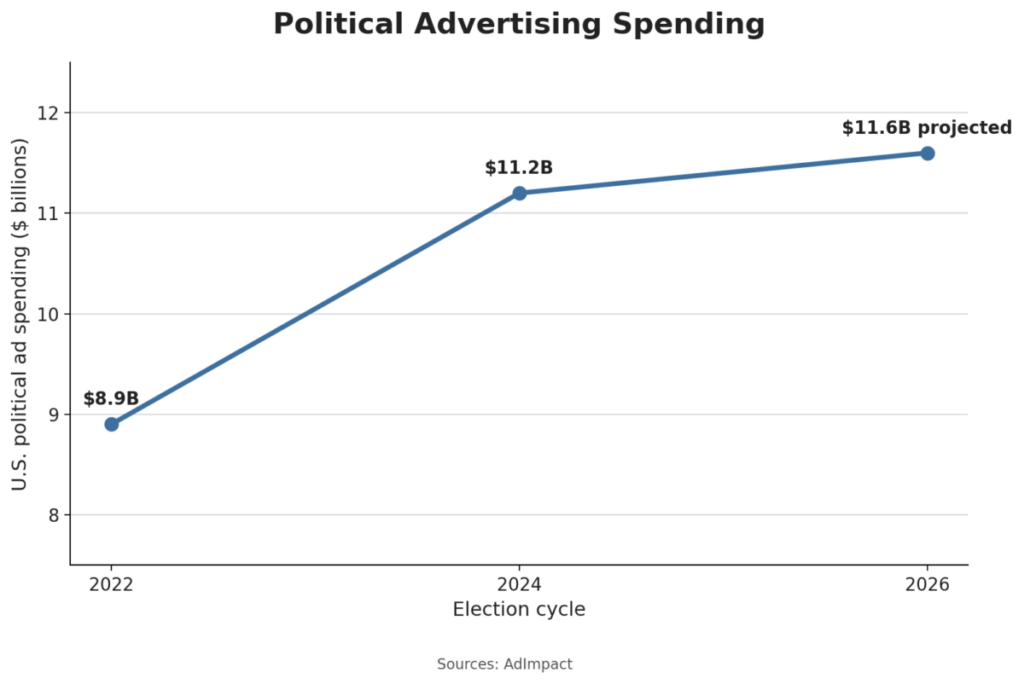
The scale of that competition is substantial. Presidential candidates spent about $1.8 billion during the 2023–2024 U.S. election cycle, congressional candidates roughly $3.7 billion, political parties $2.6 billion, and political action committees $15.5 billion. Independent expenditures added another $4.4 billion. At the same time, digital political advertising was projected to reach $3.46 billion in 2024, 156 percent above 2020 levels, lifting digital’s share of political advertising from 14.1 percent to 28.1 percent in four years.
What changes online is the degree to which influence can be deliberately assembled. Behavioral tendencies provide hypotheses about what may move an audience, while digital systems turn those hypotheses into interventions that can be observed and adjusted. Instead of searching for one universally persuasive message, campaigns can repeatedly test how a particular audience responds to a particular frame and delivery environment.
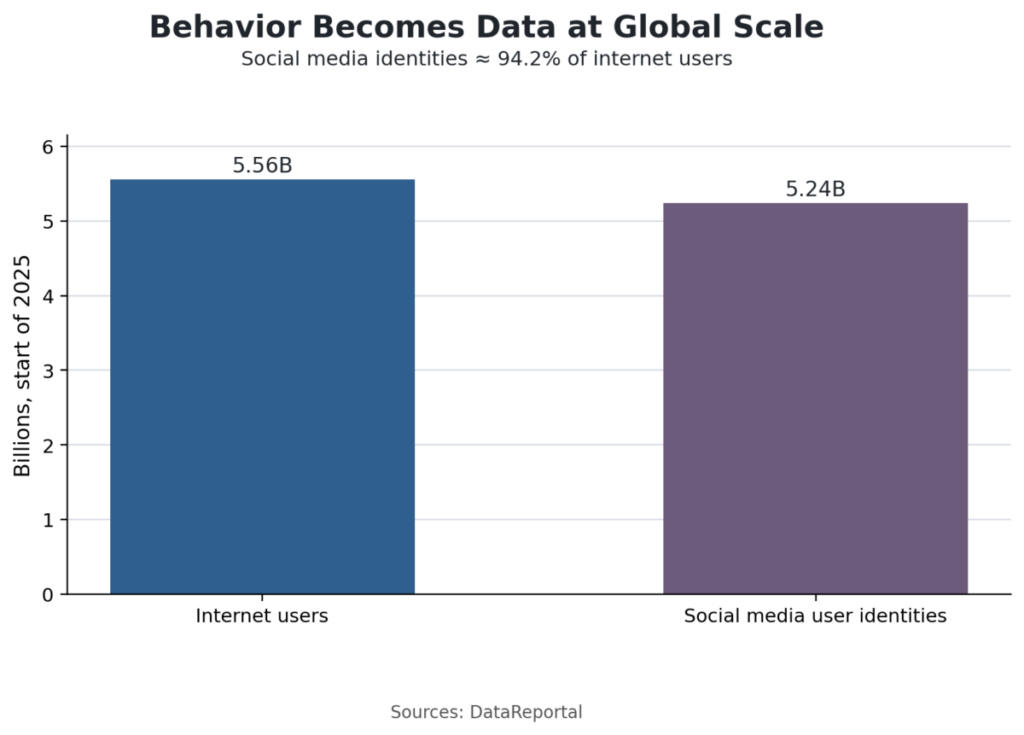
The same process can serve campaigns, movements, and other organized influence efforts. Their intentions and institutional contexts may differ sharply, but the underlying problem is similar: someone wants a population to behave differently, and the internet provides increasingly sophisticated ways to test how that behavior might be moved.
Digital systems do not make voters programmable. Political persuasion is often difficult, and the ability to reach a person says little by itself about whether that person will change an opinion or act. A study of the 2020 U.S. election removed political advertising from the feeds of 36,906 Facebook users and 25,925 Instagram users for six weeks. Researchers found no detectable effects across political knowledge, attitudes, participation, or electoral behavior. The more consequential development is not certainty. It is the ability to design an intervention, observe the response, and make another attempt.
| Objective | Behavior Sought | Observable Signal |
|---|---|---|
| Persuasion | Preference change | Survey movement |
| Mobilization | Participation | Turnout or signup |
| Fundraising | Contribution | Completed donation |
| Agenda Setting | Issue salience | Priority shift |
| Demobilization | Reduced participation | Lower action rate |
Sources: American Political Science Review, Federal Election Commission
| Measure | Earlier Level | Recent / Projected Level | Change |
|---|---|---|---|
| Digital political ad spend | 2020 baseline | $3.46B in 2024 | +156% |
| Digital share of political ads | 14.1% in 2020 | 28.1% in 2024 | Nearly doubled |
| Connected TV political ads | 2020 baseline | $1.56B in 2024 | +506% |
| Total political ad spending | $8.9B in 2022 | $11.6B projected in 2026 | +30% vs. 2022 |
| CTV share in 2026 | — | 23% of projected spend | $2.7B |
Sources: EMARKETER, AdImpact
Start With the Outcome
Influence begins with a behavioral objective. A campaign may want an undecided voter to change preference, but persuasion is only one possible conversion. An organization with a large base of supporters may gain more from increasing turnout than from changing anyone’s mind. Others may be trying to raise money, mobilize participation, or reduce the likelihood that dissatisfied voters act at all.
Those objectives require different strategies because exposure, persuasion, intention, and action are not interchangeable. A political video can reach millions of people without changing an attitude. A message can change an attitude without producing turnout. A voter may already agree with a campaign and still require additional motivation or lower participation costs before preference becomes behavior.
Political spending makes the distinction concrete. The strategic question is not simply whether communication resonates, but what the next campaign dollar is intended to produce. A fundraising operation can measure completed donations, while an organizing campaign may care more about signups than favorable comments. A turnout operation faces a different allocation problem again: additional resources may be more valuable when directed toward supporters who are less likely to vote than toward people who already behave as desired.
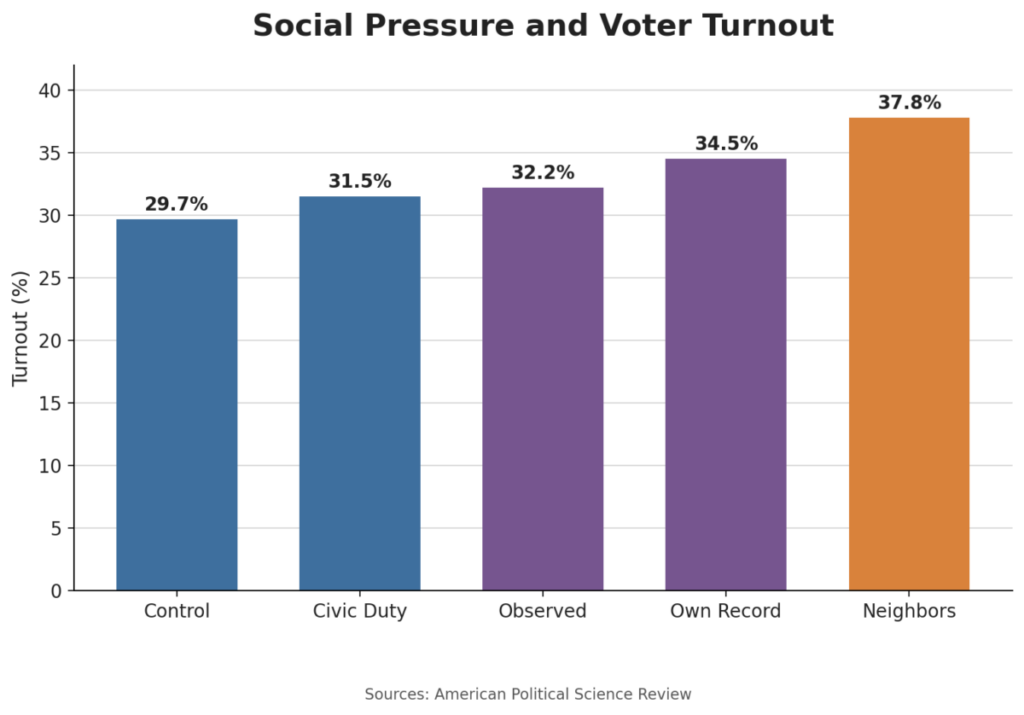
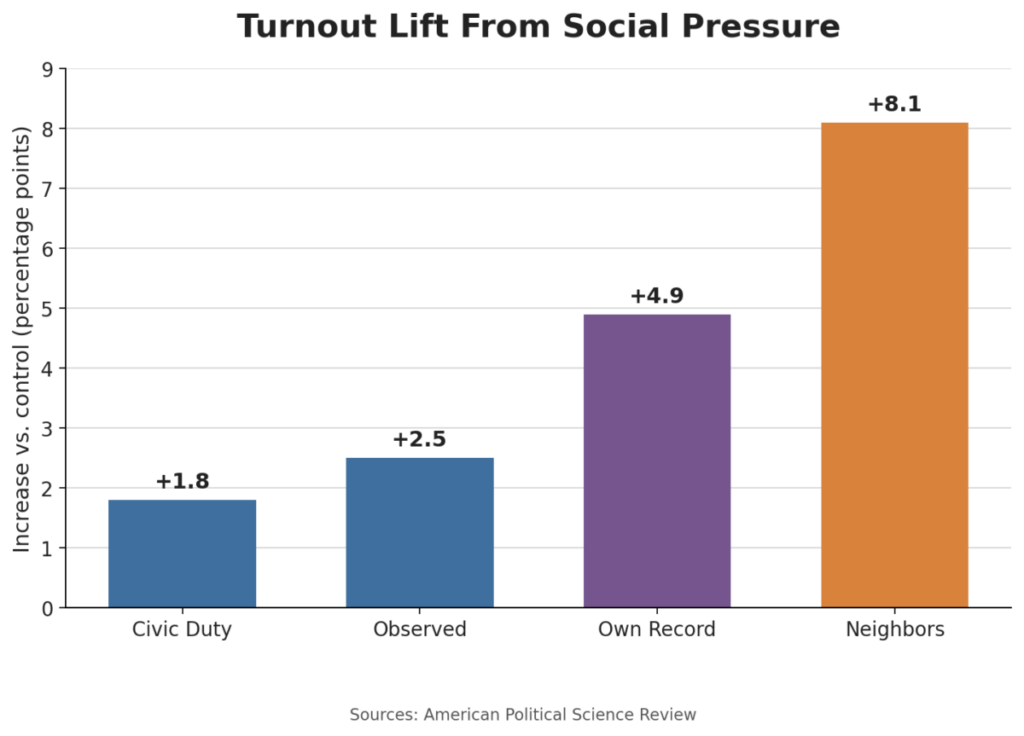
A large field experiment on voter turnout illustrates how sharply the outcome can change when the intervention changes. Turnout in the control group was 29.7 percent. A civic-duty appeal increased it to 31.5 percent, while showing voters their household voting history raised turnout to 34.5 percent. When neighborhood voting histories were added, turnout reached 37.8 percent, an 8.1 percentage-point increase over the control group. Political preference was not the lever being tested. The experiment changed the social environment around participation.
That distinction brings political communication closer to commercial conversion logic. The first question is not what message to produce but what behavior counts as success. Once the outcome is defined, resources can be allocated around it. Attention matters only to the extent that it contributes to a more valuable political result.
Political influence can also target outcomes that are harder to observe. Agenda setting and reputation strategy shape what people consider important and how they interpret institutions. Trust erosion and demobilization work differently, altering whether people believe participation or engagement is worthwhile even when their underlying ideology remains unchanged.
Defining the desired behavior therefore determines what the rest of the influence system is trying to accomplish. Once that behavior is specified, the problem becomes identifying who matters and what might move them.
| Lever | Decision Condition | Potential Response |
|---|---|---|
| Loss | Higher perceived stakes | Protective action |
| Social Pressure | Behavior becomes visible | Higher participation |
| Identity | Choice signals belonging | Expressive action |
| Efficacy | Action appears consequential | Mobilization |
| Friction | Action cost changes | Higher or lower completion |
Sources: American Political Science Review, Institute of Internet Economics
| Treatment | Behavioral Pressure | Turnout | Lift vs. Control |
|---|---|---|---|
| Control | None | 29.7% | — |
| Civic Duty | Norm reminder | 31.5% | +1.8 pts |
| Hawthorne | Awareness of observation | 32.2% | +2.5 pts |
| Household | Voting record shown | 34.5% | +4.9 pts |
| Neighbors | Neighborhood visibility | 37.8% | +8.1 pts |
Sources: American Political Science Review
Find the Behavioral Lever
A political audience is not one market. People who support the same candidate can arrive there through very different concerns. One voter may be focused on economic loss, while another responds more strongly to identity, group threat, or institutional distrust. A campaign seeking action has to identify which concern is most likely to move which audience toward the outcome already defined.
Behavioral economics and psychology provide the initial hypotheses. Perceived loss can increase the stakes of a decision, while social and identity cues can change how participation is interpreted. Friction and efficacy operate closer to the point of action: people may be more likely to participate when doing so is easier and when they believe participation can matter.
The operational step is matching those hypotheses to actual audiences. Campaigns can use past political and digital behavior to estimate where additional effort is most likely to matter. Supporter databases can generate turnout or donation probabilities, audience files can be matched to advertising platforms, and competing frames can be tested before larger spending decisions are made. The purpose is not to discover a hidden personality type. It is to estimate where additional effort is most likely to change behavior.
The turnout experiment provides a useful example of what a behavioral lever looks like in practice. Moving from a simple civic-duty message to an intervention that made household and neighborhood participation visible changed turnout effects from 1.8 percentage points to 8.1 points. The political argument remained secondary. The treatment changed the perceived social cost of failing to vote.
The lever is therefore not a secret psychological weakness waiting to be discovered. It is a plausible mechanism that may alter the probability of behavior under particular conditions. A turnout campaign might hypothesize that social pressure matters more than ideological argument among people who already support the candidate. An activist campaign might conclude that perceived efficacy matters more than anger because participation depends partly on whether collective action appears capable of producing an outcome.
Large campaign experiments show why the distinction is important. Researchers studying 146 experiments covering 617 advertisements from 51 U.S. campaigns and more than 500,000 respondents found meaningful variation in persuasive effects, yet commonly assumed characteristics of persuasive ads had limited and context-dependent predictive power. The advantage was not perfect psychological prediction. It was the ability to test competing hypotheses and identify which messages worked better in practice.
Behavioral knowledge narrows the set of possibilities. Digital measurement determines which possibilities survive.
| Stage | Function | Digital Mechanism |
|---|---|---|
| Audience | Define eligibility | CRM and audience matching |
| Message | Activate the lever | Frame testing |
| Messenger | Shape interpretation | Creator or trusted source |
| Delivery | Allocate exposure | Platform optimization |
| Action Path | Reduce completion cost | Direct action flow |
| Follow-Up | Respond to prior behavior | Retargeting |
Sources: Meta political advertising research, Pew Research Center
| Election Study | Ads Studied | Impressions | Delivery Finding |
|---|---|---|---|
| Germany 2021 | 80,000+ | 1.1B+ | Target and delivered audiences differed |
| EU Parliament 2024 | 110,000+ | 7B+ | Delivery differed after controls |
| EU 2024 coverage | 453 parties | 25 countries | 968 candidates studied |
| Populist-party delivery | EU 2024 sample | — | Male audience share +6 pts |
Sources: Bär et al., Corso et al.
Engineer the Choice Environment
Once an actor has an objective, an audience, and a plausible behavioral lever, influence becomes an exercise in construction. Strategy now has three connected parts: design the message, determine how it will be delivered, and shape the path from exposure to action.
Consider a campaign trying to increase turnout among supporters who vote inconsistently. It might begin by identifying low-propensity supporters, then test whether a loss-oriented frame creates more urgency than a policy-gain message. Delivery can be concentrated near the voting period through a trusted messenger, while easier access to polling information reduces the remaining friction between intention and action. The behavioral lever may be loss or social obligation, but the intervention depends on how the entire environment is assembled.
A donation campaign can use the same architecture differently. Identity and social proof can establish why the contribution matters, while a low-friction payment flow shortens the distance between motivation and completion. None of those elements guarantees a donation. Together, they create a choice environment designed around one.
Targeting determines who enters that environment. Political organizations can draw on first-party records such as supporter histories, previous contact, or voter information where legally available. Customer relationship management systems preserve those relationships over time. Platforms can then build modeled audiences around known responders, while retargeting changes later communication for people who have already watched, clicked, or visited a campaign page.
Platforms introduce another layer of decision-making. Researchers analyzing more than 80,000 Meta political ads from Germany’s 2021 federal election, representing more than 1.1 billion impressions, found considerable discrepancies between advertisers’ intended audiences and the audiences that actually received the ads. Meta’s delivery system participated in determining who was exposed and how efficiently parties converted spending into impressions.
The political actor therefore does not control the entire path from strategy to exposure. A campaign can define the eligible audience and desired outcome, but the platform may decide which people inside that audience are the most attractive opportunities for delivery. Campaign optimization and platform optimization operate at the same time, but they do not necessarily pursue the same objective. The campaign wants a political result. The advertising system is also solving a delivery and pricing problem inside its own marketplace.
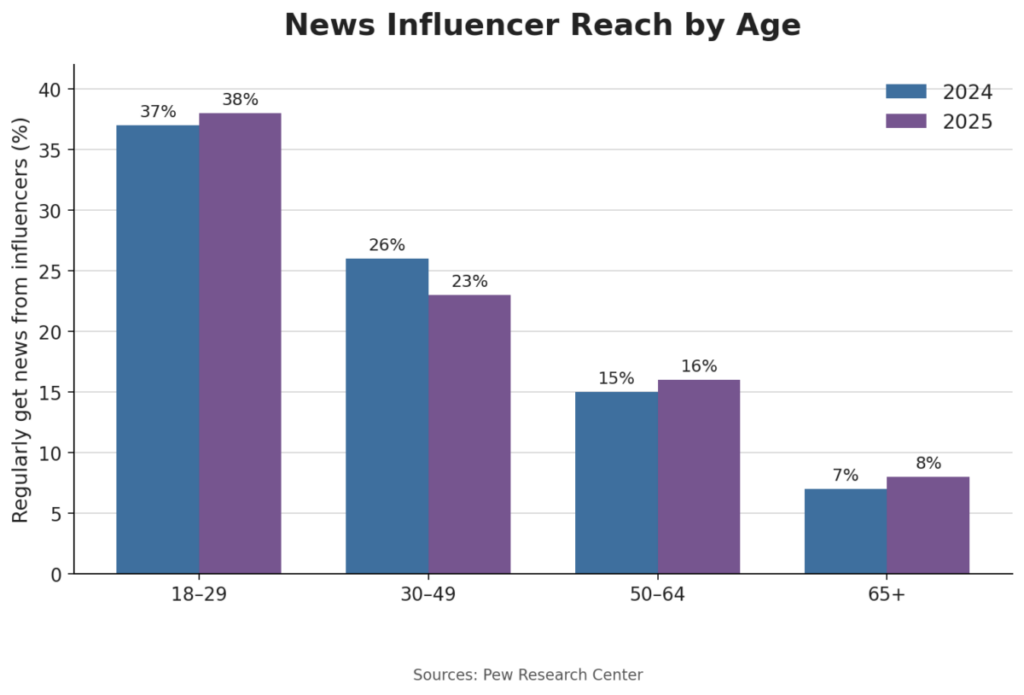
Messengers add another layer because credibility is unevenly distributed. Twenty-one percent of U.S. adults said in 2024 that they regularly received news from social-media news influencers, including 37 percent of adults ages 18 to 29. In a 2025 Pew survey of people who regularly used news influencers, 54 percent cited help understanding current events and civic issues as a major reason and 49 percent cited authenticity.
A campaign does not have to build every trusted relationship itself when a creator has already accumulated attention and credibility inside a particular community. Influence emerges from the interaction of message, distribution, and action environment. Framing shapes interpretation, delivery determines exposure, and friction affects whether intention becomes behavior.
| Channel | Source of Reach | Signal Created |
|---|---|---|
| Paid Distribution | Campaign spending | Targeted exposure |
| Creators | Existing audiences | Familiarity and trust |
| User Sharing | Peer networks | Visible participation |
| Recommendation | Algorithmic distribution | Repeated exposure |
| Coordinated Activity | Organized accounts | Apparent momentum |
Sources: Pew Research Center, TikTok recommendation audit, Institute of Internet Economics
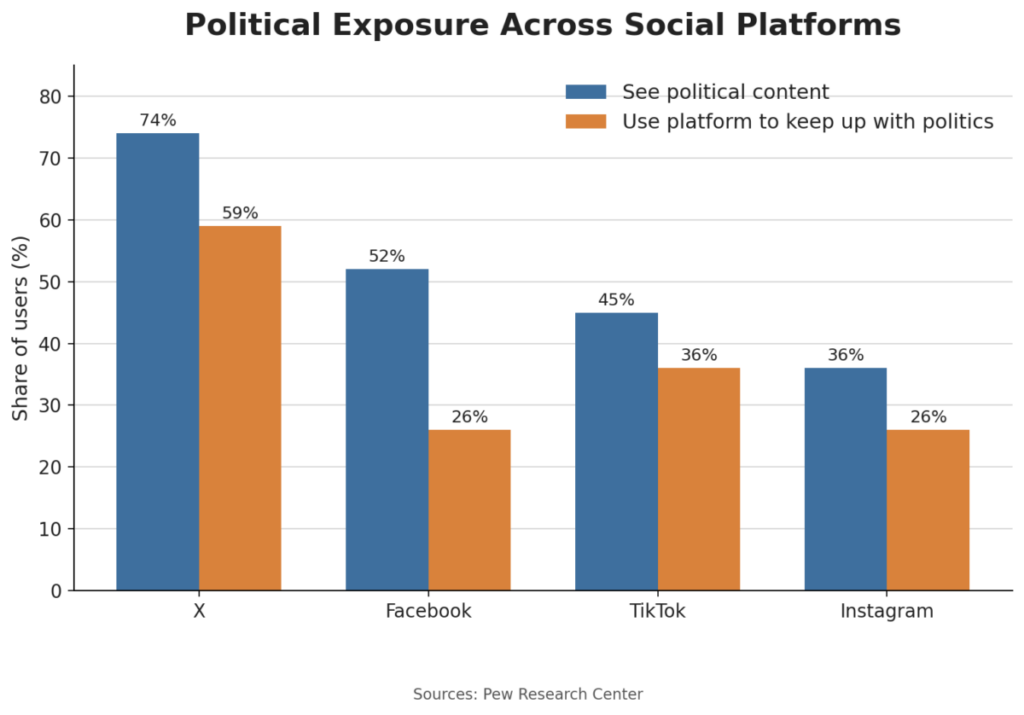
| Platform | See Political Content | Use Platform for Politics | Exposure Gap |
|---|---|---|---|
| X | 74% | 59% | +15 pts |
| 52% | 26% | +26 pts | |
| TikTok | 45% | 36% | +9 pts |
| 36% | 26% | +10 pts |
Sources: Pew Research Center
Make the Influence Spread
Targeting concentrates influence. Networks expand it.
Once political communication leaves the controlled environment of paid advertising, users begin changing it themselves. A slogan becomes a meme, while a political argument may be translated by a creator into the language of an existing community. The original actor may still benefit from the distribution, but it no longer controls every version of the message.
The economics change because audiences begin performing some of the distribution work. A campaign that pays to reach one viewer can gain additional exposure when that person reproduces the message or carries it into another community. Activist movements can operate through the same mechanism without a centralized advertising budget. Reproducible symbols and narratives lower the cost of participating in the communication process.
Memes are particularly effective at this translation because they compress meaning. Once the audience understands the underlying grammar, a new version requires little explanation. Political identity can travel with the format, making sharing both a communication act and a visible indication of affiliation.
The boundary between political and nonpolitical feeds is also porous. Forty-five percent of U.S. TikTok users said at least some of the content they saw concerned politics or political issues, even though only 7 percent said at least some of what they posted or shared was political. The contrast is sharper when compared with platform use: 95 percent cited entertainment as a reason for using TikTok, while only 36 percent cited keeping up with politics. Political exposure therefore occurs inside an attention market whose users often arrived for something else.
Creators accelerate the process because their audiences already exist. A political message entering through a creator whose following formed around culture or entertainment can reach people outside the formal political information system. The creator supplies more than distribution. Existing familiarity shapes how the audience encounters the message.
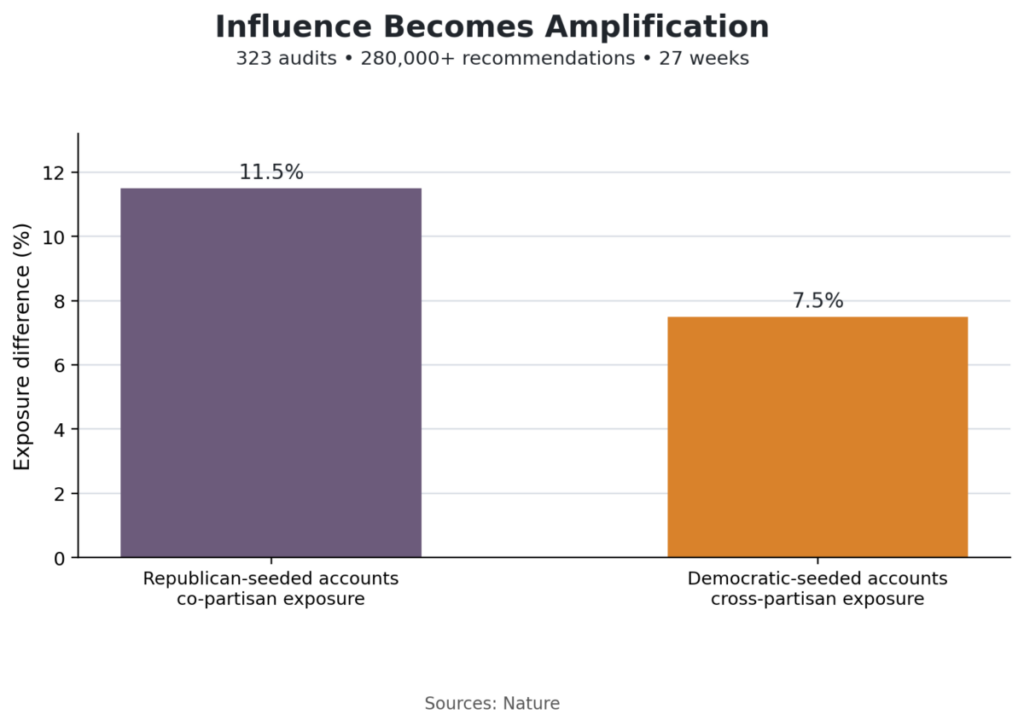
Recommendation systems add another form of amplification. A TikTok audit created 323 controlled accounts across Texas, New York, and Georgia and observed roughly 394,000 videos during the 2024 U.S. presidential campaign. Republican-seeded accounts received about 11.8 percent more party-aligned recommendations than Democratic-seeded accounts, while Democratic-seeded accounts encountered about 7.5 percent more opposite-party recommendations. The asymmetry persisted after accounting for observable engagement and channel characteristics.
The finding does not establish that recommendation differences changed votes. It makes the intermediate mechanism tangible: two audiences can begin with different behavioral signals and receive systematically different political environments from the same platform.
Visible engagement then becomes part of the environment for the next person. Metrics such as shares or comment activity record behavior, but they also signal importance and social legitimacy. A political movement with visibly growing participation can therefore affect how later users interpret it before any individual argument has been evaluated.
That creates incentives for coordinated or inauthentic amplification. Bots, astroturfing, and other organized activity can attempt to manufacture momentum or consensus. Their strongest effect need not be direct persuasion. Apparent activity can change what seems important, socially common, or worthy of further attention.
The distinction between actual public opinion and perceived public opinion therefore becomes strategically important. People may be more willing to participate when they believe others are joining, while perceived isolation can discourage expression or action. Influence can operate not only on what someone believes, but on what someone thinks everyone else believes.
By that point, the network itself has become part of the influence process. The original actor supplies a frame, users reproduce it, visible activity generates social signals, and those signals shape the environment encountered by the next audience. Every stage also produces more behavioral information.
| Channel | Source of Reach | Signal Created |
|---|---|---|
| Paid Distribution | Campaign spending | Targeted exposure |
| Creators | Existing audiences | Familiarity and trust |
| User Sharing | Peer networks | Visible participation |
| Recommendation | Algorithmic distribution | Repeated exposure |
| Coordinated Activity | Organized accounts | Apparent momentum |
Sources: Pew Research Center, TikTok recommendation audit, Institute of Internet Economics
| Research Setting | Scale | Measured Result |
|---|---|---|
| Campaign ad testing | 146 experiments; 617 ads | Meaningful variation across ads |
| Campaign archive | 51 campaigns; 500,000+ respondents | Testing identified better performers |
| LLM policy persuasion | 4,829 participants | ≈2–4 point attitude shifts |
| Personalized GPT-4 debate | 900 participants | 64.4% more-persuasive outcomes when non-tied |
| Personalized GPT-4 debate | Same experiment | +81.2% odds of greater agreement |
Sources: American Political Science Review, Nature Communications, Nature Human Behaviour
Measure, Adapt, Repeat
The feedback loop is where digital influence departs most clearly from a one-way model of persuasion. Political actors do not have to settle in advance which frame, messenger, or audience is best. They can deploy alternatives, observe what happens, and redirect resources.
A campaign testing turnout messages might find that a threat-based frame produces heavy engagement but little movement toward registration, while social pressure generates fewer views and more completed actions. A fundraising operation may discover that one creator produces cheaper traffic while another sends fewer visitors who are much more likely to donate. The value of the data lies in separating attention from the outcome the campaign actually wants.
The optimization process can be understood as a funnel. Cost per impression establishes how cheaply an audience can be reached, engagement shows whether attention was captured, and conversion measures whether that exposure produced the desired action. Cost per conversion then connects behavior back to spending. If one intervention produces registrations at $20 each and another produces them at $12, the budget does not need a complete theory of human nature to know where the next dollar is likely to work harder.
Those distinctions turn strategy into a sequence of experiments. Response to one intervention can change subsequent exposure, reshape the audience definition, and redirect the budget. What matters is not whether the first prediction was correct, but whether the system can learn from what happened.
The 146-experiment campaign archive shows how substantial the testing infrastructure has already become. Across 617 ads from 51 campaigns and more than half a million respondents, individual advertisements differed enough in persuasive performance for experimentation to have economic value. The researchers also concluded that those gains can compound the political influence of money because identifying a better-performing ad is most useful to campaigns with sufficient resources to deploy it at scale.
Measurement has an important limitation: digital systems tend to optimize what they can observe. A click or completed donation is easy to record. Long-run political trust or civic legitimacy is much harder to capture. Optimization can therefore push strategy toward measurable proxies even when the political consequences extend well beyond them.
Artificial intelligence lowers the cost of running the process at larger scale. Generative systems can produce and adapt creative material, localize it for different audiences, and analyze response more cheaply than when each variation requires a separate production cycle. Across three preregistered experiments involving 4,829 participants, LLM-generated persuasive messages produced measurable policy-attitude changes of roughly 2 to 4 points on a 101-point scale and performed similarly overall to persuasive messages written by ordinary humans.
Personalization may add another layer. In a controlled study of 900 participants, GPT-4 was given access to basic demographic information in some debate conditions. When human and AI debaters did not tie, personalized GPT-4 was more persuasive than human opponents 64.4 percent of the time, corresponding to an 81.2 percent increase in the odds of greater post-debate agreement relative to the human baseline. The result comes from a controlled debate setting rather than an election campaign, but it demonstrates how behavioral information and generative systems can interact.
The immediate economic advantage of AI is therefore broader than synthetic political content. It lowers the marginal cost of experimentation and adaptation, allowing more variants to be tested against more audiences before resources are concentrated on what appears to work.
Predictability often comes from learning after deployment rather than knowing before deployment. The system becomes influential because it can be wrong, measure the error, and change the next attempt.
| Stage | Signal | Possible Adjustment |
|---|---|---|
| Exposure | Reach and cost | Change audience |
| Attention | View or click response | Change message |
| Action | Conversion rate | Change action path |
| Efficiency | Cost per conversion | Reallocate budget |
| Learning | Treatment difference | Scale or retest |
Sources: American Political Science Review, Nature Communications, Nature Human Behaviour
| Research Setting | Scale | Measured Result |
|---|---|---|
| Campaign ad testing | 146 experiments; 617 ads | Meaningful variation across ads |
| Campaign archive | 51 campaigns; 500,000+ respondents | Testing identified better performers |
| LLM policy persuasion | 4,829 participants | ≈2–4 point attitude shifts |
| Personalized GPT-4 debate | 900 participants | 64.4% more-persuasive outcomes when non-tied |
| Personalized GPT-4 debate | Same experiment | +81.2% odds of greater agreement |
Sources: American Political Science Review, Nature Communications, Nature Human Behaviour
From Influence to Control
Influence remains a competitive process as long as actors are attempting to alter behavior from within an environment they do not control. Political power changes qualitatively when an actor can shape the conditions of the environment itself.
Political actors compete over messages and behavior, but intermediaries and governments may possess authority over the systems through which that competition occurs. Platforms can govern distribution, payment providers can affect transactions, telecommunications networks can determine connectivity, and governments can impose legal or technical constraints across all three.
The progression is from influencing a choice to influencing the conditions under which choice occurs.
Visibility is one form of structural power because ranking, recommendation, and moderation can determine whether communication reaches an audience. Access is another, encompassing the accounts, infrastructure, and transactional systems that make participation possible. Observation adds a third dimension: political behavior can become more costly when people expect it to be linked to their identity or exposed to consequences.
Internet shutdowns show what happens when control moves from influencing information to removing the infrastructure that carries it. Access Now documented at least 296 shutdowns across 54 countries in 2024. At least 103 were related to conflict across 11 countries.
Friction, which appears earlier as a tool for converting intention into action, becomes politically significant in both directions. A movement can reduce friction by making participation easier. Institutions can increase it through additional requirements, delays, or uncertainty. Neither approach requires changing anyone’s underlying political beliefs to alter behavior.
Regulation can reshape the influence market as well. European Union rules that took effect in October 2025 introduced three broad constraints: greater transparency around sponsors and spending, tighter limits on political targeting and personal-data use, and restrictions on foreign sponsorship close to elections or referendums. Political targeting requires explicit and separate consent, while special-category data such as political opinions or racial or ethnic origin cannot be used for profiling.
The compliance burden altered platform strategy rather than simply adding another disclosure. Google announced that it would stop serving political advertising in the EU before the rules took effect, including qualifying paid political promotions on YouTube. Meta stopped delivering political, electoral, and social-issue advertisements in the EU in October 2025, citing the requirements and legal uncertainty created by the regulation.
The same infrastructure can enable political action. Activists can coordinate, raise funds, and distribute evidence or messages beyond traditional institutional channels. Digital systems therefore expand political capacity while simultaneously making parts of that activity more observable and dependent on intermediaries.
Intermediary power belongs alongside persuasion because campaigns and movements rarely own the full pathway connecting them to an audience. Distribution depends on platforms, transactions on payment systems, availability on hosting and connectivity, and the boundaries of each are shaped by law and regulation. Changes at any of those points can alter the economic cost of reaching, organizing, or observing a political audience.
The line between influence and manipulation also becomes clearer at this stage. Ordinary influence attempts to change behavior through persuasion, framing, or environmental design. Manipulation introduces additional concerns when deception or hidden intent is combined with fabricated social signals or information asymmetries the target cannot reasonably evaluate. Control goes further by giving an actor meaningful authority over whether communication, participation, access, or observation occurs at all.
Politics has always involved attempts to shape attention, emotion, identity, and action. Digital systems do not invent those motives. They make influence more targetable, testable, distributable, and adaptive.
The political significance lies less in a technology that can tell people what to think than in a system that can repeatedly ask what moves them, measure the answer, and try again.
| Level | What Is Shaped | Mechanism |
|---|---|---|
| Influence | Interpretation | Message framing |
| Distribution | Visibility | Ranking and recommendation |
| Participation | Access and friction | Accounts, payments, identity rules |
| Observation | Identifiability | Tracking and surveillance |
| Infrastructure | Connectivity | Network restriction or shutdown |
Sources: Access Now, European Commission, Google, Meta
| Indicator | Measured Scale | Environment Affected |
|---|---|---|
| Internet shutdowns in 2024 | 296 | Connectivity |
| Countries affected | 54 | National access |
| Conflict-related shutdowns | 103 across 11 countries | Crisis communication |
| EU targeting consent rule | Effective Oct. 2025 | Political ad targeting |
| Foreign-sponsor restriction | 3 months before EU vote | Political ad access |
| Major platform response | Google and Meta exited EU political ads | Advertising market |
Sources: Access Now, European Commission, Google, Meta
TL;DR
- Digital political influence begins with a desired behavior rather than a message.
- Presidential, congressional, party, and PAC spending during the 2023–2024 U.S. cycle ran into tens of billions of dollars, while digital political advertising was projected at $3.46 billion in 2024.
- Persuasion, mobilization, demobilization, attention, and action are separate strategic objectives.
- A large voter-turnout experiment increased participation from 29.7 percent to 37.8 percent by increasing social pressure rather than attempting to change political preference.
- Behavioral economics supplies hypotheses about what may move an audience, not deterministic techniques for controlling people.
- Campaign databases, propensity scores, audience matching, retargeting, and platform optimization turn those hypotheses into testable interventions.
- More than 80,000 German political ads generating 1.1 billion impressions showed that actual platform delivery can differ substantially from advertiser targeting.
- Twenty-one percent of U.S. adults regularly got news from social-media news influencers in 2024, including 37 percent of adults ages 18 to 29.
- Forty-five percent of TikTok users encounter at least some political content even though only 7 percent say they post or share political content themselves.
- A 323-account TikTok audit found systematic differences in partisan recommendation patterns during the 2024 election campaign.
- Campaign experimentation covering 617 ads, 51 campaigns, and more than 500,000 respondents shows why testing can be more valuable than confidence in a persuasive theory.
- AI lowers the marginal cost of producing, personalizing, and testing political communication, while controlled experiments show measurable but context-dependent persuasive effects.
- Internet shutdowns, regulation, platform exits, surveillance, and intermediary rules demonstrate how influence can become power over the conditions of political communication itself.
Opening / Article Foundation
- Federal Election Commission; Statistical Summary of 24-Month Campaign Activity of the 2023–2024 Election Cycle; – Link
- EMARKETER; 2024 Political Ad Spending Will Jump Nearly 30% vs. 2020; – Link
- AdImpact; AdImpact Reveals 2026 Election Cycle to Reach Record $11.6 Billion in Ad Spending; – Link
- Nature Human Behaviour; The Effects of Political Advertising on Facebook and Instagram Before the 2020 US Election; – Link
- Institute of Internet Economics; The Internet Has Become a System for Shaping Behavior; – Link
Start With the Outcome
- American Political Science Review; Social Pressure and Voter Turnout Evidence from a Large-Scale Field Experiment; – Link
- Federal Election Commission; Statistical Summary of 24-Month Campaign Activity of the 2023–2024 Election Cycle; – Link
- AdImpact; AdImpact Reveals 2026 Election Cycle to Reach Record $11.6 Billion in Ad Spending; – Link
Find the Behavioral Lever
- American Political Science Review; Social Pressure and Voter Turnout Evidence from a Large-Scale Field Experiment; – Link
- American Political Science Review; How Experiments Help Campaigns Persuade Voters; – Link
Engineer the Choice Environment
- Bär, Pierri, De Francisci Morales and Feuerriegel; Systematic Discrepancies in the Delivery of Political Ads on Facebook and Instagram; – Link
- Pew Research Center; News Influencers Fact Sheet; – Link
Make the Influence Spread
- Pew Research Center; How Americans Navigate Politics on TikTok, X, Facebook and Instagram; – Link
- Pew Research Center; How TikTok Users View and Experience the Platform; – Link
- Ibrahim, Jang, Aldahoul, Kaufman, Rahwan and Zaki; TikTok’s Recommendations Skewed Towards Republican Content During the 2024 U.S. Presidential Race; – Link
- Pew Research Center; News Influencers Fact Sheet; – Link
Measure, Adapt, Repeat
- American Political Science Review; How Experiments Help Campaigns Persuade Voters; – Link
- Nature Communications; LLM-Generated Messages Can Persuade Humans on Policy Issues; – Link
- Nature Human Behaviour; On the Conversational Persuasiveness of GPT-4; – Link
From Influence to Control
- Access Now; Lives on Hold Internet Shutdowns in 2024; – Link
- European Commission; New EU Rules on Political Advertising Come Into Effect; – Link
- Google; An Update on Political Advertising in the European Union; – Link
- Meta; Ending Political, Electoral and Social Issue Advertising in the EU in Response to Incoming European Regulation; – Link
- Reuters; Meta to Halt Political Advertising in EU From October, Blames EU Rules; – Link
Keywords: Behavioral Economics, Political Influence, Digital Campaigning, Behavioral Targeting, Influence Optimization, Platform Governance, Political Participation, Digital Activism