
While the internet is not a pure utility, it now functions as one across modern economic life. ICT has become embedded in households and institutions to the point that traditional economics applies more directly than when connectivity was still an emerging technology. Much of that integration is mobile. Fixed networks remain essential to businesses, homes, and high-capacity use, but for individuals the mobile device has become the principal interface to the internet and, increasingly, to economic participation itself. By the end of 2024, 4.7 billion people were using mobile internet on a personal device, representing 58 percent of the global population; in low and middle income countries, mobile accounted for 84 percent of broadband connections.
This level of integration represents something more consequential than widespread adoption. The internet is part of daily economic life, and through basic observation the difference between the haves and have-nots is clear. Society is aligned around internet integration, and business relies on it. Until relatively recently, access could still be treated as an emerging factor and, in many settings, something closer to a luxury. Its reach and influence have now cemented it into modern economies, making ICT an economic concern that policymakers must account for when pursuing prosperity, competitiveness, and economic control.
The distinction between ICT and mobile matters, but only to a point. Mobile is not the entirety of ICT, nor does it replace the fixed infrastructure behind it. It is the most visible delivery mechanism for a much broader system. For individuals especially, mobile integration is where utility-like dependence becomes tangible. Economic participation, personal communication, and access to services increasingly converge through a device carried throughout the day. For many people in lower income markets, mobile is also the primary or only route onto the internet.
Traditional economics now applies to ICT more directly because ICT has become functionally essential, but digital characteristics distort the traditional models. Communications networks bring familiar questions of fixed investment, scale, scarcity, externalities, competition, and capital allocation into the internet economy. Yet ICT separates infrastructure from the services using it, allows economic activity to cross borders almost invisibly, and continually shifts value as technology changes. The principles remain familiar. The variables have changed.
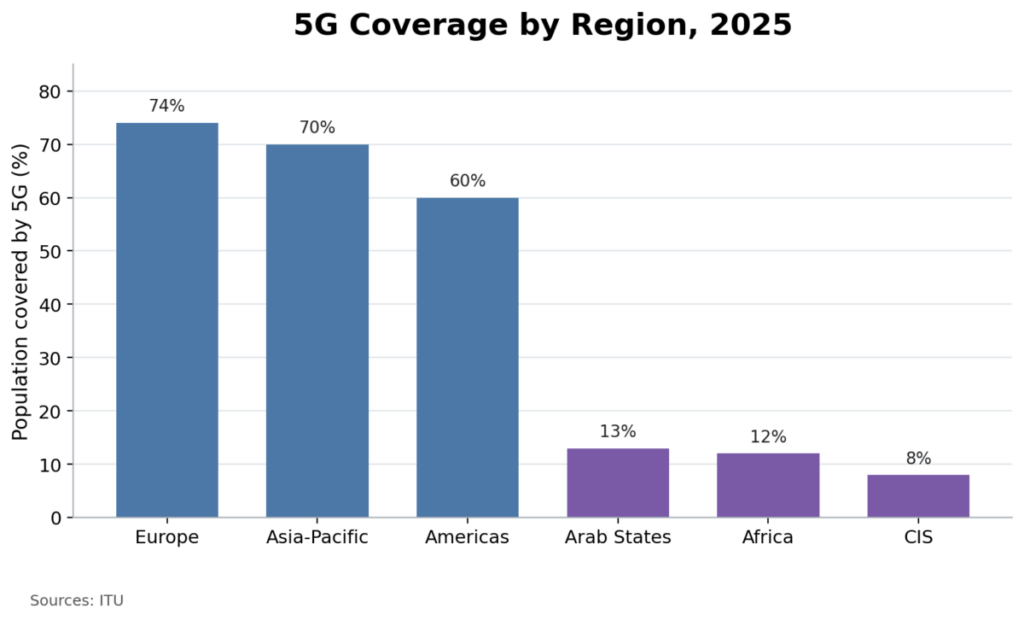
By April 2026, global internet use had reached 6.12 billion people, while close to 2.2 billion remained offline. Mobile technologies and services generated about $7.6 trillion for the global economy in 2025, equivalent to 6.4 percent of global GDP. Those outside the system increasingly face exclusion from infrastructure around which commerce, institutions, and daily participation have already organized.
ICT therefore inherits traditional infrastructure economics because modern economies already function around it. The more interesting question is how those economics change once the infrastructure itself is digital.
| Access Measure | High Income | LMIC | Least Developed |
|---|---|---|---|
| Mobile internet use | More than 80% | 54% | 25% |
| Mobile broadband cost burden | Baseline | Higher | Highest |
| 2024 first-time mobile internet users | Almost 200 million globally | ||
Sources: GSMA, ITU
More Use Does Not Necessarily Mean More Revenue
The first distortion appears in the relationship between use and return. Behind every apparently weightless digital transaction sits capital-intensive infrastructure, yet additional digital activity does not necessarily produce proportionate revenue for the companies financing it. Networks require substantial investment in spectrum and physical capacity, followed by continual maintenance and upgrades, while the incremental cost of carrying another transaction can be comparatively small.
Mature European mobile markets illustrate the tension. Subscriber growth is constrained by high penetration, while traffic continues to rise and additional usage generates diminishing incremental revenue. Greater consumption therefore becomes a weaker proxy for stronger operator economics than it was during earlier periods of subscriber expansion. The network can become more economically important at the same time that each additional unit of traffic becomes harder to monetize. Even as the industry moves toward more advanced 5G networks, translating adoption into meaningful revenue growth remains a central commercial challenge.
The difference between network value and network revenue is central to ICT economics. Digital commerce and services depend on reliable connectivity, but the operator carrying that activity does not automatically capture a comparable share of the value created. Classical ideas of externalities and consumer surplus become practical questions about who benefits from essential infrastructure and who has sufficient incentive to finance its next generation.
Development conditions change the problem rather than removing it. The United States and Western Europe increasingly face maturity, price pressure, and questions about returns on additional capacity. Across Asia, MENA, and Latin America, deep digital integration can coexist with continued adoption and uneven infrastructure. Lower income economies face the same functional dependence while often supporting it with weaker commercial returns and more expensive capital.
Once private returns diverge from wider social returns, regulation follows directly from the economics. Spectrum policy changes the cost of capacity, while universal access programs alter investment incentives where market returns are insufficient. Public financing can make projects viable when their broader economic value exceeds the revenue available to the network owner. The policy question is not whether governments should intervene because connectivity matters, but whether market incentives produce the infrastructure the wider economy benefits from having.
| Economic Condition | Mature Market | Growth Market | Lower Income Market |
|---|---|---|---|
| Subscriber growth | Limited by saturation | Still expanding | Constrained by affordability |
| Traffic demand | Continues rising | Rises with adoption | Limited by usage gap |
| Commercial constraint | Revenue per user pressure | Monetization and scale | Low returns and costly capital |
| Policy lever | Investment incentives | Competition and spectrum | Risk sharing and gap finance |
Sources: GSMA, ITU, World Bank
The Internet Has Geography After All
Geography remains an economic force in ICT, but the relevant geography is no longer simply where the producer and customer are located. A single digital transaction can separate the user from the infrastructure processing and carrying the activity, with corporate ownership and economic value located elsewhere again. Location did not disappear with digitalization. It became distributed.
That separation changes the economics of place because different parts of a digital service respond to different location incentives. Networks remain sensitive to distance and physical infrastructure. Computing facilities respond more directly to factors such as available power and operating cost. Companies make location decisions around market access and taxation, while governments introduce another geography through jurisdiction and security. A service that appears identical to two users can therefore have materially different economics depending on where its underlying functions occur.
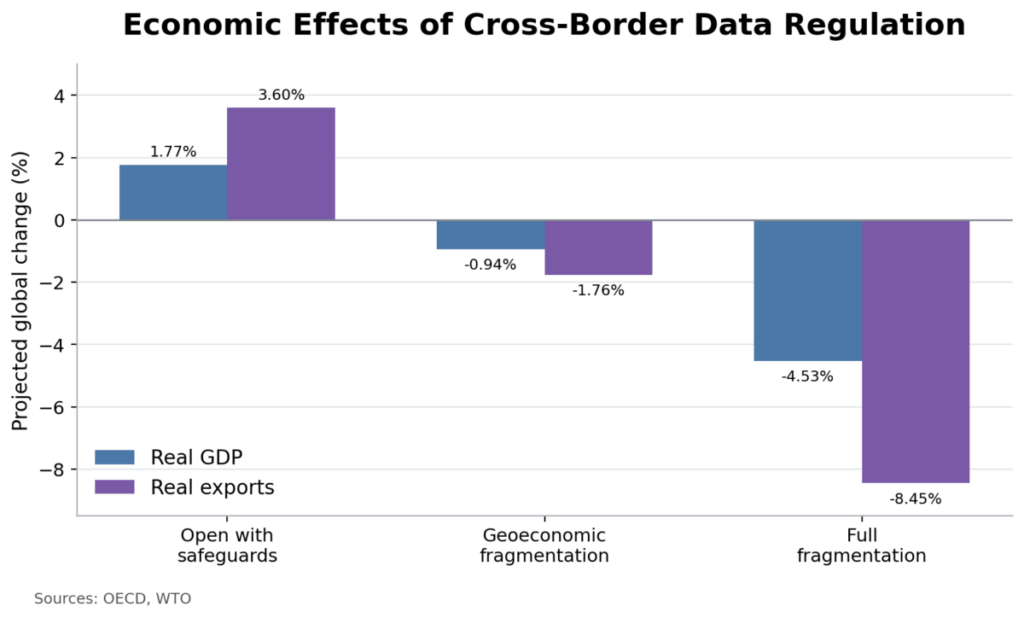
Borders matter for the same reason. Complete fragmentation of international data flows could reduce global GDP by an estimated 4.5 percent and exports by 8.5 percent, while broader systems that preserve data movement with safeguards produce substantially stronger modeled economic outcomes. The choice is more complicated than open versus closed. Regulation can raise transaction costs while also supplying the trust and legal certainty required for cross-border activity.
ICT therefore creates a jurisdictional problem that traditional infrastructure encountered less often in this form. The person buying a service, the company providing it, and the infrastructure processing it can fall under different authorities. Rules governing data, taxation, cybersecurity, and trade can change the cost or location of economic activity without visibly changing the product experienced by the user.
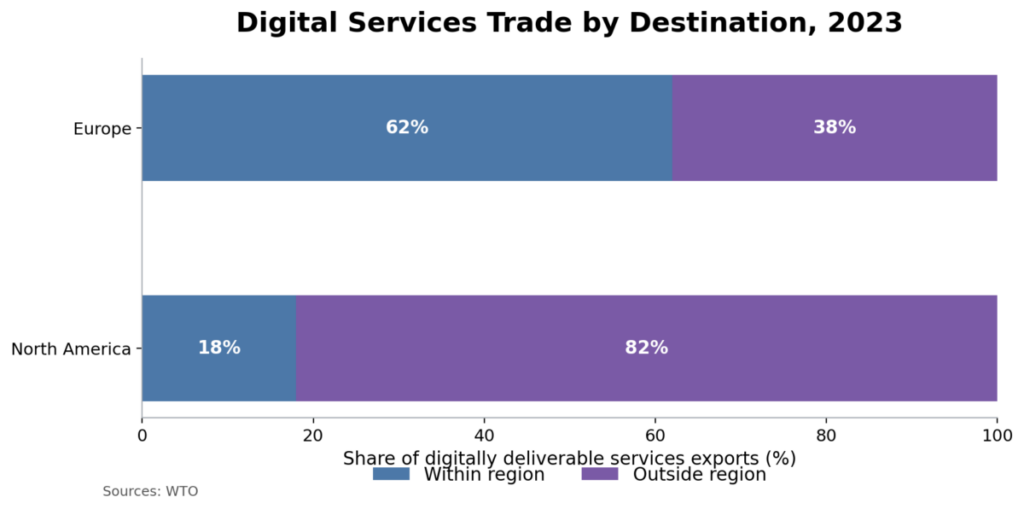
Region determines how strongly those forces are felt. Europe sent 62 percent of its digitally deliverable service exports to other European economies in 2023, while 82 percent of North America’s exports went outside its region. Similar technologies can therefore operate within very different patterns of trade and infrastructure dependence, with regulatory and capital conditions changing the economics further.
| Location | Economic Driver | Policy Exposure |
|---|---|---|
| User | Demand and purchasing power | Consumer and privacy rules |
| Processing | Power, latency, operating cost | Data localization |
| Network route | Distance and infrastructure | Security and transit rules |
| Firm | Market access and tax | Corporate jurisdiction |
Sources: OECD, WTO, World Bank
Competition Meets Infrastructure Economics
Competition policy becomes more complicated when the asset being regulated must continually finance its own renewal. Lower prices and additional competitors can improve welfare today, while weaker investment economics can affect what the network can provide tomorrow. Telecommunications brings a familiar economic argument into a market where the underlying asset changes unusually quickly.
Competition can discipline firms and lower prices, while scale can spread fixed costs and strengthen investment capacity. Neither effect cancels the other. The tension sits between static efficiency, concerned with current prices and output, and dynamic efficiency, which considers future investment and productive capability.
In ICT, that distinction is particularly important because networks do not simply depreciate physically. Technology standards change and capacity requirements rise, leaving equipment economically obsolete even when it still functions. Consumer expectations move as well. A network can therefore become inadequate long before its physical assets fail.
European mobile markets illustrate the problem as mature demand meets continuing capital requirements. Industry research has linked greater operator scale with stronger investment, supporting the argument that fragmentation can constrain financing capacity. But scale is not automatically synonymous with welfare. European regulators continue to emphasize that effective competition itself supports investment and consumer welfare, preserving the central policy tension rather than resolving it in favor of concentration or fragmentation.
Market structure also travels poorly across borders. Several infrastructure operators serving a wealthy, dense population face different economics from the same number serving dispersed customers with lower incomes or higher financing costs. Local demand affects revenue potential, while capital costs and existing infrastructure determine whether another competitor creates useful pressure or expensive duplication.
Regulation therefore cannot treat operator count as a universal proxy for competitive health. The economic question is whether a particular market structure produces affordable service while sustaining investment and resilience over time.
| Economic Dimension | More Fragmentation | Greater Scale |
|---|---|---|
| Price pressure | Generally stronger | Potentially weaker |
| Fixed-cost sharing | Lower | Higher |
| Investment capacity | Can be constrained | Can improve |
| European evidence | Four-player benchmark | Three-player markets invested about 48% more per connection |
| Regulatory focus | Consumer welfare | Dynamic investment |
Sources: GSMA, BEREC
Efficiency Has to Make Room for Resilience
Digital dependence also complicates conventional measures of efficiency. Infrastructure is normally expected to earn its keep through utilization, yet resilient networks need alternative routes and spare capacity that may remain largely unused during ordinary conditions. Economically valuable infrastructure can therefore appear inefficient precisely because it is waiting for a failure that may never occur.
Submarine cables expose the economic value of that redundancy. More than 99 percent of international data traffic travels through subsea cable systems. For economies organized around continuous digital access, disruption reaches well beyond telecommunications. Payments and essential services can fail alongside ordinary business activity because each already assumes the network is available.
Economically, redundancy has option value. A second route may look underutilized until disruption removes the first, at which point spare capacity can preserve economic activity worth far more than its normal utilization would imply. Traditional efficiency measured primarily through asset use therefore understates the value of infrastructure whose purpose is continuity rather than everyday throughput.
Markets may also underprovide that resilience. A network owner bears the cost of duplicate routes and spare capacity, while the losses avoided during an outage are distributed across the wider economy. The same divergence between private and social returns that appears in network expansion appears again in redundancy.
Geography determines how large the problem becomes. Dense North American and Western European networks generally offer more routing alternatives than island states or lower development markets dependent on a small number of international links. The regional difference is not whether connectivity is essential, but how expensive that essentiality is to protect.
Resilience policy consequently becomes an economic allocation problem rather than merely a technical requirement. Governments and regulators must decide how much redundancy is worth financing before failure makes its value obvious.
| Dimension | Utilization Economics | Resilience Economics |
|---|---|---|
| Asset objective | High use | Continuity during failure |
| Spare capacity | Underused capital | Option value |
| Cost bearer | Infrastructure owner | Infrastructure owner |
| Failure exposure | Operational loss | Economy-wide spillover |
| Global cable network | 500+ active and planned systems | About 200 faults annually |
Sources: ITU, International Cable Protection Committee
The Next Economics of ICT
The underlying economic principles are not new. Scarcity still governs allocation, scale still changes costs, and competition still shapes market behavior. Externalities continue to separate private incentives from social returns. Geography and regulation remain economic forces as well. What ICT changes is how closely these forces now interact.
One set of distortions sits inside the market itself. Consumption can rise without equivalent infrastructure revenue, while a network can create downstream value that its owner cannot fully capture. Another is spatial. Economic activity can occupy several jurisdictions at once, and regulation in one market can alter infrastructure decisions elsewhere. Even redundancy behaves differently: unused capacity can acquire significant value precisely because it is available when ordinary infrastructure fails.
Mobile integration makes many of these effects visible at the level of the individual, but the underlying economics belong to the broader ICT system supporting that access.
Those forces carry different weights across economies rather than forming distinct versions of the internet. In advanced markets, saturation gives more weight to capital renewal and resilience. Where digital markets are still expanding rapidly, affordability and infrastructure gaps remain more influential. Lower development environments can face an especially wide gap between the social value of connectivity and the commercial returns available to finance it.
Regional differences therefore change the parameters, not the economics themselves. Income shapes demand and monetization, while density changes deployment cost. Financing conditions determine which investments clear the required return. Geography alters the value of redundancy, and institutional capacity influences how effectively governments manage the market around it.
The economics of ICT have become consequential precisely because connectivity no longer sits at the edge of economic activity. Its costs and incentives increasingly influence who can participate, where businesses invest, and how markets connect. They also determine what governments must regulate or protect.
ICT has not escaped traditional economics by becoming digital. It has realigned those economics around new forms of geography, value creation, infrastructure dependence, technological renewal, and regulatory control.
| Economic Variable | ICT Realignment | Measure to Watch |
|---|---|---|
| Scarcity | Spectrum, capacity, capital | Deployment cost |
| Scale | Large fixed network costs | Investment per connection |
| Externalities | Value captured downstream | Private vs social return |
| Geography | Distributed processing | Cross-border exposure |
| Competition | Price versus investment | Price, capex, network quality |
| Resilience | Unused capacity has value | Route diversity |
Sources: ITU, OECD, WTO, GSMA, BEREC, World Bank
TL;DR Summary
- ICT now functions as essential economic infrastructure across modern economic life.
- Mobile is the dominant individual interface to that system, while fixed infrastructure remains fundamental to capacity and business use.
- Traditional economics applies more directly because households, firms, and institutions increasingly assume connectivity.
- Digital characteristics change familiar relationships between demand, revenue, investment, scale, and value capture.
- Rising network use does not necessarily produce proportionate revenue for infrastructure providers.
- ICT can create substantial downstream economic value that network owners do not fully capture.
- Digital geography separates economic activity across jurisdictions.
- Cross-border regulation can alter transaction costs, trade, investment, and infrastructure location.
- Competition policy must balance current consumer welfare with future investment and network capability.
- Resilience gives spare infrastructure economic option value even when capacity is normally unused.
- Regional conditions change the weight of these economic mechanisms without changing their underlying principles.
- Regulation increasingly follows from the need to reconcile private incentives with the broader economic value of functionally essential digital infrastructure.
Sources
When Connectivity Stops Being a Technology Product
- International Telecommunication Union; Facts and Figures 2025; – Link
- GSMA; Mobile Connectivity Index Methodology 2026; – Link
- GSMA; The Mobile Economy 2026; – Link
- Institute of Internet Economics; ICT 2026 Stats and Summary Report Mid Year; – Link
More Use Does Not Necessarily Mean More Revenue
- GSMA; Mobile Policy Handbook; – Link
- GSMA; Mobile Investment Needs in Europe; – Link
- World Bank; Bridging the Digital Divide Digital Infrastructure Driving Jobs and Economic Growth; – Link
The Internet Has Geography After All
- OECD and World Trade Organization; Economic Implications of Data Regulation; – Link
- World Trade Organization; Regional Exports of Digitally Deliverable Services by Destination; – Link
- OECD; Measuring the Economic Value of Data and Cross Border Data Flows; – Link
Competition Meets Infrastructure Economics
- GSMA; Efficient Operator Scale in European Mobile Markets; – Link
- Body of European Regulators for Electronic Communications; Competition a Key Driver of Investment and Consumer Welfare; – Link
- OECD; Emerging Trends in Communication Market Competition; – Link
- OECD; Policies to Bridge Connectivity Divides; – Link
Efficiency Has to Make Room for Resilience
- International Telecommunication Union; Submarine Cable Resilience; – Link
- International Telecommunication Union; International Advisory Body Report on Submarine Cable Resilience; – Link
- International Telecommunication Union; Strengthening Submarine Cable Resilience; – Link
The Next Economics of ICT
- World Bank; Infrastructure Foundations From Current Assets to Future Growth; – Link
- GSMA; The State of Mobile Internet Connectivity 2025 Overview Report; – Link
- UN Trade and Development; Digital Economy Report; – Link
- Institute of Internet Economics; State of the Internet 2026 Mid Year Review; – Link
Keywords: Internet Economics, ICT, Mobile Connectivity, Infrastructure Economics, Digital Geography, Cross Border Data Flows, Dynamic Efficiency