
The first worker displaced by a robot may never receive a termination notice. A warehouse employee leaves or a cleaner retires, and the employer simply does not replace the position. Part of the workload moves to a machine. The rest stays with the people already there. Labor demand contracts through attrition rather than a visible layoff.
A robotic floor scrubber makes the mechanism easy to see. It cannot handle every space or unexpected condition, but it can remove hours of predictable work from a shift. The cleaner moves toward the irregular work that still requires judgment. The building has not become autonomous. It simply requires less human time to maintain.
The occupation remains. The staffing ratio changes.
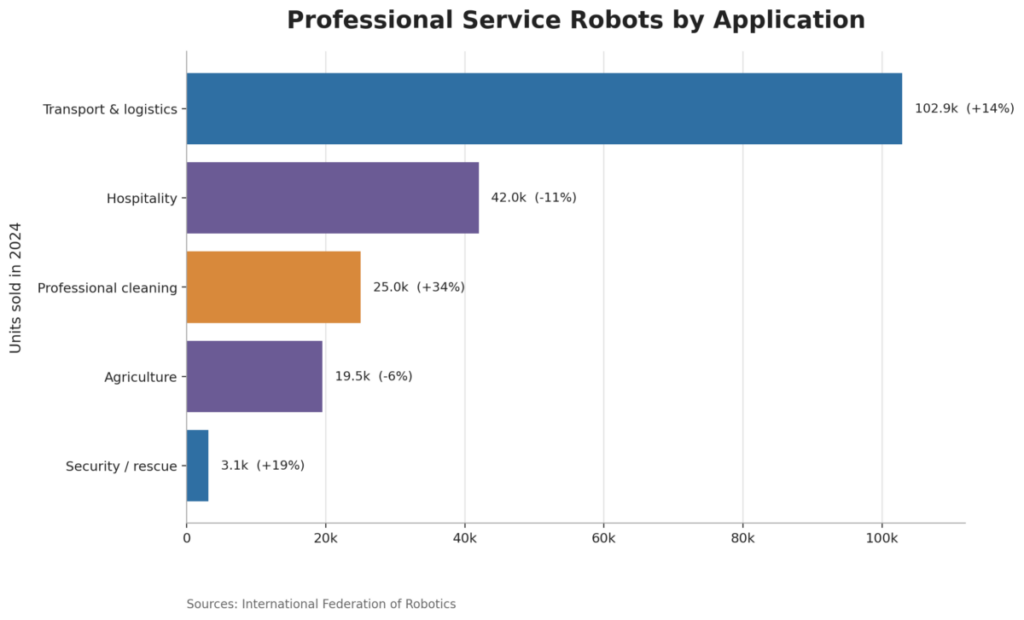
Nearly 200,000 professional service robots were sold worldwide in 2024, 9 percent more than a year earlier. Transportation and logistics represented the largest application category, where repetitive movement offers a relatively clear path from machine capability to economic value. Service robot figures remain a supplier-based market sample rather than a complete census, but deployment has moved well beyond isolated experimentation.
Labor displacement does not need to arrive as mass unemployment. A company can keep headcount flat while output rises, leave vacancies open as workers depart, or increase the amount of work covered by each remaining employee. The labor effect appears gradually, often inside businesses that continue to grow.
AI-powered moving platforms replace bounded tasks before they replace most occupations. Once enough work migrates to machines, firms can expand with fewer entry-level employees and direct more of the productivity gain toward robotic capital.
| Measure | 2024 | Change |
|---|---|---|
| Professional service robots sold | Nearly 200,000 | +9% |
| Transport and logistics robots | 102,900 | +14% |
| Professional cleaning robots | More than 25,000 | +34% |
| Robotics as a Service fleet growth | Subscription fleets expanding | +42% |
Sources: International Federation of Robotics
AI Is Becoming the Brain of the Machine
Industrial automation traditionally depended on bringing predictable work to a predictable machine. Components arrived in controlled positions, equipment repeated the same movement, and barriers separated workers from the process. That model transformed manufacturing because the environment could be engineered around the robot.
AI changes the relationship between machine and environment. The physical platform can remain comparatively simple while software takes on more interpretation. Wheels move the machine. A narrow mechanism carries, scans, or cleans. Intelligence increasingly sits above the hardware, determining where the platform goes and how it responds when conditions change.
Computer vision identifies an obstruction, navigation software redirects the route, and fleet systems coordinate assignments across multiple machines. The mechanical design does not need human versatility when software can make a specialized platform less rigid.
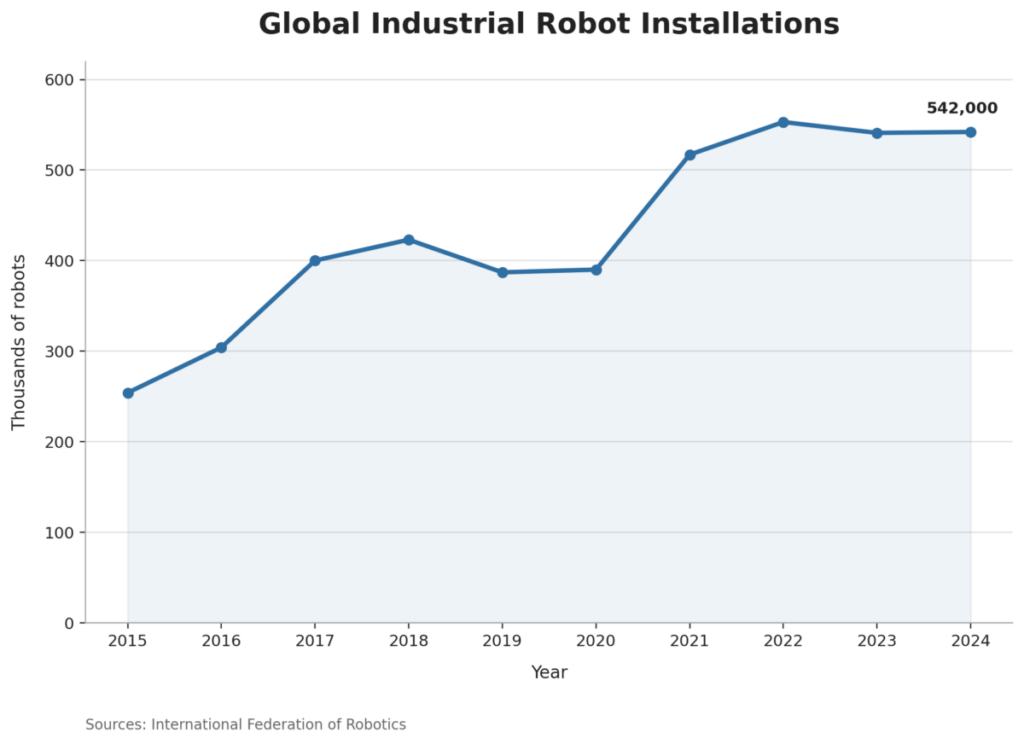
The industrial base beneath that shift is already substantial. About 542,000 industrial robots were installed worldwide in 2024, more than twice the annual number installed a decade earlier. Global deployments remained above 500,000 for a fourth consecutive year, while the operational stock reached approximately 4.66 million machines, an increase of 8.9 percent. Asia accounted for 74 percent of new installations, compared with 16 percent in Europe and 9 percent in the Americas.
Moving platforms extend that investment logic beyond the fixed production cell. A machine no longer has to wait for work to arrive. It can travel through a facility and perform a bounded physical function wherever software sends it. Internal transport and floor cleaning become automation problems without requiring the mechanical complexity of a general-purpose robot.
Connectivity makes the platform more than a machine with wheels. Performance and failures flow back into software that coordinates the fleet. Updates can alter machine behavior without changing the underlying hardware. Robotics increasingly functions as a physical execution layer for software rather than a collection of isolated machines.
Mechanical reality still sets the boundary. Batteries run down, sensors misread conditions, and unfamiliar objects stop workflows. Commercial viability depends on useful work completed after charging, maintenance, supervision, and human intervention are included.
A demonstration shows that a machine can perform a task. Deployment shows that it performs the task often enough to earn its place in the operation.
| Market | Share of 2024 Installations | Additional Measure |
|---|---|---|
| Asia | 74% | Largest deployment region |
| Europe | 16% | Second-largest region |
| Americas | 9% | Third-largest region |
| China | 54% globally | 295,000 installations |
Sources: International Federation of Robotics
Simple Platforms Will Lead the Transition
Humanoid robots dominate public attention because they make labor replacement easy to imagine. The more immediate economic pressure is likely to come from machines that look far less impressive. A warehouse carrier does not need legs. A floor-cleaning machine does not need hands. Specialized platforms avoid mechanical capabilities that add cost without improving the task.
AI makes those narrow machines more adaptable. A platform can recognize the place where a load should be collected, route around an obstruction, and request assistance when conditions exceed its operating range. Its body remains limited. Its behavior becomes less so.
Humanoids pursue a broader proposition. Warehouses and factories are designed around the human body, so their shelves, workstations, and passageways already favor human dimensions. A reliable humanoid could use that infrastructure without forcing an employer to redesign the workplace around a specialized machine.
Commercial evidence is moving beyond demonstrations. Agility Robotics reported in November 2025 that Digit robots had moved more than 100,000 totes during a live GXO logistics deployment. The result shows sustained work inside an operating facility, though it remains a manufacturer-reported milestone rather than an independent benchmark.
General-purpose deployment still faces a harder reliability problem. Dexterity and error recovery remain difficult, and unfamiliar situations can still require human intervention. For many businesses, a simpler platform performing one repeatable job offers a clearer return on investment than a machine designed to imitate the physical range of a person.
The nearer labor effect comes from intelligence attached to simple hardware. Humanoids may eventually broaden the frontier, but businesses do not need mechanical people to begin buying less routine human labor.
| Application | 2024 Unit Sales | Annual Change |
|---|---|---|
| Transportation and logistics | 102,900 | +14% |
| Hospitality | More than 42,000 | -11% |
| Professional cleaning | More than 25,000 | +34% |
| Agriculture | About 19,500 | -6% |
| Search, rescue and security | 3,100 | +19% |
Sources: International Federation of Robotics
Tasks Disappear Before Occupations
Low wages are often mistaken for simple work. In practice, a janitor, warehouse employee, or hotel worker adjusts continuously to conditions outside the original workflow. The physical task may look repetitive from a distance while requiring constant judgment at the margins.
Automation enters occupations unevenly. A warehouse platform can move containers between stations, leaving damaged products and unusual situations to people. A hospital platform can carry supplies while employees retain responsibility for patients. Machines absorb the structured movement. Human labor shifts toward whatever resists standardization.
That division changes staffing before it eliminates occupations. A vacancy can remain open because machines absorb part of the workload. Employees can handle more throughput because routine movement no longer consumes as much of their time. Supervision and exception handling become a larger share of the job.
Employment can still rise during the same transition. U.S. employment for hand laborers and material movers is projected to grow 4 percent between 2024 and 2034. More shipments can create more jobs even while automated facilities use fewer workers for each unit of output.
Across 21 OECD countries, employment in occupations considered at high risk of automation increased about 6 percent between 2012 and 2019. Lower-risk occupations grew 18 percent. Automation exposure did not erase employment, but growth was three times faster in lower-risk work.
Local labor markets reveal the cost more clearly. One additional industrial robot per 1,000 workers was associated with a 0.18 to 0.34 percentage-point decline in the employment-to-population ratio and a wage reduction of 0.25 to 0.50 percent. The estimated local employment effect was about 5.6 fewer workers per robot. Once national price and capital-income effects were included, the estimate fell to roughly 3.3 fewer workers.
The distinction between those estimates is important. Automation can impose concentrated losses on a factory town even when lower prices and higher capital returns soften the effect across the national economy. Productivity gains spread more widely than the disruption that produces them.
Those estimates come from industrial robotics during a defined historical period, not from every future service platform. The economic mechanism is more durable than the exact ratio: productivity can rise while losses remain concentrated among workers whose tasks have been absorbed.
| Occupation | 2024 Employment | Projected Change 2024–34 |
|---|---|---|
| Stockers and order fillers | 2.76 million | +8% |
| Freight and material movers | 2.99 million | +1% |
| Packers and packagers | 591,800 | -5% |
| Machine feeders and offbearers | 46,500 | -13% |
Sources: U.S. Bureau of Labor Statistics
The Career Ladder Is Also Being Automated
Employment statistics show whether a person has a job. They reveal much less about whether that job still provides a route upward. Manufacturing and logistics have long offered workers without four-year degrees a way into larger firms, where experience can lead to machine operation, maintenance, quality control, or supervision.
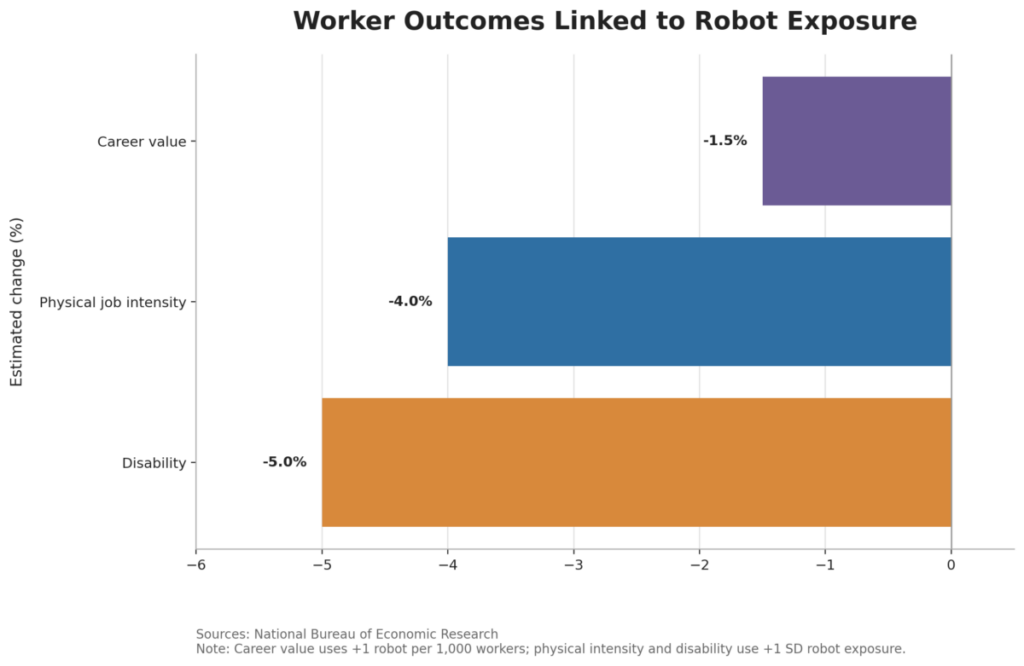
As robots absorb more structured work, those entry routes can narrow. Between 2000 and 2016, one additional robot per 1,000 workers reduced the estimated value of local career opportunities by approximately 1.5 percent. Exposure increased movement toward similar-wage and lower-wage work while reducing transitions into better-paid positions.
A worker can remain employed and still lose part of a career. Slower wage progression rarely produces the visibility of a layoff, but its effect accumulates across years. The missing hire represents another loss because an entry-level position can be the first step into work that pays more later.
Robotic fleets create technical positions of their own, but they need not appear in the same number as the jobs affected. They also demand preparation that an entry-level worker may not already possess. Across the OECD, roughly 28 percent of employment sits in occupations with the highest exposure to automation, a much broader population than the workers likely to move directly into robot maintenance or integration.
Automation can improve the physical quality of work at the same time. Greater robot exposure in German worker-level research was associated with a 4 percent decline in physical job intensity and a 5 percent reduction in disability. The gains are tangible because repetitive lifting and physically demanding movement are precisely the activities simple platforms are increasingly able to absorb.
Less strenuous work does not automatically mean better work. A warehouse employee can lift less while being held to machine-driven throughput. A cleaner can spend less time scrubbing while covering more of the property. As fleet software makes performance easier to measure, physical relief can arrive alongside tighter supervision.
Robotics can make work safer while making it faster, narrower, and more closely managed.
| Outcome | Measured Effect | Exposure Measure |
|---|---|---|
| Local career value | -1.5% | +1 robot per 1,000 workers |
| Physical job intensity | -4% | +1 standard deviation robot exposure |
| Disability | -5% | +1 standard deviation robot exposure |
| Annual workplace injury rate | -1.2 cases per 100 workers | +1 standard deviation robot exposure |
Sources: National Bureau of Economic Research
Ownership Will Shape the Outcome
Adoption moves at different speeds because workplace economics differ. Persistent labor shortages strengthen the case for automation. Frequent machine intervention weakens it. Intelligence expands what simple hardware can accomplish, but the machine still has to cost less than the problem it solves.
Stopping automation would also discard part of its value. Machines can raise productivity and remove physically damaging work. The harder policy problem is deciding who absorbs the transition when the same investment reduces hiring or weakens wage growth.
Training improves mobility, but it cannot create an equal number of technical positions. Nor does a new job automatically replace the wages or security of the one that disappeared. Income protection and employer-supported training address different parts of the transition because the economic loss is not limited to a shortage of skills.
Liability becomes more important once moving platforms leave fenced production areas. A machine operating beside workers or the public can cause physical damage or collect information outside its intended purpose. Clear responsibility reduces uncertainty for employees and businesses deploying the systems.
Ownership reaches beyond retraining. The 4.66 million industrial robots already operating worldwide represent accumulated productive capital, not merely technological adoption. When ownership of that capital is concentrated, higher output can increase returns to a relatively small group while labor demand softens across a much larger workforce. Broader participation in those returns changes the distribution even when the underlying machine stays exactly the same.
The installed base continues to grow even when annual sales level off. An 8.9 percent increase in operational stock during 2024 means each year of new deployment builds on millions of machines already performing work. Labor markets therefore adjust to an expanding stock of robotic capacity, not simply the installations announced in any single year.
AI-controlled moving platforms now extend that capital base into workplaces that once demanded constant human navigation. Humanoids may eventually push the boundary further, but the labor transition does not depend on machines that resemble people.
The first worker replaced may still be the person who is never hired. Who owns the platforms, who controls their intelligence, and who shares in the productivity they create will determine what that absence ultimately costs.
| Measure | Labor Indicator | Capital Indicator |
|---|---|---|
| Productivity | Output per worker | Output per robot |
| Compensation | Wage growth | Return on robotic investment |
| Labor intensity | Workers per unit of output | Robot stock per worker |
| Distribution | Labor income share | Capital income share |
| Participation | Profit sharing | Equity ownership |
Sources: National Bureau of Economic Research, OECD, International Federation of Robotics
TL;DR Summary
- Robotics can reduce labor demand through vacancies that are never refilled.
- Nearly 200,000 professional service robots were sold worldwide in 2024, up 9 percent.
- Industrial robot installations reached approximately 542,000 units in 2024.
- The global industrial robot stock reached roughly 4.66 million units and grew 8.9 percent.
- AI increasingly supplies the intelligence while simple platforms perform the physical work.
- Specialized moving platforms can scale without the complexity of humanoid machines.
- High-risk occupations grew about 6 percent across 21 OECD countries, compared with 18 percent for lower-risk work.
- One additional robot per 1,000 workers was associated with lower local employment and wages.
- Local employment losses were estimated at roughly 5.6 workers per robot, compared with 3.3 after wider national effects.
- Robot exposure reduced estimated local career value by about 1.5 percent.
- Greater robot exposure was associated with lower physical job intensity and disability.
- Ownership shapes how the gains from a growing stock of robotic capital are divided between labor and capital.
Sources
The Worker Who Is Never Hired
- International Federation of Robotics; World Robotics 2025 Service Robots; – Link
- U.S. Bureau of Labor Statistics; Hand Laborers and Material Movers; – Link
AI Is Becoming the Brain of the Machine
- International Federation of Robotics; World Robotics 2025 Industrial Robots; – Link
- Institute of Internet Economics; Robotics The Next Internet Platform Will Move Things; – Link
Simple Platforms Will Lead the Transition
- Agility Robotics; Digit Moves Over 100,000 Totes in Commercial Deployment; – Link
- Institute of Internet Economics; Robotics Enters the Distribution Chain and Disrupts Supply Chain Dynamics; – Link
Tasks Disappear Before Occupations
- National Bureau of Economic Research; Robots and Jobs Evidence from US Labor Markets; – Link
- OECD; What Happened to Jobs at High Risk of Automation; – Link
- OECD; What Skills and Abilities Can Automation Technologies Replicate and What Does It Mean for Workers; – Link
The Career Ladder Is Also Being Automated
- National Bureau of Economic Research; Career Values for Labor Markets Evidence from Robot Adoption; – Link
- National Bureau of Economic Research; Industrial Robots Workers’ Safety and Health; – Link
Ownership Will Shape the Outcome
- National Bureau of Economic Research; Robots and Firm Investment; – Link
- International Labour Organization; AI in Manufacturing Challenges and Opportunities for Promoting Decent Work Productivity and a Just Transition; – Link
- International Labour Organization; Algorithmic Management in the Workplace; – Link
- International Labour Organization; Robots Worldwide The Impact of Automation on Employment and Trade; – Link
Keywords: Robotics, Artificial Intelligence, Labor Economics, Moving Platforms, Occupational Mobility, Workforce Restructuring, Robotic Capital