AI and Compute as Economic Production Capacity
| Indicator | Latest Measure | Economic Dimension |
|---|---|---|
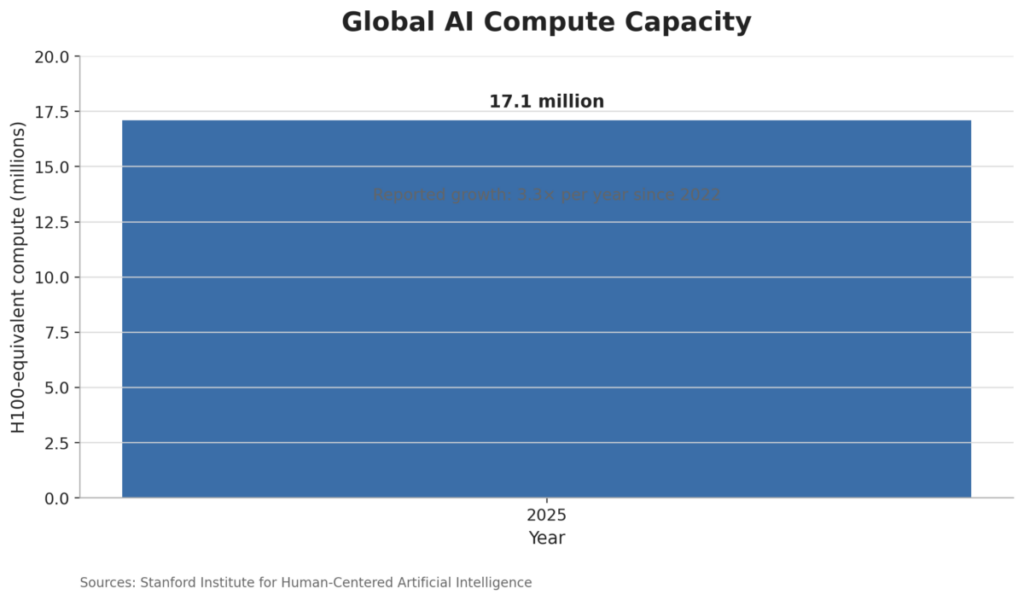
| Global AI Compute | 17.1 million H100-equivalents | Physical productive capacity |
| Organizational AI Adoption | 88% | Business diffusion |
| Generative AI Adoption | 53% in three years | Speed of technology diffusion |
| U.S. Consumer Surplus | $172 billion annually | End-user economic value |
Sources: Stanford Institute for Human-Centered Artificial Intelligence
AI Is Driving a Broader Compute Economy
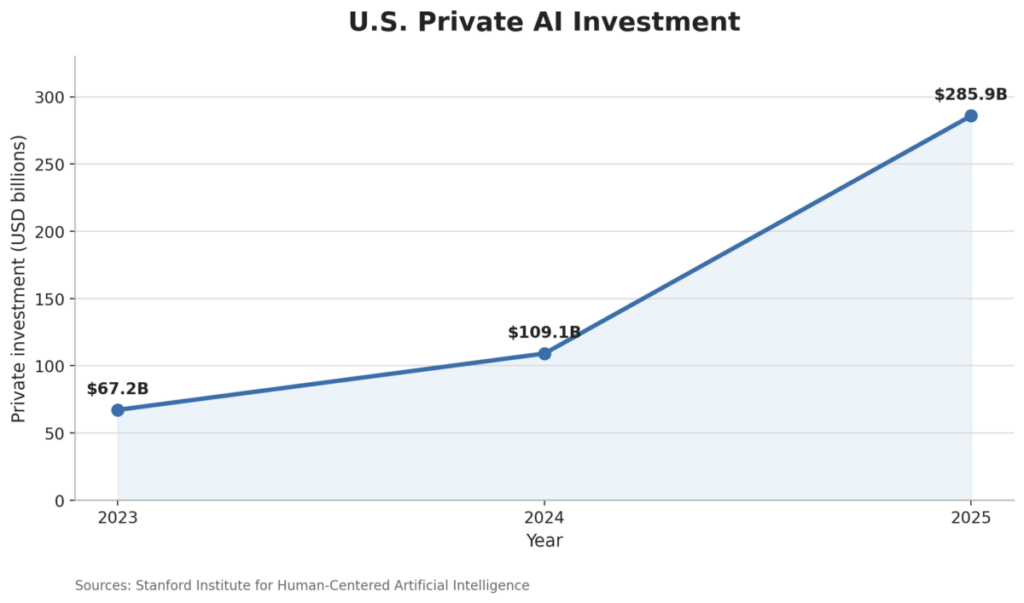
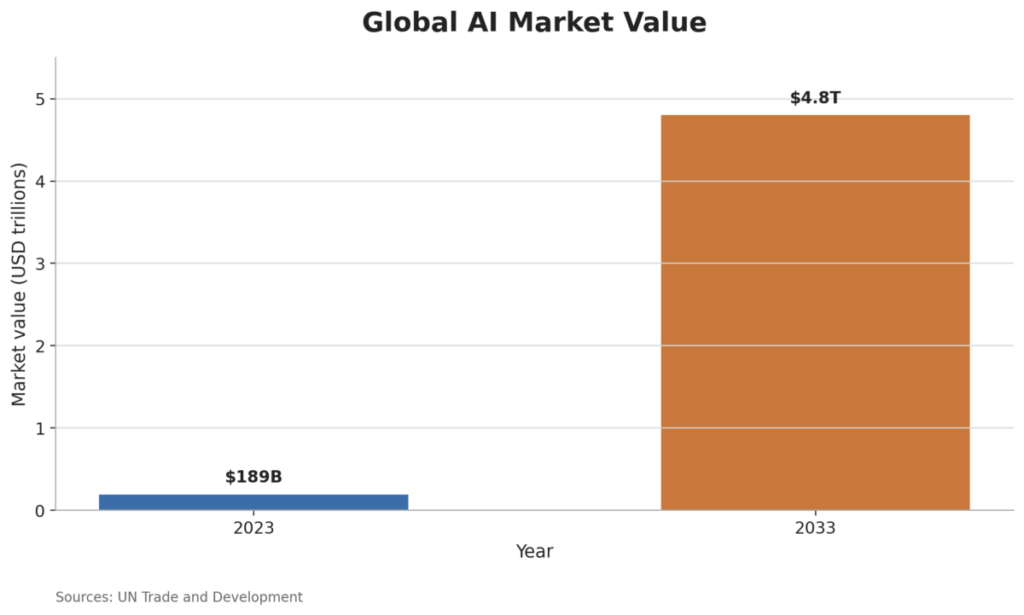
With U.S. private AI investment reaching $285.9 billion in 2025, artificial intelligence has made the economic value of compute unusually visible. UN Trade and Development projects the global AI market to expand from $189 billion in 2023 to $4.8 trillion by 2033, reinforcing an investment cycle increasingly dependent on the ability to deploy large-scale computing resources. AI is the dominant current driver, but the productive asset being accumulated is broader computing capacity.
Early productivity evidence helps explain why access to that capacity carries economic weight beyond technology spending alone. A study of 5,179 customer-support agents found that generative AI increased productivity by 14 percent on average and by 34 percent among novice and lower-skilled workers. OECD modeling places potential AI-related annual productivity gains in highly exposed G7 economies at roughly 0.4 to 1.3 percentage points under different adoption scenarios. These results do not guarantee equivalent gains across the economy, but they establish that successful deployment can materially change output.
As businesses move from experimentation toward production, the economic competition increasingly concerns whether sufficient computing power can be deployed at viable cost and speed. Better models matter, but their productive value ultimately depends on the infrastructure capable of running them at scale. AI is therefore the largest current expression of a wider economic shift in which compute itself is becoming a constrained productive input.
Where Compute Capacity Becomes Constrained
| Market | Vacancy | Available Capacity | Monthly Asking Rent |
|---|---|---|---|
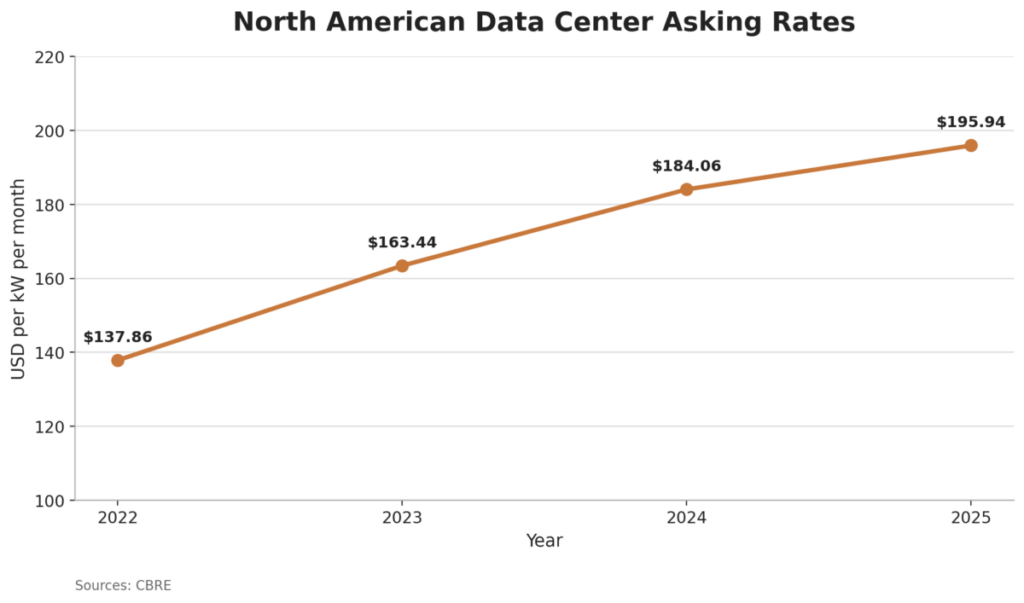
| Northern Virginia | 0.3% | 10.8 MW | $190–$235/kW |
| Chicago | 2.2% | 19.8 MW | $200–$230/kW |
| Frankfurt | 5.0% | 10.3 MW | $235–$265/kW |
| Singapore | 2.0% | Fragmented supply | $403/kW average |
Sources: CBRE
Digital Production Still Needs Physical Capacity
When digital demand grows faster than the infrastructure beneath it, the supposedly weightless digital economy becomes visibly physical. Data centers convert specialized computing equipment, reliable electricity, and high-capacity connectivity into usable compute, while the facilities required to provide that capacity can take years to plan and construct. Software can expand rapidly; the physical systems supporting it cannot.
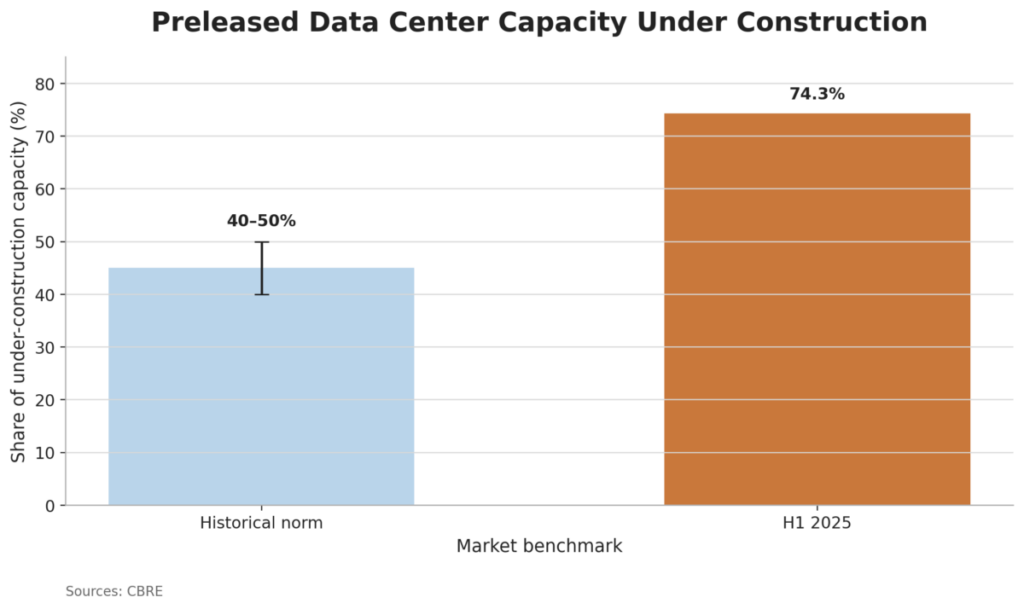
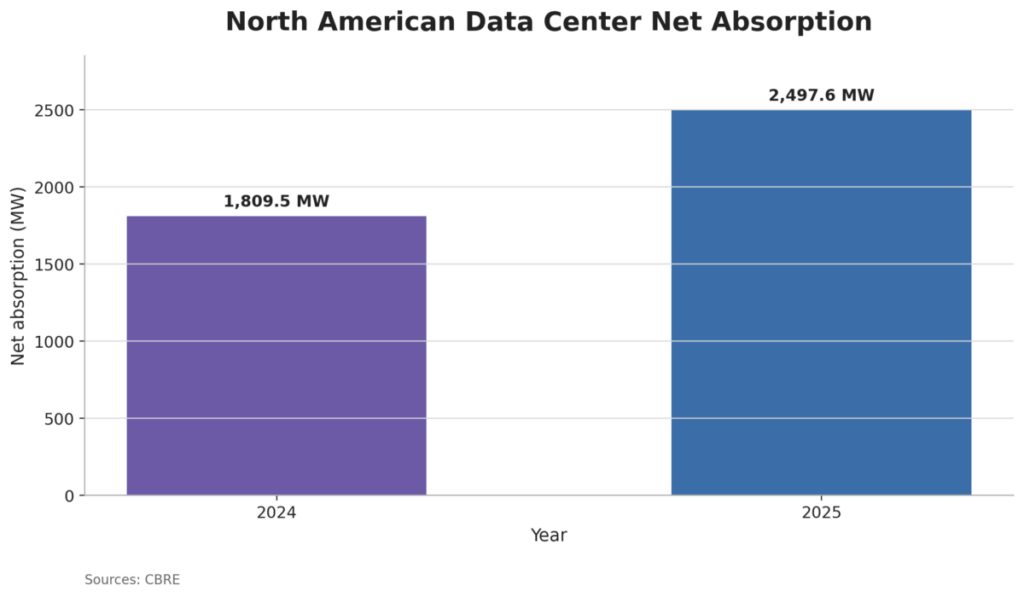
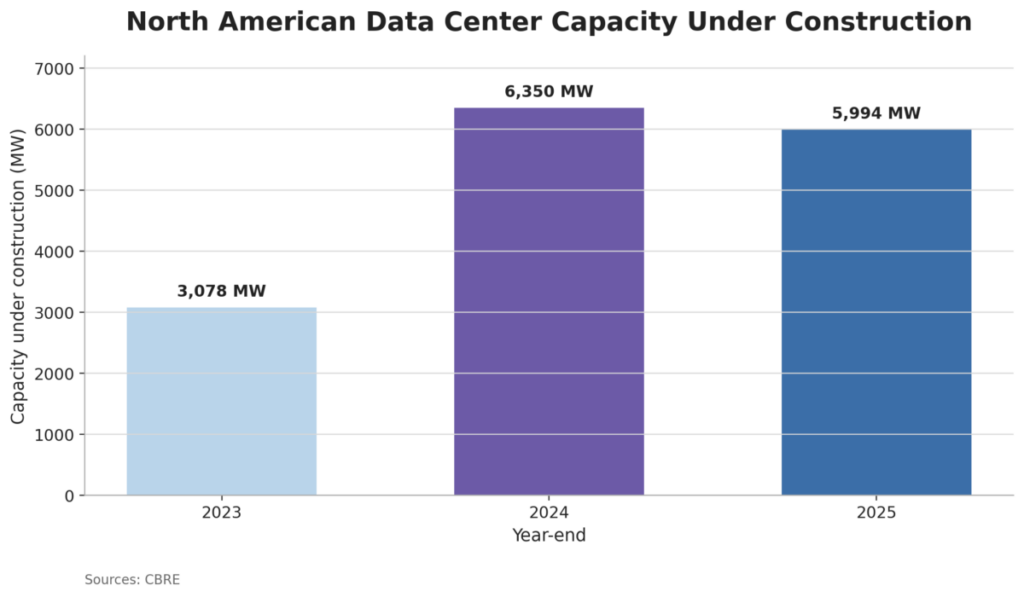
Across eight major North American markets, data-center capacity expanded 36 percent in 2025 even as vacancy fell to a record 1.4 percent. By the first quarter of 2026, Northern Virginia had added more than 1.1 gigawatts of inventory year over year while vacancy declined to 0.3 percent. Rapid expansion alongside declining vacancy indicates that demand is absorbing new supply rather than waiting for it.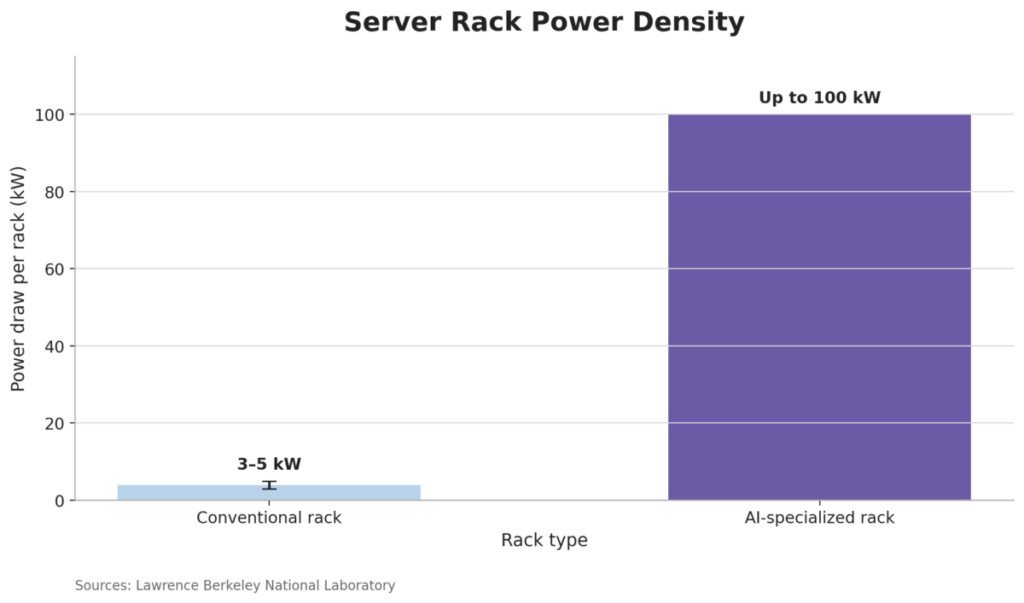
The electricity requirement is equally significant because power increasingly determines how much capacity can be developed and where it can operate. Berkeley Lab estimates that U.S. data centers consumed 176 TWh in 2023, representing about 4.4 percent of national electricity use, while its 2026 update places the sector at a possible 9.5 to 15.3 percent of U.S. consumption by 2030. That creates a legitimate infrastructure challenge, but it also reveals the scale of economic demand seeking access to compute.
As grid constraints lengthen development timelines, power availability is becoming a location factor for digital production much as industrial energy once shaped manufacturing geography. A project unable to secure sufficient capacity in one market may not disappear; underlying demand can remain while investment seeks a location capable of supporting it.
Regional Economics of Data Center Development
| Development Pattern | Information-Sector Effect | Incentive Share | Regional Pattern |
|---|---|---|---|
| Single Facility | No significant growth | Varies | Modest spillover |
| 4+ Facilities | +23% | Varies | Cluster effect |
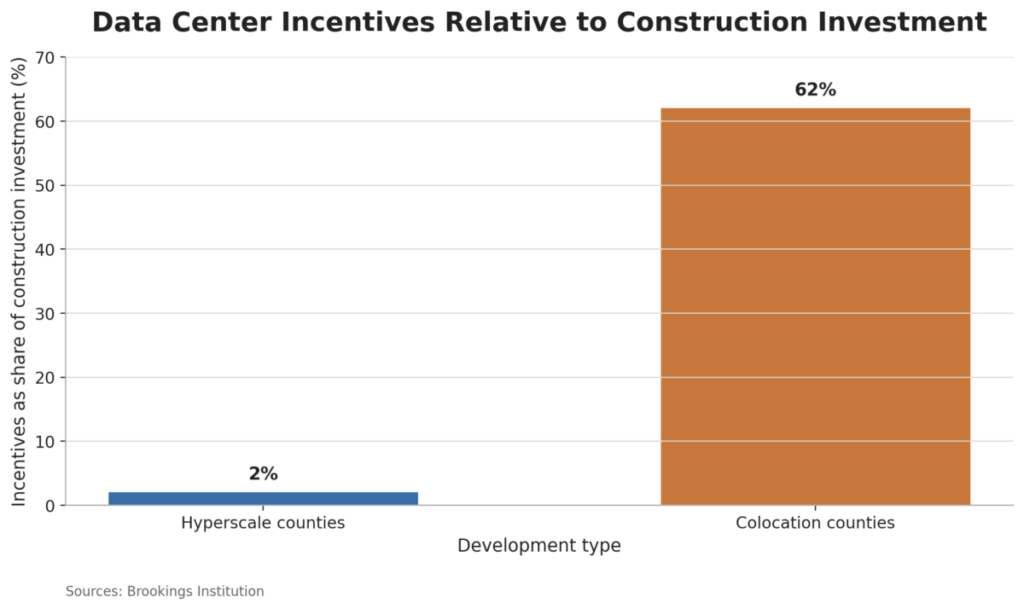
| Hyperscale | Strong gains | ~2% of investment | Technology ecosystem |
| Colocation | No comparable IT gain | ~62% of investment | Construction-led effect |
Sources: Brookings Institution
What Regions Gain and What They Can Lose
How Compute Constraints Become Economic Losses
| Economic Channel | Measurement | Loss Classification |
|---|---|---|
| Project Relocation | Capital moved elsewhere | Observed |
| Delayed Compute Access | Deployment timing and cost | Opportunity cost |
| Cluster Formation Elsewhere | Sector employment and follow-on investment | Opportunity cost |
| Slower Technology Diffusion | Adoption and productivity growth | Prospective |
| External Compute Dependence | Domestic versus external capacity use | Structural exposure |
Sources: Stanford Institute for Human-Centered Artificial Intelligence, Brookings Institution, OECD, National Bureau of Economic Research
The Larger Loss Happens Outside the Building
The most important economic effect of computing infrastructure may ultimately appear in businesses that never own or operate a data center themselves. Compute derives its value from the productive activity it enables, and artificial intelligence currently provides the clearest measurable example of that relationship.
A 14 percent productivity gain in one workplace does not imply that rejecting a single facility produces a comparable economic loss. Insufficient capacity can, however, affect the timing and cost of deployment. When access becomes more expensive or slower, productivity improvements may arrive later. Repeated across firms and over several years, even modest delays can accumulate into meaningful differences in output.
Regional clustering can make those differences more persistent because established infrastructure lowers the barriers to subsequent investment. Once a market develops high-capacity power connections, experienced contractors, specialized infrastructure, and a concentration of major users, future projects can build on capabilities already in place. A locality that changes direction later may therefore find that the ecosystem it hoped to attract has matured elsewhere.
Although AI is generating the immediate demand shock, the same capacity can support a broader digital production base whose future applications extend beyond today’s model-training cycle. Scientific computing and cloud infrastructure already depend on large-scale compute, and future high-value services are likely to rely on the same underlying systems. Underbuilding therefore risks losing more than the individual project visible at the time a decision is made.
Legacy and Emerging Data Center Design
| Facility Type | Modeled UPS Efficiency | Cooling Profile |
|---|---|---|
| Small / Edge | 77–85% | Conventional air cooling |
| Colocation | 80–94% | Primarily air cooled |
| Hyperscale / AI Air | 90–99% | High-efficiency air systems |
| AI Liquid Cooled | 90–99% | ASHRAE W45 liquid cooling |
Sources: Lawrence Berkeley National Laboratory
Technology Is Moving Faster Than the Debate
Environmental and infrastructure costs remain legitimate constraints, but the technical baseline used to evaluate data centers is changing rapidly enough to complicate long-lived restrictions. Local water availability, grid reliability, electricity costs, and land use remain important considerations, yet older facilities are increasingly poor proxies for the design and operating characteristics of newer high-density systems.
As AI servers account for a larger share of data-center electricity demand, high-performance facilities are adopting redesigned cooling and operating systems that can substantially alter resource intensity. At Berkeley Lab’s NERSC facility, operational improvements reduced non-IT power use by 42 percent while saving more than 2 million kWh of electricity and roughly half a million gallons of water annually. Efficiency does not eliminate aggregate demand, but it changes the relationship between computing output and the resources required to produce it.
Higher computing densities are also placing economic pressure on facilities designed for earlier generations of workloads. Newer thermal architectures can support far greater processing density, while buildings unable to accommodate modern systems face pressure to be upgraded, reassigned to less demanding uses, or retired. Around 2028 may therefore become a meaningful modernization threshold, although not a fixed date when environmental pressures disappear.
For economic decision-making, the important issue is the possibility that restrictions survive longer than the technical assumptions used to justify them. Environmental scrutiny remains necessary, but projects should be evaluated against their actual design, resource requirements, and productive value rather than against a legacy model that may already be moving toward obsolescence.
The Geography of Compute Competition
| Region | Inventory Growth | Net Absorption | Market Signal |
|---|---|---|---|
| North America Top Four | +33% | 2,236 MW | Demand absorbing rapid expansion |
| Europe Top Four | +18.9% | 572 MW | Hyperscale and AI demand rising |
| Asia-Pacific Top Four | +13.4% | 609 MW | Core hubs remain constrained |
| Latin America Top Four | +41.3% | 271 MW | Fastest inventory expansion |
Sources: CBRE
From Local Decisions to Global Competition
Because data-center proposals usually enter public debate through local land use and utility requirements, their immediate economic consequences can appear relatively contained. Communities confront development directly, while local governments and utilities determine whether infrastructure can accommodate the additional demand.
Once similar decisions accumulate across jurisdictions, however, the geography of investment can begin to change rather than merely the fate of individual projects. A locality can lose a facility to a neighboring market; repeated constraints can push a developing cluster across state lines, while smaller countries can experience the same movement across national borders. Local decisions can therefore aggregate into regional investment patterns.
A rejected data center may begin as a land-use decision, but repeated restrictions across a state increasingly function as investment policy. At national scale, the cumulative effect can resemble industrial strategy whether policymakers intended such an outcome or not.
International competition raises the stakes because advanced digital production is already highly concentrated among economies and companies capable of financing large-scale deployment. U.S. private AI investment reached $285.9 billion in 2025 compared with $12.4 billion in China, although China’s state-directed investment makes the private comparison incomplete. UNCTAD also reports that only 100 companies accounted for 40 percent of global AI research and development in 2022.
Countries are consequently competing not only over who develops advanced AI, but also over where the productive capacity needed to deploy advanced computing can expand economically. An economy can purchase computing services from elsewhere, but in doing so may capture less of the capital formation and regional spillovers associated with the infrastructure itself. Where computing capacity becomes abundant can therefore shape where future expertise, investment, and digital industries concentrate.
Because resource consumption appears immediately while foregone investment and delayed productivity emerge gradually, underbuilding can initially look less expensive than it becomes. The economic accounting is incomplete when the measurable cost of construction is compared with an assumed cost of zero for infrastructure that is delayed, displaced, or never built.
Building indiscriminately can waste public resources and impose legitimate local costs, but systematically underbuilding productive compute creates a different economic risk. By the time missing investment, infrastructure, and productive capacity become visible, much of that activity may already have found another home.
TL;DR Summary
- AI is driving today’s data-center expansion, but the underlying economic asset is broader compute capacity.
- U.S. private AI investment reached $285.9 billion in 2025, while the global AI market could reach $4.8 trillion by 2033.
- North American data-center vacancy fell to 1.4 percent in 2025 despite rapid capacity growth, while Northern Virginia reached 0.3 percent in early 2026.
- Brookings found measurable employment and wage gains following major data-center entry.
- Power constraints and restrictions are already redirecting development toward alternative regions.
- The larger cost of insufficient capacity can emerge through delayed AI adoption, weaker productivity, and lost economic clustering.
- AI is the dominant current demand driver, but the same compute infrastructure supports a broader digital production base.
- Environmental and infrastructure constraints remain real while facility design and computing efficiency continue to change.
- Restrictions based on legacy data-center assumptions can outlast the technological conditions that originally shaped them.
- Local infrastructure decisions can accumulate into regional investment patterns and eventually national competitiveness effects.
- Compute-intensive activity can relocate even when underlying demand remains strong.
- The overlooked economic question is not only what data centers cost, but what economies risk losing when they build too little
Sources
AI Is Driving a Broader Compute Economy
- Stanford Institute for Human-Centered Artificial Intelligence; Economy | The 2026 AI Index Report; – Link
- National Bureau of Economic Research; Generative AI at Work; – Link
- OECD; Macroeconomic Productivity Gains from Artificial Intelligence in G7 Economies; – Link
- UN Trade and Development; Technology and Innovation Report 2025 Inclusive Artificial Intelligence for Development; – Link
Digital Production Still Needs Physical Capacity
- CBRE; North America Data Center Trends H2 2025; – Link
- CBRE; North America Data Center Trends H1 2025; – Link
- CBRE; North America Data Center Trends H2 2024; – Link
- Lawrence Berkeley National Laboratory; United States Data Center Energy Usage Report 2025 Update; – Link
What Regions Gain and What They Can Lose
- Brookings Institution; New Evidence on Data Center Employment Effects; – Link
- CBRE; Global Data Center Trends 2026; – Link
- CBRE; 2026 Asia Pacific Data Centre Trends and Outlook; – Link
- Brookings Institution; Turning the Data Center Boom into Long Term Local Prosperity; – Link
The Larger Loss Happens Outside the Building
- Stanford Institute for Human-Centered Artificial Intelligence; Research and Development | The 2026 AI Index Report; – Link
- OECD; The Impact of Artificial Intelligence on Productivity Distribution and Growth; – Link
- CBRE; 2025 Global Data Center Investor Intentions Survey; – Link
Technology Is Moving Faster Than the Debate
- Lawrence Berkeley National Laboratory; Addressing Data Center Energy Efficiency Challenges Posed by the Growth of AI; – Link
- Lawrence Berkeley National Laboratory; The Water Use of Data Center Workloads A Review and Assessment of Key Determinants; – Link
- Institute of Internet Economics; AI Environmental Water Debate Is Already Solved by Obsolescence and Design; – Link
From Local Decisions to Global Competition
- Stanford Institute for Human-Centered Artificial Intelligence; The 2026 AI Index Report; – Link
- UN Trade and Development; World Investment Report 2025 International Investment in the Digital Economy; – Link
- CBRE; Global Data Center Trends 2025; – Link
- CBRE; 2024 Global Data Center Investor Intentions Survey; – Link
Keywords: Computing Power, Data Centers, Artificial Intelligence, Economic Growth, Compute Capacity, Regional Competitiveness, Digital Infrastructure