
Nearly two decades after Bitcoin emerged as an alternative to conventional electronic payments, its economic identity has evolved considerably. In 2025, Bitcoin processed 153.7 million on-chain transactions, with an estimated $3.1 trillion in economically adjusted settlement volume. By September 2026, reported institutional holdings in U.S. spot Bitcoin exchange-traded products had reached $29.8 billion. Yet these figures describe different economic activities, not a uniform expansion of Bitcoin as a currency.
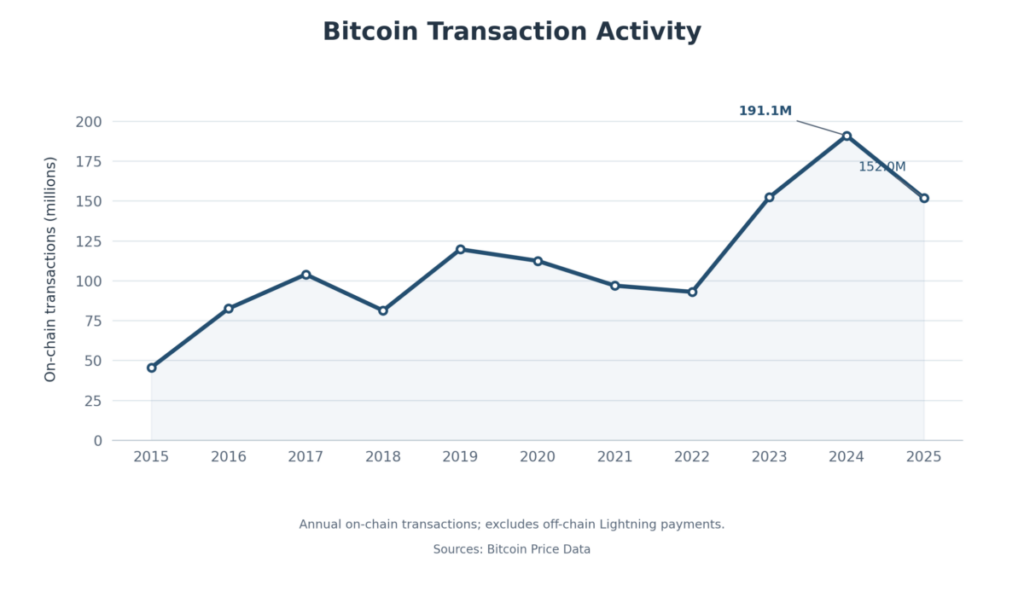
Experience has revealed important distinctions. Faster payment technology has not automatically changed consumer behavior, although the median Bitcoin payment through Square was approximately $13, demonstrating its emerging use for everyday purchases. Scarcity has attracted investors without guaranteeing stable purchasing power. Financial institutions have incorporated Bitcoin into investment and lending markets, often without customers interacting with its underlying network. Governments are exploring Bitcoin reserves, while mining infrastructure is finding applications in artificial intelligence. Declining mining subsidies also raise questions about the long-term economics of securing the network.
Bitcoin’s future may depend less on becoming a universal currency than on the economic functions where it provides lasting advantages. For households, these include access to wealth and international transfers; for businesses, payments, collateral and capital management; and for institutions, new approaches to financial reserves. Toward 2030, Bitcoin’s economic maturity may be measured less by the market value of its coins than by the economic activity they enable, the costs they reduce and the financial functions they can sustain.
Medium of Exchange
Bitcoin has become considerably easier to spend. Payment networks have reduced transaction times and costs, allowing processors to incorporate Bitcoin into existing checkout systems. In November 2026, the median Bitcoin purchase through Square was approximately $13, with 72 percent of transactions involving food and beverages. Merchants can accept Bitcoin and receive conventional currency without assuming the risks of holding it.
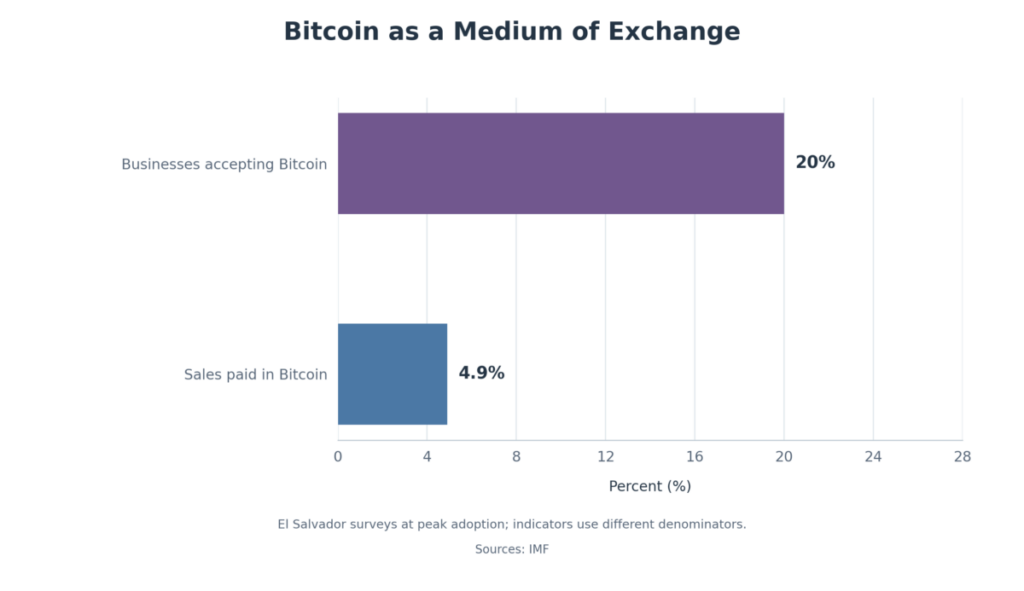
Changing consumer behavior has proven more difficult. Research following El Salvador’s national adoption of Bitcoin revealed limited utilization despite government incentives. Consumers in developed economies already have convenient payment systems, often accompanied by rewards and consumer protections. Those expecting Bitcoin to appreciate have an additional incentive to retain it.
Community initiatives in Central America and Africa have approached adoption differently, paying workers in Bitcoin and encouraging its circulation through local businesses. Their wider economic sustainability remains uncertain, but they address something payment technology alone cannot resolve. A spending currency becomes more useful when people earn it and can subsequently purchase what they need within their own economy.
Bitcoin as a Medium of Exchange
| Adoption Measure | El Salvador |
|---|---|
| Businesses accepting Bitcoin | 20% |
| Sales paid in Bitcoin among accepting firms | 4.9% |
| Chivo users making no further transactions after using bonus | Over 60% |
Sources: NBER, IMF. Early adoption survey evidence, 2021–2022.
Store of Value
The reluctance to spend Bitcoin reveals something about its development as a store of value. Its predetermined issuance schedule and maximum supply of 21 million coins offer an alternative to currencies whose supply can be expanded through monetary policy.
Scarcity, however, has not produced stability. Considerable long-term appreciation has been interrupted by periods of substantial depreciation, and research has produced mixed findings about Bitcoin’s effectiveness as an inflation hedge. An individual accumulating wealth over several decades faces different financial considerations from a household protecting savings needed within the coming year.
For people living under certain monetary conditions, preserving access to wealth can be as important as preserving its purchasing power. Bitcoin can be held independently of financial institutions and transferred internationally without transporting physical assets. Neither characteristic protects its owner from depreciation, yet both have practical significance in economies experiencing currency instability or restrictions on capital mobility.
Bitcoin as a Store of Value
| Asset Class | Annualized Volatility |
|---|---|
| Bitcoin | ~62% |
| Equities | ~20% |
| Gold | ~16% |
| Bonds | ~6% |
Sources: Czech National Bank. Approximate annualized values, 2020–2025.
Unit of Account
A merchant selling a $100 product for its equivalent in Bitcoin is still conducting business in dollars. Bitcoin facilitates the transaction, but the dollar determines the product’s economic value. Much of Bitcoin’s commercial activity operates within this arrangement. Wages, operating expenses and contractual obligations remain predominantly denominated in conventional currencies.
Displaying prices in satoshis, the smallest standard unit of Bitcoin, does little to change that relationship when prices are continuously recalculated against another currency. Independent monetary denomination requires businesses and workers to adopt a common basis for measuring value. A business receiving Bitcoin while paying dollar-denominated wages has little economic incentive to abandon the dollar as its accounting unit. Established currencies are embedded in commercial relationships far more deeply than their use at the checkout counter might suggest.
Bitcoin as a Unit of Account
| Monetary Measure | El Salvador |
|---|---|
| National accounting reference currency | U.S. dollar |
| Bitcoin-accepting firms converting receipts to dollars | 88% |
| Currency required for tax payments | U.S. dollar |
Sources: IMF, NBER. Business conversion measure reflects early adoption research; tax framework reflects 2025 reforms.
Investment Asset
An investor can participate extensively in Bitcoin’s investment economy without ever using its monetary network. Exchange-traded products have made Bitcoin accessible through the same brokerage accounts used to purchase stocks and bonds, removing the need for investors to manage digital wallets and private keys.
At the end of September 2026, investment managers filing institutional ownership disclosures in the United States reported $29.8 billion in spot Bitcoin exchange-traded product holdings. Galaxy Research attributed approximately 40 percent of these positions to a category encompassing financial advisers, wealth managers and brokerage platforms. Bitcoin has entered established investment distribution channels, extending its reach beyond investors who actively participate in cryptocurrency markets.
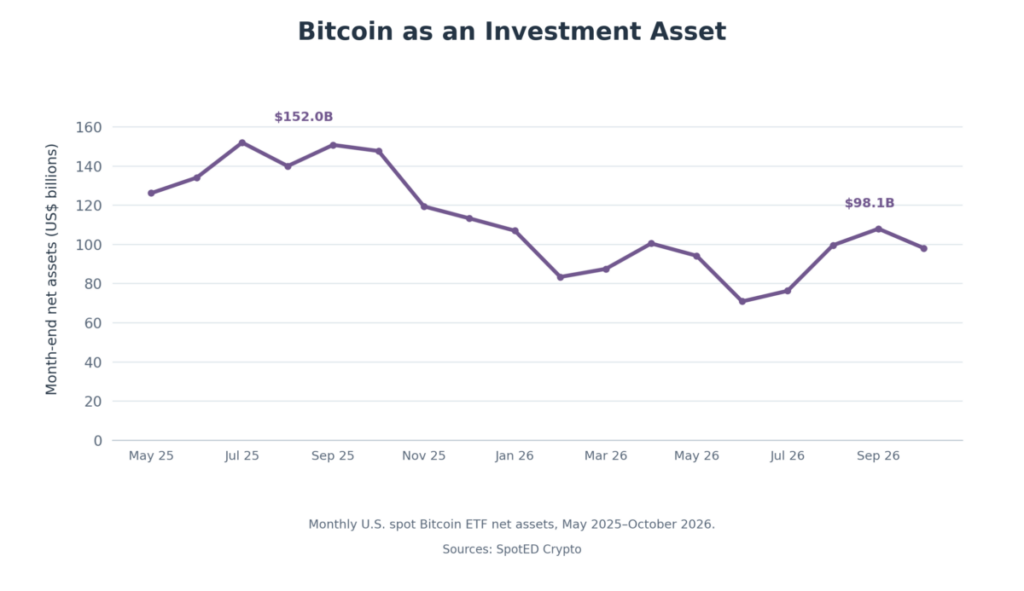
Greater institutional participation can improve liquidity and expand portfolio utilization without generating a corresponding increase in Bitcoin-denominated commerce. Bitcoin’s investment economy has acquired a degree of independence from its original monetary purpose, a development that has substantially broadened its financial relevance.
Bitcoin as an Investment Asset
| Institutional Market Measure | Q3 2026 |
|---|---|
| Reporting investment managers | 2,166 |
| Spot Bitcoin funds represented | 13 |
| Quarterly increase in managers | 191 |
| Net BTC-equivalent additions | 49,229 BTC |
| Adviser and wealth-platform share | 40.5% |
Sources: Galaxy Research, SEC Form 13F Filings.
Financial Instrument
For a business holding Bitcoin, access to credit changes the economics of ownership. Accumulated holdings can serve as collateral for working capital, allowing the business to finance operations or expansion without immediately liquidating the asset.
In February 2026, a $188 million securities offering backed by Bitcoin-collateralized loans brought this form of lending into conventional asset-backed credit markets. The issuer reported that the senior securities received a BBB− investment-grade credit rating. The transaction demonstrated that Bitcoin-backed lending could be financed through established securities markets.
Earlier failures among cryptocurrency lenders exposed weaknesses in collateral management and counterparty risk. Transparency concerning outstanding financial obligations remains important when collateral values can decline rapidly. A borrower facing additional collateral requirements during a market downturn may ultimately be forced to sell the Bitcoin that the original loan was intended to preserve. The usefulness of Bitcoin-backed credit therefore rests not simply on access to financing, but on whether loan structures can accommodate the asset’s volatility.
Bitcoin as a Financial Instrument
| Lending Stage | Loan-to-Value | Action |
|---|---|---|
| Initial loan | 50% | Loan originated |
| First alert | 70% | Collateral warning |
| Second alert | 75% | Additional notification |
| Liquidation | 80% | Partial collateral sale |
| Post-liquidation target | 65% | LTV restored |
Sources: Ledn. Provider-specific lending thresholds, not industry-wide requirements.
Settlement Mechanism
Neither party to a financial transfer needs to retain Bitcoin for its network to serve an economic purpose. Capital can move between parties operating in conventional currencies, with Bitcoin serving as an intermediary and currency conversion occurring during the transfer.
In February 2026, Lightspark and Cross River announced a partnership designed to connect Bitcoin-enabled transactions with existing real-time banking networks. The arrangement is intended to support continuous settlement, although its commercial outcomes remain to be demonstrated. For businesses paying international suppliers, delays in transferring capital can tie up working funds. Individuals sending earnings overseas face similar costs through currency conversion and transfer fees. The commercial value of Bitcoin-based settlement depends on how efficiently the complete transaction can be executed.
Stablecoins offer competing settlement mechanisms and opportunities for interoperability. Much of Bitcoin’s contribution to international commerce could eventually become invisible to the people using it. Consumers rarely consider which financial networks process their electronic payments, provided the money reaches its destination.
Bitcoin as a Settlement Mechanism
| Transfer Measure | Value | Market |
|---|---|---|
| Average remittance cost | 6.36% | Global |
| Crypto-wallet remittance share | 1.2% | El Salvador |
Sources: World Bank, IMF. Different reporting periods; crypto-wallet transfers are not Bitcoin-only.
Reserve Asset
By October 2026, businesses collectively held an estimated 1.64 million Bitcoin, equivalent to 7.8 percent of its maximum supply. River’s research into corporate ownership reveals substantial concentration among specialized Bitcoin treasury companies. Accumulation has expanded, but participation remains uneven across the business economy.
Governments have approached Bitcoin from different economic perspectives. The United States established a strategic reserve primarily through forfeited assets, while Bhutan has employed its hydroelectric resources to accumulate Bitcoin through mining. One country retains digital wealth acquired through legal proceedings; the other converts domestic energy resources into a transferable financial asset.
Reserve management imposes financial disciplines that ordinary asset ownership does not. A corporation must meet its obligations regardless of fluctuations in the value of its holdings. Governments face similar liquidity considerations when financial resources are needed during economic stress. Bitcoin appreciation can strengthen a balance sheet, but depreciation may coincide with the very circumstances that require an institution to draw upon its reserves. The timing of those obligations is as important as the long-term performance of the asset.
Bitcoin as a Reserve Asset
| Institutional Holder | Estimated Holdings | Share of Maximum Supply |
|---|---|---|
| Businesses | 1.63 million BTC | 7.8% |
| Funds and ETFs | 1.50 million BTC | 7.2% |
| Governments | 442,000 BTC | 2.1% |
Corporate Ownership Concentration
Economic Infrastructure
Bitcoin has generated an economy around its own existence. Semiconductor manufacturers supply specialized computing equipment to mining operators, whose profitability is closely tied to electricity costs. An associated financial services industry has developed to secure and administer the resulting digital wealth.
Some infrastructure investments are finding commercial applications outside cryptocurrency. Bitcoin mining companies have accumulated expertise in electricity procurement and data center management. With the expansion of artificial intelligence, several operators are redirecting capital toward AI computing, where access to power and industrial facilities has acquired additional economic value.
The financing of Bitcoin’s network is undergoing a gradual transition. Transaction fees accounted for just 0.67 percent of mining revenues during the 90 days ending October 4, 2026. Almost all remaining compensation came from the issuance of new Bitcoin, a source of revenue programmed to diminish over time.
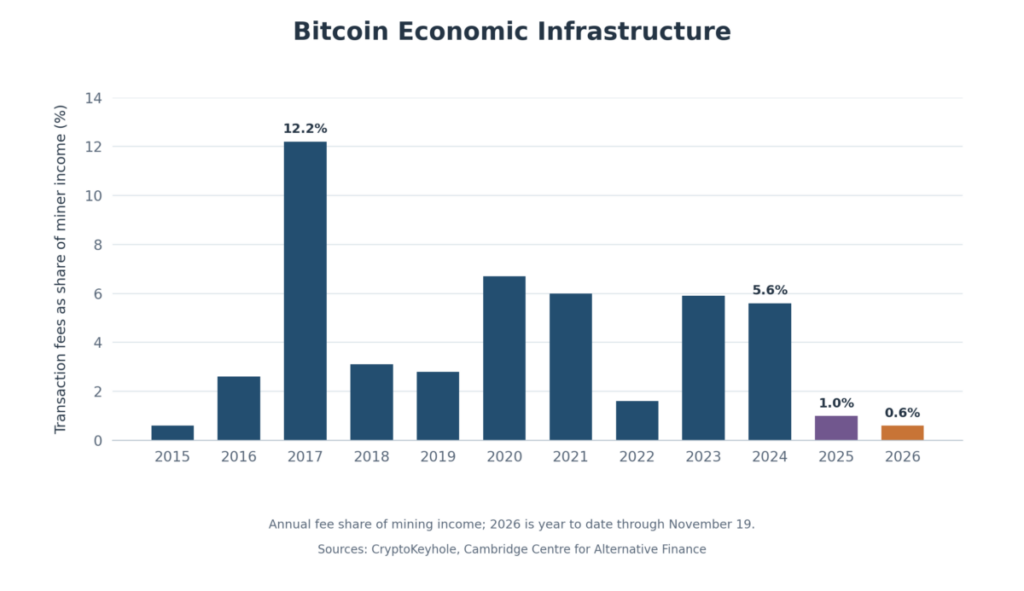
This creates a long-term economic challenge. As issuance declines, transaction fees will need to assume greater importance unless other market conditions compensate for the diminishing subsidy. The industry’s ability to finance network security will increasingly depend on the relationship between mining costs, the value of block rewards and demand for transaction processing. The consequences extend beyond miners to the financial businesses relying on Bitcoin’s continued operation.
Bitcoin Economic Infrastructure
| Economic Indicator | Reported Baseline | Measurement |
|---|---|---|
| Energy demand | 138 TWh/year | Electricity consumption |
| Global energy footprint | 0.54% | Share of global electricity |
| Operating cost exposure | Over 80% | Electricity share of miners’ cash costs |
| Hardware productivity | 28.2 J/TH | Energy per unit of hashing |
| Efficiency improvement | 24% annually | Hardware efficiency change |
| Network security funding | Monitor over time | Fees versus issuance rewards |
Sources: Cambridge Centre for Alternative Finance. Operating benchmarks published in 2025; hardware efficiency measured through June 2024.
Bitcoin’s Economic Identity
Nearly two decades of practical experience have revealed how differently Bitcoin’s economic functions have matured. Its integration into investment markets is well established, credit markets are developing around accumulated holdings, and commercial spending remains comparatively limited. Independent monetary denomination has made little progress beyond experimentation.
These differences reveal something more significant than Bitcoin’s success or failure as a currency. The asset has acquired financial functions that do not require widespread monetary adoption, while its supporting infrastructure has generated economic activity beyond the transfer of coins. Toward 2030, the durability of these functions will depend on their ability to deliver practical economic advantages. Bitcoin’s next stage of development will be determined increasingly by the financial activities its network can sustain and the economic value those activities create.
TL;DR
- Bitcoin has evolved from decentralized payment technology into a multifaceted economic asset and supporting infrastructure.
- In 2025, Bitcoin processed 153.7 million on-chain transactions and approximately $3.1 trillion in economically adjusted settlement volume.
- Institutional holdings in U.S. spot Bitcoin exchange-traded products reached approximately $29.8 billion by September 2026.
- Payment technology has improved faster than consumer spending adoption, revealing the importance of established economic behavior.
- Bitcoin’s fixed supply provides scarcity without guaranteeing purchasing-power stability.
- Conventional currencies continue to dominate commercial pricing, accounting and monetary denomination.
- Bitcoin-collateralized lending allows accumulated digital wealth to support financing, although volatility complicates credit management.
- Bitcoin-enabled settlement could facilitate transfers between parties operating in conventional currencies.
- Corporate Bitcoin holdings remain concentrated, while sovereign accumulation reflects differing national resources and strategic objectives.
- Bitcoin mining investments are finding additional commercial applications in artificial intelligence infrastructure.
- Declining issuance subsidies present a long-term challenge for financing network security.
- Toward 2030, Bitcoin’s economic significance will depend increasingly on the financial functions and commercial activities its asset and infrastructure can sustain.
Sources
- Bitwise; Bitcoin 2025 Roundup; Link
Medium of Exchange
Store of Value
-
Czech National Bank; Analysis of Possible Investment in Other Asset Classes Part I Digital Assets; Link
-
Journal of Economics and Business; Is Bitcoin an Inflation Hedge?; Link
-
Accounting & Finance; Cryptocurrency as an Alternative Inflation Hedge?; Link
Unit of Account
Investment Asset
Financial Instrument
Settlement Mechanism
- Cross River; Lightspark and Cross River Partner to Power 24/7 Real Time Fiat Payments Through Bitcoin; Link
- World Bank; Remittance Prices Worldwide; Link
- International Monetary Fund; El Salvador Request for Extended Arrangement Under the Extended Fund Facility; Link
Reserve Asset
Economic Infrastructure
- Cambridge Centre for Alternative Finance; Funding Bitcoin’s Future Paying for Security as the Block Subsidy Fades; Link
- Cambridge Centre for Alternative Finance; Cambridge Digital Mining Industry Report Global Operations Sentiment and Energy Use; Link
- Cambridge Judge Business School; Where AI Meets Blockchain Assets Agents and Blind Spots; Link